
Comment créer un effet Découpage avec AI — Magic Eraser
Transformez vos photos en œuvres d'art découpage avec AI. Guide étape par étape couvrant le découpage victorien, vénitien, la technique de collage tridimensionnel et les styles décoratifs modernes en couches.
SEO & Growth
Vérifié par Magic Eraser Editorial ·
Sommaire
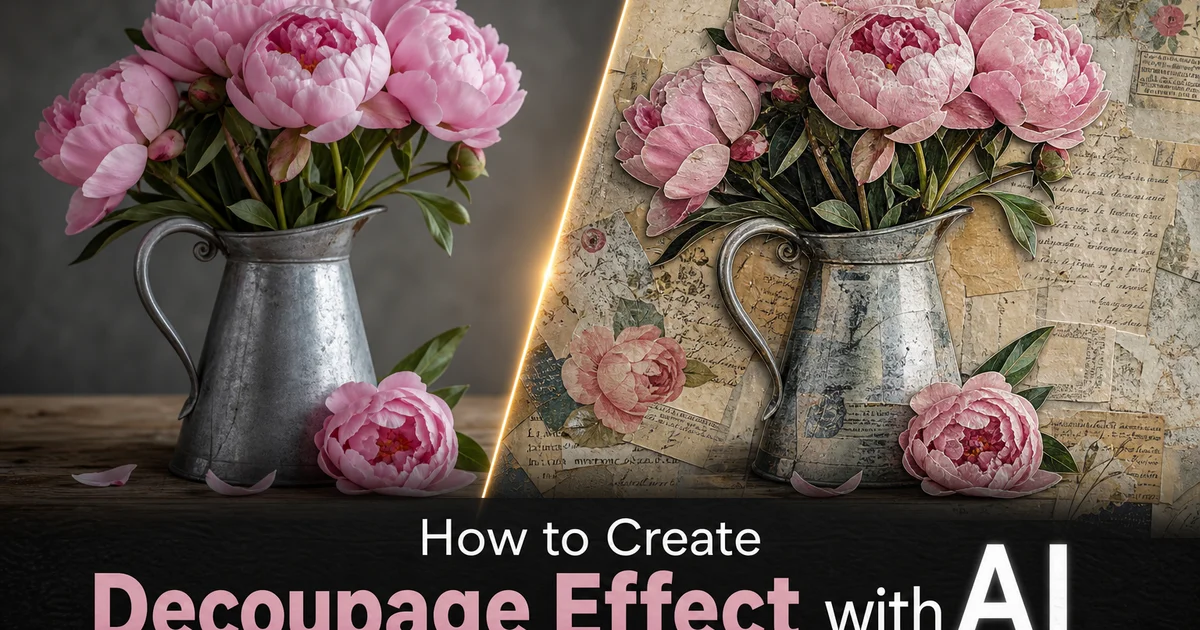
Le découpage est l'art de découper des motifs dans du papier, de les disposer sur une surface et de les sceller sous plusieurs couches de vernis pour créer l'illusion d'une peinture incrustée. La technique est née en Italie au XVIIe siècle, où les artisans reproduisaient des motifs d'incrustation coûteux en collant des découpes de papier sur des meubles et en les vernissant. Cette approche démocratique de la décoration — rendant des motifs complexes accessibles sans formation artistique ni matériaux coûteux — a fait du découpage un artisanat domestique populaire à travers l'Europe victorienne et jusqu'à aujourd'hui. La caractéristique visuelle déterminante est la stratification d'images découpées superposées avec des bords qui conservent leur qualité découpée, scellées sous un fini de surface uniforme qui aplatit le papier et la colle en une surface composite unique.
La simulation numérique du découpage fait face au défi de reproduire les caractéristiques physiques spécifiques des éléments en papier découpé et superposé. Les filtres de collage génériques échouent en traitant tous les éléments superposés comme des calques nets numériques qui flottent sur la surface sans l'intégration physique qui définit le vrai découpage. Les pièces de papier découpé ont des bords qui montrent une légère épaisseur et des fibres de papier, les superpositions projettent des ombres portées subtiles qui varient avec l'épaisseur du papier et la quantité de colle utilisée, et les surfaces inférieures restent partiellement visibles à travers les éléments de papier fin dans un processus appelé affleurement. Chacune de ces qualités physiques doit être présente pour qu'un effet de découpage paraisse authentique plutôt que numérique.
Le transfert de style découpage par AI surmonte ces limitations en comprenant la logique de construction du découpage en papier comme un processus physique. L'AI analyse l'image source pour identifier les régions de premier plan, d'arrière-plan et les bords de transition, puis génère des éléments de papier découpé qui suivent les contours significatifs de l'image. Chaque pièce reçoit une épaisseur de bord réaliste, une texture de papier et un comportement d'ombre qui correspond à la densité du papier et à l'épaisseur de la couche de colle simulées. Les espaces d'arrière-plan visibles entre les pièces maintiennent la texture de la surface en dessous. La stratification suit les règles de composition du découpage, où les éléments sont collés à plat sur la surface en couches, créant de la profondeur par l'empilement plutôt que l'ombrage tridimensionnel. Ce guide couvre l'utilisation de AI Filter et AI Enhance pour créer des effets de découpage qui honorent cet artisanat papier historique.
- L'AI génère des éléments découpés avec des bords de papier réalistes — légère épaisseur, texture de fibres et variation qui imitent le papier découpé à la main plutôt que des masques numériques parfaits.
- Les ombres portées entre les couches de papier reproduisent l'épaisseur physique du papier et de la colle, avec des ombres plus foncées sous le papier épais et des ombres plus légères sous le papier fin.
- L'affleurement du papier fin permet aux surfaces inférieures de transparaître partiellement à travers les éléments de papier translucide, imitant la semi-transparence du papier découpé mince.
- Les finitions de surface vont de l'aspect satiné du vernis mat au lustre brillant d'un émail de résine époxy, le vernis unifiant les découpes en une surface composite unique.
- La stratification des éléments suit la logique du découpage physique — pièces collées à plat en couches empilées créant de la profondeur par l'accumulation plutôt que l'ombrage tridimensionnel.
Comment l'AI simule la physique du papier découpé et de la superposition
La qualité la plus immédiatement reconnaissable du découpage authentique est le bord du papier. Contrairement aux superpositions numériques qui créent des bords de sélection parfaits sans aucune information de bord physique, le papier découpé à la main présente des micro-variations, une légère épaisseur de bord qui attrape la lumière et une texture de fibres qui devient visible sous certaines conditions d'éclairage. L'AI recrée cela en générant des bords d'éléments avec une légère épaisseur 3D qui attrape les reflets de la lumière ambiante, en ajoutant des micro-déchirures et des irrégularités de bord que les ciseaux ou les cutters produisent naturellement, et en appliquant une texture de fibres de papier qui devient visible dans les zones de bordure et de faible couverture d'encre. Ces détails transforment des découpes d'apparence numérique en éléments qui se lisent comme du papier physique.
La gestion des ombres dans la simulation par AI est ce qui distingue fondamentalement le découpage numérique convaincant des filtres de collage plats. Chaque pièce de papier superposée projette une ombre sur la surface ou la pièce en dessous, mais l'intensité et la propagation de l'ombre varient selon plusieurs facteurs physiques. L'épaisseur du papier détermine la distance à laquelle la pièce surélève la surface, le type de colle et la quantité utilisée affectent l'écart entre les couches, et la pression appliquée lors du collage crée des variations dans le contact de surface. Les pièces fines avec beaucoup de colle créent des ombres nettes et serrées. Le papier épais avec moins de pression de collage crée des ombres plus douces et plus larges. L'AI cartographie ces propriétés variables d'ombre sur différentes régions de la composition, créant un environnement d'ombrage physiquement cohérent qui renforce l'illusion de papier superposé.
L'affleurement se produit lorsque la translucidité du papier fin permet aux motifs de la surface en dessous d'apparaître partiellement à travers la couche supérieure. Dans le découpage authentique, c'est le plus visible lorsque des éléments de papier fin sont collés sur du papier journal ou des images imprimées où le texte et les motifs du dessous sont visibles en transparence. L'AI reproduit cela en rendant les bords et les grandes zones de papier fin avec une opacité réduite proportionnelle à l'épaisseur de papier simulée. Les zones plus épaisses restent opaques tandis que les papiers plus fins laissent passer le fond. Ce comportement d'opacité variable est l'un des signes les plus subtils mais les plus convaincants d'un véritable effet découpage.
- Les bords des éléments reçoivent une épaisseur 3D, des micro-déchirures et une texture de fibres de papier qui transforment les découpes numériques en éléments de papier physique sous différentes conditions d'éclairage.
- Le comportement des ombres varie par couche — papier épais avec moins de pression de colle crée des ombres douces larges tandis que le papier fin avec beaucoup de colle crée des ombres nettes et serrées au niveau des bords.
- L'effet d'affleurement rend les zones de papier fin partiellement translucides, permettant aux motifs de la surface inférieure d'apparaître à travers — l'une des marques les plus convaincantes du véritable découpage.
- L'épaisseur de papier et la pression de collage simulées créent un environnement d'ombrage physiquement cohérent qui renforce l'illusion de papier superposé plutôt que de calques numériques.
Traditions historiques et styles de découpage moderne
Le découpage a évolué à travers des périodes historiques distinctes, chacune développant des approches esthétiques et des applications de surface spécifiques. Le découpage vénitien du XVIIIe siècle imitait les incrustations de mobilier coûteuses en utilisant des gravures coloriées à la main, découpées et appliquées sur des meubles et autres objets, puis recouvertes de trente à quarante couches de vernis. Cet aspect de stratification intense — construire une surface qui semble en单一 pièce malgré la composition de nombreux éléments découpés — définit la qualité artisanale du découpage vénitien. L'AI reproduit cet aspect historique en superposant des éléments décoratifs avec des densités de surface variables et en remplissant les espaces d'arrière-plan avec des motifs complémentaires qui créent l'apparence d'une conception cohérente et intégrée.
Le découpage victorien a élargi la portée du médium avec des images de scrapbooking produites en masse — les cartes de vœux chromolithographiées populaires connues sous le nom de scraps — que les artisans découpaient et disposaient en compositions élaborées. La qualité du découpage victorien tend vers l'abondance visuelle, avec des compositions denses remplies de fleurs, d'anges, d'animaux et d'éléments décoratifs disposés en couches superposées créant une profondeur maximale. L'AI capture l'essence du découpage victorien en générant des compositions denses avec des éléments superposés multiples qui remplissent l'espace disponible, en utilisant ce vocabulaire d'imagerie historique tout en maintenant des ombres et des textures de papier cohérentes entre les couches superposées.
Le découpage moderne et contemporain s'est étendu pour inclure la photographie, les images de magazines et les documents trouvés comme sources de papier, des matériaux non papier comme le tissu et la feuille métallique, et des applications de surface au-delà des meubles traditionnels — y compris l'art mural, les accessoires de mode et la décoration intérieure. Les styles vont de la représentation figurative précise aux compositions abstraites. L'AI génère des motifs de découpage à partir de n'importe quelle image source, vous permettant de transformer des photographies de famille, des paysages ou des sujets abstraits en art découpage tout en maintenant les caractéristiques physiques cohérentes qui définissent le médium.
- Le découpage vénitien se caractérise par une stratification intense avec trente à quarante couches de vernis, créant une surface qui semble un单一pièce malgré la composition de nombreux éléments découpés.
- Le découpage victorien utilise des scraps chromolithographiés produits en masse dans des compositions denses et superposées qui maximisent la profondeur visuelle et l'abondance.
- Les styles modernes intègrent la photographie, les images de magazines et les matériaux mixtes, élargissant le vocabulaire du découpage des meubles traditionnels à diverses applications décoratives.
- L'AI adapte les motifs de découpage à n'importe quelle image source tout en maintenant des caractéristiques physiques cohérentes de papier, d'ombre et de superposition à travers la composition.
Stratégies de composition : profondeur, densité et traitement des bords
La profondeur de composition dans le découpage est créée par la superposition plutôt que l'ombrage tridimensionnel. Les pièces de premier plan sont placées au-dessus des pièces d'arrière-plan, chaque couche ajoutant de la profondeur par l'espace physique entre les surfaces en papier plutôt que par l'ombrage illusoire. L'AI gère cela en construisant une hiérarchie de couches qui assigne différentes profondeurs aux éléments en fonction de leur importance compositionnelle. Les sujets principaux reçoivent la profondeur de couche la plus élevée, les éléments de décor secondaires des couches moyennes et les papiers de fond se situent à la couche la plus basse. Chaque transition de couche produit des ombres physiquement cohérentes et l'atténuation de contact de bord appropriée qui renforce la sensation d'espace et de matériaux.
La densité fait référence à la quantité de surface de papier qui recouvre la surface sous-jacente. Le découpage à haute densité crée une surface presque entièrement recouverte d'éléments de papier superposés, ne laissant que peu ou pas de fond visible. Ceci crée l'apparence d'une surface incrustée où le support original est entièrement masqué par la composition en papier. Le découpage à faible densité laisse des espaces d'arrière-plan substantiels visibles, créant une apparence plus ouverte et aérée où le papier découpé semble flotter sur la surface. La décision de densité affecte l'impact global de la pièce, les compositions denses transmettant la richesse et l'abondance, tandis que les dispositions clairsemées semblent délibérées et minimalistes.
Le traitement des bords est un choix stylistique critique dans le découpage. Les bords de ciseaux créent des coupes lisses et courbes avec des micro-variations qui suggèrent une découpe à la main délibérée. Les bords de cutter créent des coupes nettes et angulaires adaptées aux motifs géométriques. Les bords déchirés créent des bords texturés et irréguliers qui évoquent une esthétique artisanale et trouvée. L'AI propose des profils de bord sélectionnables par l'utilisateur qui changent le caractère de chaque élément découpé. La cohérence du traitement des bords à travers la composition est cruciale — mélanger différents types de bords crée une incohérence visuelle qui brise l'illusion d'une pièce de découpage cohérente.
- La profondeur est créée par l'empilement physique des couches plutôt que l'ombrage illusoire, chaque transition de couche ajoutant de l'espace réel entre les surfaces en papier.
- La composition à haute densité recouvre entièrement la surface d'éléments de papier superposés créant une esthétique incrustée, tandis que la faible densité crée une apparence ouverte et flottante.
- Les profils de bord sélectionnables (ciseaux, cutter, déchiré) changent le caractère des éléments découpés, la cohérence entre les pièces étant cruciale pour l'intégrité de la composition.
- Les compositions à densité mixte alternant des zones de couverture dense et clairsemée créent un intérêt visuel grâce à la variation de la densité de papier.
Applications créatives : art mural, objets fonctionnels et design de surface
L'art mural en découpage offre des possibilités allant des cadres de style victorien avec des compositions florales denses aux pièces modernes avec des découpes photographiques abstraites. La force du médium réside dans sa capacité à transformer des images plates en expériences de surface texturées qui invitent à une inspection rapprochée. L'AI vous permet de créer de l'art mural en découpage à partir de n'importe quelle source — transformez des photos de voyage en souvenirs, créez des portraits de famille dans le style d'albums victoriens, ou transformez des images botaniques en compositions de spécimens qui ressemblent à des herbiers en couches. La profondeur et la texture de la surface ajoutent une présence physique que les impressions plates ne peuvent pas égaler.
Les objets fonctionnels — boîtes, plateaux, meubles, cadres photo — sont des applications historiques du découpage que vous pouvez prévisualiser avec la conversion AI avant de les engager dans un projet physique. Un rendu AI peut montrer à quoi ressemblerait une commode victorienne avec une composition découpage de roses et de vignes, ou comment un plateau de service moderne apparaîtrait avec des éléments de découpage géométriques profilés. Ces visualisations aident à prendre des décisions de conception concernant le placement, la densité et la palette de couleurs avant de passer des heures sur le découpage, la superposition et le vernissage réels.
Les applications de design de surface — carreaux, textiles, papier peint et revêtements numériques — bénéficient des motifs de découpage AI qui peuvent être appliqués sur n'importe quelle surface. Les carreaux de découpage créent des dosserets de cuisine ou des salles de bains avec l'apparence de collages de papier superposés scellés sous une surface en verre. Les textiles imprimés avec des motifs de découpage portent l'héritage décoratif du papier découpé dans le tissu. Les papiers peints numériques avec des motifs de découpage AI créent des murs d'accent qui ont la profondeur et la texture d'un collage fait main mais peuvent être appliqués comme un revêtement mural numérique.
- L'art mural en découpage transforme les photographies en expériences de surface texturées avec une profondeur physique que les impressions plates ne peuvent pas reproduire — idéal pour des souvenirs de voyage ou des portraits de famille.
- Les visualisations de design de produits pour meubles, boîtes et plateaux vous permettent de prévisualiser les motifs de découpage avant de vous engager dans un projet physique.
- Les applications de design de surface étendent l'esthétique du découpage aux carreaux, textiles et revêtements muraux pour une décoration intérieure intégrée.
- L'AI vous permet d'expérimenter avec différentes échelles de motifs, densités et traitements de bords pour trouver la composition parfaite pour chaque surface et application.
How to do it
- 1
Upload your photograph and assess its suitability for decoupage conversion
Open your image in AI Filter and evaluate whether the photograph has distinct visual elements. Objects, figures, textures, and background areas — that can be convincingly decomposed into layered paper cutouts. Decoupage is the art of decorating surfaces by gluing paper cutouts in overlapping layers and then sealing them with varnish or lacquer. The AI needs identifiable regions that can become individual paper pieces. Photographs with multiple distinct subjects, varied textures. Clear foreground-background separation produce the most visually interesting decoupage effects because each element becomes a separate paper cutout with its own edges, textures, and layering position. Highly uniform images or abstract textures without discernible elements produce flat decoupage that lacks the layered depth that defines the craft.
- 2
Select the decoupage style and configure paper type and cutting method
Choose from decoupage style presets that simulate different traditions and aesthetic approaches. Victorian decoupage uses precisely hand-cut printed paper illustrations. Botanical engravings, fashion plates, cherub motifs — arranged symmetrically on furniture and boxes with meticulous attention to seamless edge alignment. Vintage collage decoupage features torn newspaper, aged book pages, postage stamps, and ephemera layered in on purpose casual overlapping compositions. Modern art decoupage uses bold geometric paper shapes, solid color blocks, and modern pattern papers arranged in graphic compositions. Configure the cutting method: clean scissor-cut edges with crisp boundaries, hand-torn edges with fibrous irregular margins, or die-cut shapes with decorative scalloped or patterned edges.
- 3
Configure layering depth, adhesive visibility, and varnish finish
Adjust the layering depth to control how many overlapping paper layers the AI generates and how visibly three-dimensional the stacking appears. Real decoupage builds up perceptible thickness where multiple paper layers overlap, creating subtle shadows at layer boundaries and a slight topographic relief visible in raking light. The AI mimics this dimensionality through shadow casting between layers, making higher pieces cast shadows on lower ones. Adhesive visibility controls whether the effect includes visible glue residue and air bubbles trapped beneath the paper. Minor imperfections that add handcrafted realism. Finally, select the varnish finish from matte to high gloss: matte produces a soft papery surface, satin adds subtle sheen. High gloss mimics the thick lacquer coating of traditional Japanese or Florentine decoupage that gives the surface a glass-like depth.
- 4
Use AI Enhance to refine paper textures and edge details for authenticity
After the initial decoupage conversion, run AI Enhance to add fine paper texture details that sell the handcrafted illusion. Real paper cutouts show fiber structure at torn edges, slight color bleeding where glue has dampened the paper, tiny wrinkles and bubbles from the adhesion process. The subtle transparency where thin paper overlaps and the layer beneath shows through. The boost step also refines the shadow transitions between stacked layers, ensuring they appear physically accurate rather than digitally generated. Adds the trait slight yellowing that happens to paper edges when sealed under layers of aging varnish.
- 5
Export the finished decoupage effect and verify craft authenticity against reference pieces
Save the completed decoupage image at full resolution and compare it against photographs of real decoupage artwork to verify craft realism. Check that paper edges look physically cut or torn rather than digitally masked, that overlapping layers show right shadow depth and partial transparency, that the varnish surface shows consistent finish across the entire composition. That the paper textures vary between different cutout elements as they would when an artist uses multiple paper sources. Verify that the composition follows decoupage logic. Elements are glued flat to a surface in layers rather than floating freely — and that the overall effect reads as a decorated physical object rather than a digital collage.
Sources
- Decoupage: A Practical Guide to the Art of Decorating Surfaces — Victoria and Albert Museum
- Neural Collage: Artistic Composition through Learned Cut-and-Paste — arXiv — Computer Vision and Pattern Recognition
- The Art of Paper Collage: Techniques and Applications in Contemporary Design — Tate Modern — Art Terms and Techniques