
Comment creer un effet Bokeh avec l'IA — Magic Eraser
Creez un flou d'arriere-plan bokeh professionnel sur n'importe quelle photo grace a l'estimation de profondeur par IA. Guide pas a pas couvrant le flou de portrait, l'isolation de produit et la simulation naturelle de profondeur de champ.

Product Marketing
Vérifié par Magic Eraser Editorial ·
Sommaire
- Comment l'estimation de profondeur par IA cree un bokeh realiste a partir de photos planes
- Controle de l'intensite et du caractere du bokeh pour differents styles photographiques
- Gestion des defis de detection des bords : cheveux, lunettes et elements fins
- Bokeh pour la photographie de produits et le commerce electronique
- Comparaison du bokeh IA au bokeh optique : ce qu'il faut rechercher
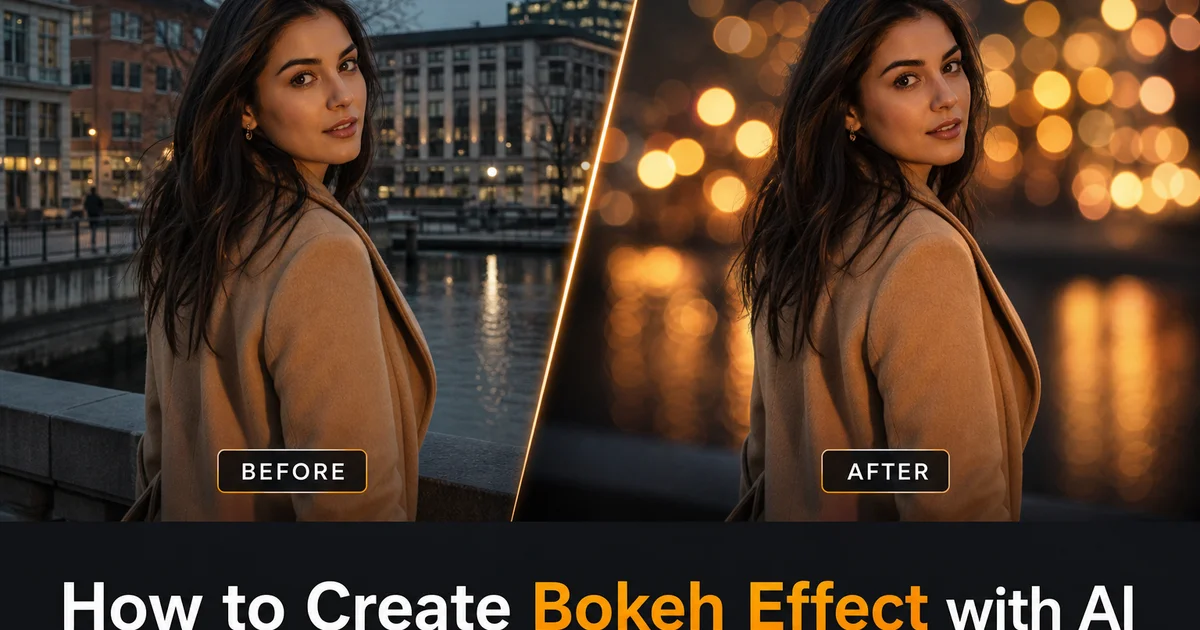
Le bokeh — la qualite esthetique des zones hors foyer dans une photographie — est l'un des effets visuels les plus recherches en photographie, et pour cause. Un effet bokeh bien execute separe le sujet de l'arriere-plan, creant une sensation de profondeur tridimensionnelle qui attire directement l'oeil du spectateur vers l'element le plus net du cadre. Les photographes portraitistes professionnels depensent des milliers de dollars pour des objectifs rapides a large ouverture maximale specifiquement pour obtenir cette faible profondeur de champ, et l'effet est immediatement reconnaissable et universellement associe a la photographie de qualite professionnelle.
Le defi est que l'obtention d'un bokeh naturel necessite traditionnellement un equipement couteux. Les objectifs primes rapides a grande ouverture coutent de plusieurs centaines a plusieurs milliers de dollars, et la physique des petits capteurs fait que les appareils photo de smartphones ne peuvent pas egaler la separation de profondeur de champ que les grands capteurs avec objectifs rapides atteignent optiquement. C'est pourquoi les modes portrait des smartphones existent — ils utilisent des methodes computationnelles pour simuler ce que le materiel ne peut pas produire physiquement. Mais ces modes ont des limitations bien connues : une detection des bords imprecise qui bave les cheveux et les objets fins, des cartes de profondeur binaires net-flou qui manquent du gradient naturel du bokeh optique, et un rendu des highlights artificiel que les photographes experimentes reconnaissent immediatement comme computationnel.
Les outils de bokeh bases sur l'IA representent la generation suivante de la simulation computationnelle de profondeur de champ, produisant des resultats bien plus convaincants que les modes portrait basiques des smartphones. L'IA construit une carte de profondeur continue plutot qu'un masque binaire, estime les limites de profondeur occluses plus precisement que les calculs de camera stereo, et rend le flou avec des caracteristiques optiques qui imitent le comportement d'un objectif reel — incluant un rendu correct des disques de highlights, des transitions de mise au point progressives, et une intensite de flou adaptee a la profondeur. Ce guide explique comment utiliser AI Filter, AI Enhance et Background Eraser pour creer des effets bokeh de qualite professionnelle sur des photos provenant de n'importe quel appareil.
- L'estimation de profondeur par IA cree une carte de profondeur continue plutot qu'un masque binaire net-flou, produisant le gradient de flou naturel qui caracterise le bokeh optique.
- AI Filter controle a la fois l'intensite du flou et le caractere du bokeh — de la separation environnementale subtile a l'isolation cremeuse maximale equivalente aux objectifs rapides f/1.4 couteux.
- Les cheveux et les elements fins comme les montures de lunettes recoivent un traitement de bord specialise qui maintient le detail au niveau de la meche tout en fleurissant l'arriere-plan visible entre eux.
- Background Eraser offre une approche alternative pour les photos de produits ou le remplacement complet de l'arriere-plan est preferable au flou d'arriere-plan.
- Le rendu des highlights hors foyer imite les formes d'ouverture reelles des objectifs — disques circulaires ou polygonaux qui donnent au bokeh computationnel son realisme optique.
Comment l'estimation de profondeur par IA cree un bokeh realiste a partir de photos planes
Le defi fondamental dans la creation d'un bokeh artificiel est de determiner la distance de chaque pixel de l'image par rapport a l'appareil photo. Un objectif reel accomplit cela par la physique — la lumiere provenant d'objets a differentes distances converge a des positions differentes par rapport au capteur, et seuls les objets a la distance focale exacte produisent des points nets tandis que tout le reste produit des cercles de flou de plus en plus grands. Un systeme computationnel doit calculer explicitement la profondeur de chaque pixel pour savoir combien de flou appliquer. Cette estimation de profondeur est ce qui separe un bokeh IA convaincant de resultats manifestement artificiels.
L'estimation de profondeur par IA fonctionne en reconnaissant les indices de profondeur presents dans toute photographie bidimensionnelle : relations de taille, occlusion, gradient de texture, perspective atmospherique et geometrie du point de fuite. L'IA a appris ces indices a partir de millions d'images avec des informations de profondeur connues — souvent capturees par des appareils equipes de LiDAR ou generees a partir de paires de cameras stereo — et les applique collectivement pour estimer une valeur de profondeur continue pour chaque pixel de votre photo.
La carte de profondeur continue est ce qui rend le bokeh IA naturel. Les premiers modes portrait des smartphones creaient des cartes de profondeur binaires ou chaque pixel etait soit premier plan soit arriere-plan, produisant un effet de decoupage evident. Un objectif reel ne cree pas de profondeur binaire — le flou augmente graduellement avec la distance par rapport au plan focal. L'estimation de profondeur par IA attribue une valeur de profondeur specifique a chaque pixel, donc le sujet est net, les objets a soixante centimetres derriere sont legerement adoucis, et les objets a six metres derriere sont fortement fleuris. Chaque zone de profondeur recoit une quantite de flou proportionnellement differente, creant le gradient de profondeur naturel qui caracterise le bokeh optique.
- L'IA reconnait les indices de profondeur incluant les relations de taille, l'occlusion, le gradient de texture, la perspective atmospherique et la geometrie du point de fuite a partir d'une seule photographie plane.
- Les cartes de profondeur continues attribuent des valeurs de distance specifiques a chaque pixel, permettant un flou proportionnel qui augmente graduellement avec la distance plutot qu'un masquage binaire net-flou.
- L'entrainement sur des millions d'images avec des donnees de profondeur connues — provenant de LiDAR et de captures stereo — apprend a l'IA a estimer la profondeur bien plus precisement que les methodes basees sur des regles.
- L'augmentation progressive du flou avec la distance est ce qui rend le bokeh IA indistinguable du bokeh optique dans la plupart des contextes de visualisation — les masques binaires semblent toujours artificiels.
Controle de l'intensite et du caractere du bokeh pour differents styles photographiques
Le bokeh subtil — equivalent a une prise de vue a f/2.8 a f/4 sur un appareil plein format — fournit juste assez d'adoucissement de l'arriere-plan pour separer le sujet tout en gardant le cadre reconnaissable. Ce niveau de flou est ideal pour les portraits environnementaux, les photos de fiancailles et la photographie de style de vie ou le cadre contribue a l'histoire mais ne doit pas la dominer.
Le bokeh moyen — equivalent a f/1.8 a f/2.4 — fleurit suffisamment l'arriere-plan pour que les objets specifiques deviennent meconnaissables, reduits a des formes et des couleurs. Cette plage est le point ideal pour la plupart des photographies de portrait : une forte isolation du sujet avec un rendu d'arriere-plan lisse tout en maintenant suffisamment d'indices de profondeur pour comprendre le cadre general.
Le bokeh maximal — equivalent a f/1.2 ou plus large — dissout l'arriere-plan en couleur et lumiere pures, les sources lumineuses ponctuelles devenant de grands disques lumineux. Ce niveau de flou est dramatique et accrocheur, ideal pour les portraits serres, la photographie macro de produits et le travail creatif artistique. Le defi est de maintenir la credibilite — les objectifs reels a ces ouvertures extremes ont une profondeur de champ tres etroite.
- Le bokeh subtil a l'equivalent f/2.8 a f/4 garde l'arriere-plan reconnaissable tout en l'adoucissant — ideal pour les portraits environnementaux ou le cadre contribue a l'histoire.
- Le bokeh moyen a l'equivalent f/1.8 a f/2.4 reduit les objets d'arriere-plan a des formes et couleurs non identifiables — le point ideal pour la plupart des photos de portrait et de produit.
- Le bokeh maximal a l'equivalent f/1.2 ou plus large dissout l'arriere-plan en couleur pure et disques de highlights lumineux — dramatique pour les portraits serres et le travail artistique.
- Un bokeh maximal convaincant devrait appliquer un leger adoucissement aux elements du sujet en dehors du plan focal plutot que de maintenir l'ensemble du sujet uniformement net.
Gestion des defis de detection des bords : cheveux, lunettes et elements fins
Les cheveux constituent le bord le plus difficile pour le bokeh computationnel car les meches individuelles sont plus fines qu'un pixel et creent des motifs de transparence complexes ou l'arriere-plan est visible entre les meches. Un systeme d'estimation de profondeur qui classe chaque pixel comme sujet ou arriere-plan echouera inevitablement sur les cheveux car de nombreux pixels le long du bord des cheveux contiennent a la fois des elements de meche et d'arriere-plan.
L'estimation de profondeur par IA gere mieux les cheveux que les methodes traditionnelles en attribuant des transitions de profondeur basees sur des probabilites le long des bords des cheveux. Un pixel qui est soixante pour cent cheveux et quarante pour cent arriere-plan recoit un traitement melange qui fleurit la contribution de l'arriere-plan tout en gardant la contribution de la meche nette. Cette approche de matage doux produit des bords de cheveux d'apparence naturelle avec des meches individuelles conservant leur definition sur un arriere-plan fleuri.
Les montures de lunettes, boucles d'oreilles et autres petits accessoires presentent un defi different. Ces objets sont a la meme profondeur que le visage mais ont des formes complexes que l'estimation de profondeur peut manquer. AI Enhance affine ces detections apres le passage initial du bokeh en analysant les motifs de details haute frequence, reconnaissant que les montures de lunettes et les bijoux ont des caracteristiques de bord distinctes qui doivent etre preservees en tant qu'elements de premier plan nets.
- Les cheveux sont le bord le plus difficile car les meches individuelles creent des motifs de transparence subpixel — l'IA utilise un matage doux base sur les probabilites plutot qu'une classification binaire des pixels.
- Le matage doux attribue des transitions de profondeur melangees aux pixels des bords des cheveux, preservant la definition des meches tout en fleurissant l'arriere-plan visible entre les meches.
- Les montures de lunettes et les accessoires fins peuvent etre mal classes comme arriere-plan — AI Enhance les affine apres le passage initial du bokeh en utilisant la reconnaissance de motifs de details haute frequence.
- Pour les cas problematiques, Background Eraser applique uniquement a la zone d'arriere-plan offre un controle manuel sur les elements qui recoivent le flou et ceux qui restent nets.
Bokeh pour la photographie de produits et le commerce electronique
Le bokeh est tout aussi puissant pour la photographie de produits ou la separation du produit de son environnement aide le spectateur a se concentrer sur les details et le design de l'article. Un bijou photographie sur une table avec un arriere-plan charge entre en competition visuelle avec chaque element du cadre. La meme photo avec un bokeh IA applique isole le bijou sur un fond lisse et fleuri qui elimine les distractions tout en maintenant suffisamment de contexte environnemental pour communiquer le cadre.
La photographie culinaire est un autre domaine ou le bokeh IA transforme les photos de smartphone en contenu d'apparence professionnelle. Une assiette de nourriture a une table de restaurant a souvent des salieres, des porte-serviettes et du desordre de surface de table en arriere-plan. Le bokeh IA garde la nourriture nette tout en fleurissant ces distractions en une vague appetissante de couleurs chaudes. Pour les restaurants qui publient sur les reseaux sociaux ou les plateformes de livraison de repas, cette seule etape d'edition eleve dramatiquement les photos prises au telephone.
Pour la photographie de produits ou le retrait complet de l'arriere-plan est preferable au flou — comme les annonces de commerce electronique necessitant des fonds blancs — Background Eraser offre l'approche alternative. Cependant, de nombreux contextes de produits beneficient de l'indice de profondeur que le bokeh fournit plutot que d'une isolation complete. Une montre au poignet avec un fond de bureau fleuri semble plus desirable que la meme montre flottant sur du blanc.
- La photographie de produits avec bokeh offre a la fois clarte du produit et contexte aspirant — convertissant souvent mieux que les decoupes blanches pures ou les photos de style de vie encombrees.
- La photographie culinaire beneficie enormement du bokeh IA qui isole le plat contre un flou d'arriere-plan chaud et appetissant tout en gardant chaque texture alimentaire nette.
- Background Eraser est preferable pour les fonds blancs de commerce electronique, mais de nombreux contextes marketing beneficient de l'indice de profondeur et du contexte de style de vie que le bokeh preserve.
- Le choix entre le bokeh et la suppression d'arriere-plan depend de la plateforme et de l'objectif — le marketing de style de vie favorise le bokeh tandis que les pages de details produits favorisent une isolation propre.
Comparaison du bokeh IA au bokeh optique : ce qu'il faut rechercher
La caracteristique la plus revelatrice du bokeh computationnel est le rendu des highlights. Le bokeh optique transforme les sources lumineuses ponctuelles hors foyer en disques lumineux dont la forme reflete l'ouverture de l'objectif — sept lamelles produisent des disques heptagonaux, neuf lamelles en produisent de plus ronds, et des lamelles circulaires produisent des disques parfaitement ronds. Un bokeh IA qui rend les highlights comme de simples flous gaussiens plutot que des disques en forme semble subtilement faux a quiconque connait le comportement d'un objectif reel.
La deuxieme caracteristique est la qualite du bokeh — si les zones hors foyer sont lisses et agreables ou agitees et distrayantes. Dans l'optique des objectifs, cela depend des caracteristiques d'aberration spherique. Les objectifs avec une aberration sous-corrigee produisent un bokeh lisse avec des disques de highlights aux bords doux. Le meilleur bokeh IA emule cette caracteristique avec des highlights aux bords doux qui ressemblent au rendu d'un objectif premium.
La precision de transition de profondeur est le troisieme indicateur. La profondeur de champ optique a une relation mathematique specifique avec la distance — le flou augmente avec le carre de la distance par rapport au plan focal. Les objets legerement derriere le sujet montrent un flou a peine perceptible tandis que les objets deux fois plus loin montrent quatre fois plus de flou. L'estimation de profondeur par IA qui applique une echelle de flou lineaire cree un aspect subtilement non naturel, et le bokeh IA de la plus haute qualite reproduit les caracteristiques avant-arriere asymetriques de l'optique reelle.
- Les disques de highlights optiques refletent la forme de l'ouverture de l'objectif — sept lamelles produisent des disques heptagonaux, neuf lamelles en produisent de plus ronds — le meilleur bokeh IA rend ces formes correctement.
- Une qualite de bokeh agreable necessite des disques de highlights aux bords doux qui s'estompent progressivement, imitant l'aberration spherique sous-corrigee caracteristique des objectifs premium.
- Le flou augmente avec le carre de la distance par rapport au plan focal dans l'optique reelle — le bokeh IA devrait suivre cette relation non lineaire plutot que d'appliquer un flou egal par increment de profondeur.
- Le flou de premier plan et d'arriere-plan ont des caracteristiques optiques differentes — le premier plan est plus dur tandis que l'arriere-plan est plus lisse — et le bokeh IA devrait reproduire cette asymetrie.
How to do it
- 1
Choose a photo that benefits from background blur separation
Not every photo improves with added bokeh. The effect works best when there is a clear subject that you want to emphasize and a background that is distracting or uninteresting. Portraits are the classic case.
- 2
Apply AI depth estimation to create a natural blur gradient
Upload your photo to AI Filter and select the bokeh or portrait blur mode. The AI constructs a depth map of the image, estimating the distance of every pixel from the camera, then applies blur as a gradient following this depth map.
- 3
Adjust the blur intensity and bokeh character to match your vision
The default AI bokeh provides a tasteful, moderate blur. Adjust the intensity from subtle separation to creamy, heavily blurred backgrounds. Control the shape and quality of out-of-focus highlights.
- 4
Refine edge detection with AI Enhance for clean subject boundaries
Examine subject boundaries at full magnification after applying bokeh. AI Enhance refines edges by sharpening the subject and improving contrast at the subject-background boundary, particularly for challenging hair edges.
- 5
Compare your result to optical bokeh and adjust for realism
Check that your AI bokeh result mimics real lens behavior: out-of-focus highlights become circular or polygonal discs, blur increases smoothly with distance, and transition edges are soft and gradual rather than sharp cutoffs.
Sources
- Depth Estimation and Bokeh Rendering Using Deep Neural Networks — arXiv
- Understanding Bokeh and Depth of Field in Photography — Cambridge in Colour
- Computational Bokeh: Advances in Portrait Mode Photography — Google AI Blog