
Retouche photo IA pour domaines viticoles : Sublimez vos photos de salle de dégustation et de vignoble
Découvrez comment les domaines viticoles et vignobles utilisent la retouche photo IA pour créer de superbes photos de salle de dégustation, améliorer l'imagerie des bouteilles, nettoyer les paysages viticoles. Produisez du contenu visuel fort pour le marketing du club de vin, les plateformes touristiques et les réseaux sociaux.

Product Marketing
Vérifié par Magic Eraser Editorial ·
Sommaire
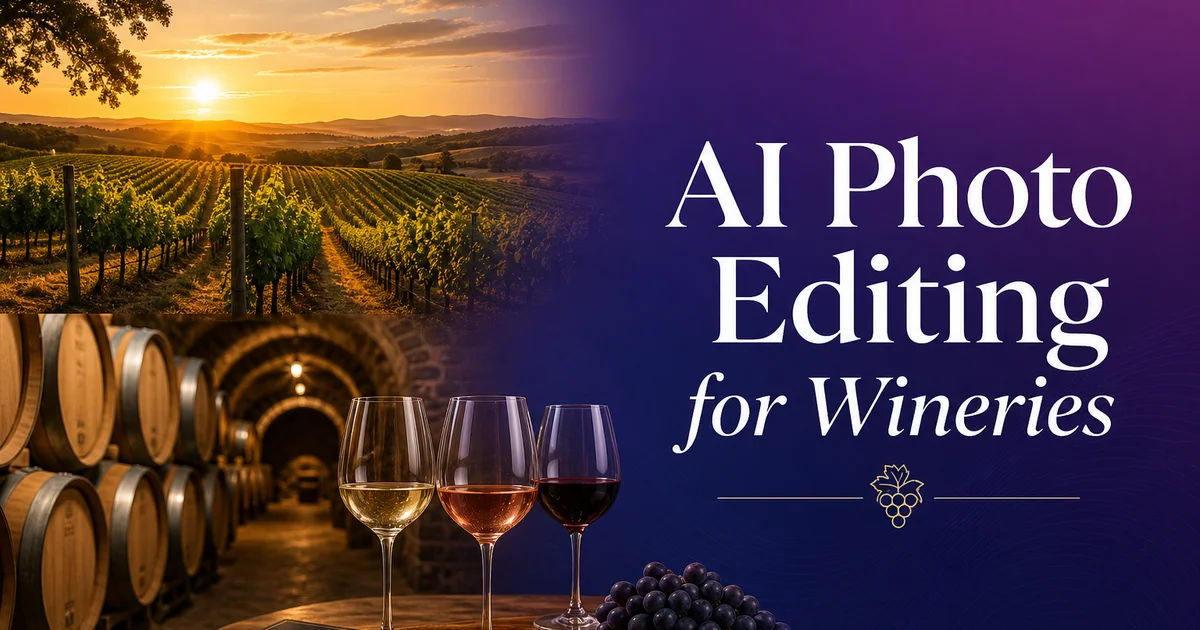
Le vin est l'un des produits les plus visuels de l'industrie agroalimentaire. Chaque étape de son parcours — les rangs de vignes au coucher du soleil, les bennes de vendange débordant de raisin, la géométrie tranquille du chai à barriques, l'hospitalité soignée de la salle de dégustation, le design de l'étiquette de la bouteille. Le service dans un verre en cristal — offre une occasion de photo qui influence directement les décisions d'achat. Les consommateurs de vin sont des acheteurs en quête d'idéal, et l'imagerie associée à un vin façonne leur perception de sa qualité, de son terroir et de sa valeur autant que les notes de dégustation.
Pourtant, la plupart des domaines fonctionnent avec des budgets marketing limités et sans photographe attitré. Le responsable de la salle de dégustation prend des photos sur son téléphone entre deux services. Le responsable du vignoble capture un magnifique lever de soleil sur les vignes mais ne peut éviter le tracteur garé au bout du rang. Le vigneron photographie le nouveau millésime dans le chai. L'éclairage fluorescent utilitaire rend le vin terne et les barriques grises. Ces photos brutes contiennent un excellent sujet. Elles ont simplement besoin d'une retouche de niveau expert que le domaine n'a ni le temps ni le budget de sous-traiter pour chaque image.
La retouche photo par IA comble cette lacune. Avec Magic Eraser, AI Enhance et AI Filter, les domaines peuvent transformer des photos prises au téléphone pendant les opérations quotidiennes en images marketing soignées, adaptées aux campagnes du club de vin, aux plateformes touristiques, aux réseaux sociaux et au site web du domaine. Le tout sans photographe expert ni abonnement à Photoshop.
- La retouche par IA transforme les photos de téléphone du quotidien d'un domaine en supports marketing soignés, sans photographe professionnel.
- Magic Eraser supprime les infrastructures agricoles, le désordre opérationnel et le matériel d'accueil des photos de vignoble et de salle de dégustation.
- AI Enhance corrige l'éclairage et fait ressortir la vraie couleur du vin dans les bouteilles et les verres, quelles que soient les conditions de lumière ambiante.
- AI Filter crée des esthétiques saisonnières cohérentes pour les campagnes du club de vin et les promotions de sortie de cuvée.
- Une imagerie professionnelle du domaine influence directement les visites œnotouristiques, les inscriptions au club et les ventes en direct au consommateur.
Le défi du marketing visuel pour les domaines viticoles
Les domaines vendent une expérience autant qu'un produit. Un client qui achète une bouteille de Pinot Noir à 40 dollars achète aussi l'histoire du vignoble, l'ambiance de la salle de dégustation. Le style de vie que représente le domaine. Cela rend le marketing visuel essentiel — et rend une photographie de mauvaise qualité activement nuisible à la marque. Une photo de salle de dégustation mal éclairée et encombrée transmet une expérience très différente de la même pièce photographiée avec une composition épurée et une lumière chaleureuse et accueillante, même si la salle réelle est identique.
Le défi est opérationnel. Les domaines sont des exploitations agricoles en activité. Le vignoble comporte des lignes de goutte-à-goutte, des fils de palissage, du matériel de gestion de la vigne, des filets anti-oiseaux, des pièges de surveillance des nuisibles et des véhicules utilitaires. Le chai abrite des tuyaux, des pompes, du matériel de laboratoire et un stockage de produits chimiques. La salle de dégustation est un espace d'accueil, mais elle comporte aussi des terminaux de caisse, des cartons d'inventaire, des produits d'entretien. L'infrastructure fonctionnelle d'un service de boissons. Ces éléments sont nécessaires à la marche de l'entreprise, mais ils nuisent à l'imagerie idéalisée qui stimule les ventes de vin.
Le calendrier saisonnier ajoute de la pression. La vendange est la saison la plus photogénique et la plus vendeuse, mais c'est aussi la plus chargée. Toutes les mains du domaine traitent le raisin, et personne n'a le temps pour une séance photo de plusieurs heures. Le débourrement au printemps, la véraison en été et le repos hivernal offrent chacun des occasions visuelles uniques qui ne durent que quelques jours ou semaines. Manquer ces fenêtres signifie attendre une année de plus, ou se contenter des photos brutes prises au téléphone au passage.
- Les consommateurs de vin sont des acheteurs en quête d'idéal dont les décisions d'achat sont fortement influencées par l'imagerie de la marque.
- Les vignobles et salles de dégustation en activité comportent des éléments opérationnels qui nuisent à l'esthétique soignée attendue par les acheteurs.
- Les fenêtres de photographie saisonnière sont brèves et coïncident avec les périodes opérationnelles les plus chargées.
- Des budgets marketing limités permettent rarement une photographie professionnelle à la fréquence qu'exigent les canaux de contenu modernes.
Nettoyer les paysages viticoles pour le tourisme et l'image de marque
Le paysage du vignoble est l'atout le plus emblématique du domaine. Des rangs de vignes ondoyants, des montagnes en toile de fond, la brume matinale dans la vallée. Ces images définissent les régions viticoles et attirent le flux touristique qui remplit les salles de dégustation. Mais la réalité d'un vignoble en activité correspond rarement à la carte postale. Les colonnes montantes d'irrigation interrompent la géométrie épurée des rangs. Une cuve à diesel trône au bout d'une parcelle. Les filets anti-oiseaux drapés sur le feuillage en fin d'été paraissent protecteurs, pas pittoresques. Un pulvérisateur garé entre les rangs attend son prochain passage.
Magic Eraser supprime ces éléments sans perturber le paysage naturel. Passez le pinceau sur l'infrastructure d'irrigation et l'IA comble avec le sol, le couvert végétal ou l'herbe qui s'y trouverait naturellement. Effacez le matériel garé au bout d'un rang et le vignoble s'étend sans rupture jusqu'à la lisière des arbres. Effacez le filet anti-oiseaux et les grappes apparaissent dans toute leur beauté intacte. Les images obtenues représentent le vignoble fidèlement. Voilà à quoi ressemble le paysage — moins les éléments temporaires ou utilitaires présents par hasard le jour de la prise de vue.
La photographie par drone, de plus en plus courante dans le marketing des domaines, bénéficie du même traitement. Les prises aériennes qui révèlent la beauté géométrique des parcelles capturent aussi chaque chemin d'accès, zone de stockage du matériel et propriété voisine. La suppression sélective de ces éléments dans les photos aériennes produit ces panoramas viticoles grandioses qui fonctionnent exceptionnellement bien sur les sites web des domaines, les brochures touristiques et les supports marketing du club de vin.
Amélioration de la photographie de bouteilles et verres de vin
La photographie de bouteilles de vin est une compétence spécialisée car le produit est un cylindre de verre réfléchissant contenant un liquide coloré. Deux des sujets les plus délicats de la photographie de produit réunis. La bouteille reflète tout ce qui se trouve dans la pièce, le verre capte et dévie la lumière de façon imprévisible. La couleur du vin change beaucoup selon la température de couleur de la source lumineuse. Un Cabernet Sauvignon qui paraît d'un rubis profond à la lumière naturelle semble presque noir sous les lampes à incandescence de la salle de dégustation et prend une teinte violacée sous l'éclairage LED sur rail.
AI Enhance s'attaque directement au défi de la justesse des couleurs. Il analyse la température de couleur de la lumière ambiante et corrige la balance des blancs pour que la vraie couleur du vin soit rendue fidèlement. Le rubis profond d'un Pinot Noir, l'or paille d'un Chardonnay, les tons cuivrés d'un vin orange. Ces couleurs sont essentielles à la façon dont les amateurs perçoivent et anticipent le produit. Les rendre justes en photo ne consiste pas à embellir le vin ; il s'agit de le rendre fidèle.
La lisibilité de l'étiquette est l'autre élément crucial. Les étiquettes de vin contiennent le nom de la marque, le cépage, le millésime, l'appellation et souvent un récit ou un élément de design artistique. Sur les photos brutes, les étiquettes sont souvent partiellement masquées par des reflets, légèrement floues car l'appareil a fait la mise au point sur le vin plutôt que sur l'étiquette, ou décolorées par la lumière ambiante. AI Enhance accentue le texte de l'étiquette, corrige le rendu des couleurs et réduit les reflets. Rendant l'étiquette lisible et les éléments de design visibles comme le concepteur l'avait voulu.
- La couleur du vin change radicalement selon la lumière ambiante, et AI Enhance corrige la balance des blancs pour un rendu fidèle.
- Les bouteilles en verre réfléchissant et les surfaces liquides créent des défis photographiques que le traitement par IA gère efficacement.
- L'accentuation de l'étiquette et la réduction des reflets rendent les noms de marque, les cépages et les éléments de design clairement lisibles.
- Une photographie de bouteille cohérente sur tout un portefeuille crée un catalogue professionnel adapté aux distributeurs et aux ventes DTC.
Photographie de salle de dégustation pour le marketing touristique et hôtelier
La salle de dégustation est l'endroit où la plupart des domaines convertissent les visiteurs en membres du club de vin et en clients en direct. Les photos qui représentent cet espace sur Google Business Profile, Yelp, TripAdvisor, Viator. Le site web du domaine lui-même influence directement le fait qu'un touriste ajoute le domaine à son itinéraire. Les recherches en marketing œnotouristique présentent souvent l'imagerie de la salle de dégustation comme l'une des influences les plus fortes, aux côtés des avis, des récompenses, du prix et de l'emplacement, dans la décision d'un visiteur de s'arrêter dans un domaine particulier.
Une photographie efficace de salle de dégustation transmet la chaleur, une hospitalité soignée et un lien intime avec le vin. La réalité d'une journée de dégustation chargée comprend des verres empilés, du matériel de caisse, des menus de dégustation accrochés à des porte-bloc, des pots à pourboires, des crachoirs. Le désordre accumulé d'un service soutenu. Magic Eraser supprime ces éléments fonctionnels du service afin que la photo mette en valeur ce que vit le client. Le beau comptoir, la lumière chaleureuse, le vin dans le verre, la vue par la fenêtre — plutôt que l'infrastructure opérationnelle.
Les personnes sur les photos de salle de dégustation ajoutent de l'énergie et du réalisme, mais des personnes identifiables soulèvent des questions de vie privée et de consentement. Magic Eraser peut supprimer de façon sélective les personnes n'ayant pas consenti à être photographiées tout en conservant l'impression générale d'un espace animé et fréquenté. Vous pouvez aussi flouter ou supprimer les visages en arrière-plan tout en gardant les sujets clairement posés ayant donné leur accord. Cette approche produit une imagerie de salle de dégustation qui paraît vivante sans créer de responsabilité juridique.
How to do it
- 1
Photograph vineyard rows and tasting room spaces during golden hour
The hour before sunset bathes vineyards in warm, directional light that emphasizes the texture of grape canopy and the geometry of vine rows. Shoot wide-angle for landscape marketing images and medium-close for tasting room interior shots. Position wine bottles and glasses where they catch the golden light for natural reflections and warmth. If you cannot shoot during golden hour, overcast days provide soft, even light that is easier to enhance later.
- 2
Remove distracting elements from vineyard and tasting room photos
Use Magic Eraser to remove irrigation equipment, vineyard management tools, pest traps, bird netting poles, parked utility vehicles. Any agricultural infrastructure that breaks the idyllic vineyard aesthetic. In tasting room photos, remove POS systems, tip jars, stacked boxes, cleaning supplies. Other operational items that detract from the hospitality atmosphere you want to convey.
- 3
Enhance wine color and bottle presentation with AI Enhance
Run wine bottle and glass photos through AI Enhance to bring out the true color of the wine. The ruby depth of a Cabernet, the golden clarity of a Chardonnay, the salmon hue of a rosé. The tool corrects white balance so the wine's color reads accurately regardless of ambient lighting conditions. It also sharpens label text and enhances the clarity of glass and liquid, making bottles look polished without artificial retouching.
- 4
Apply atmospheric filters for seasonal marketing campaigns
Use AI Filter to create warm, harvest-season tones for fall wine club promotions, bright and airy treatments for spring release events. Rich, moody aesthetics for reserve wine marketing. Consistent filter application across a campaign's image set creates a cohesive visual identity that distinguishes each seasonal collection and reinforces the brand's personality.
- 5
Export images for website, wine club emails, and tourism platforms
Save high-resolution versions for your website's vineyard and tasting room galleries. Create optimized versions for wine club email campaigns, where file size affects deliverability. Export properly sized images for tourism platforms like Viator, TripAdvisor, and local wine trail directories. Include square crops for Instagram and Google Business Profile. Vertical formats for Pinterest and Stories, where wine and travel content performs exceptionally well.
Sources
- Wine Tourism and Visual Marketing: How Imagery Drives Tasting Room Visits — Wine Business Monthly
- The Impact of Digital Photography on Wine Label Design and Consumer Perception — Journal of Food Products Marketing
- Wine Industry Direct-to-Consumer Shipping and Marketing Report — Silicon Valley Bank