
Retouche photo IA pour pomologues — Photographie scientifique des fruits
Comment les pomologues et scientifiques des fruits utilisent la retouche photo IA pour la documentation de spécimens, l'identification des variétés, le suivi des maladies et les publications de recherche. Améliorez la précision des couleurs et les détails de surface.
SEO & Growth
Vérifié par Magic Eraser Editorial ·
Sommaire
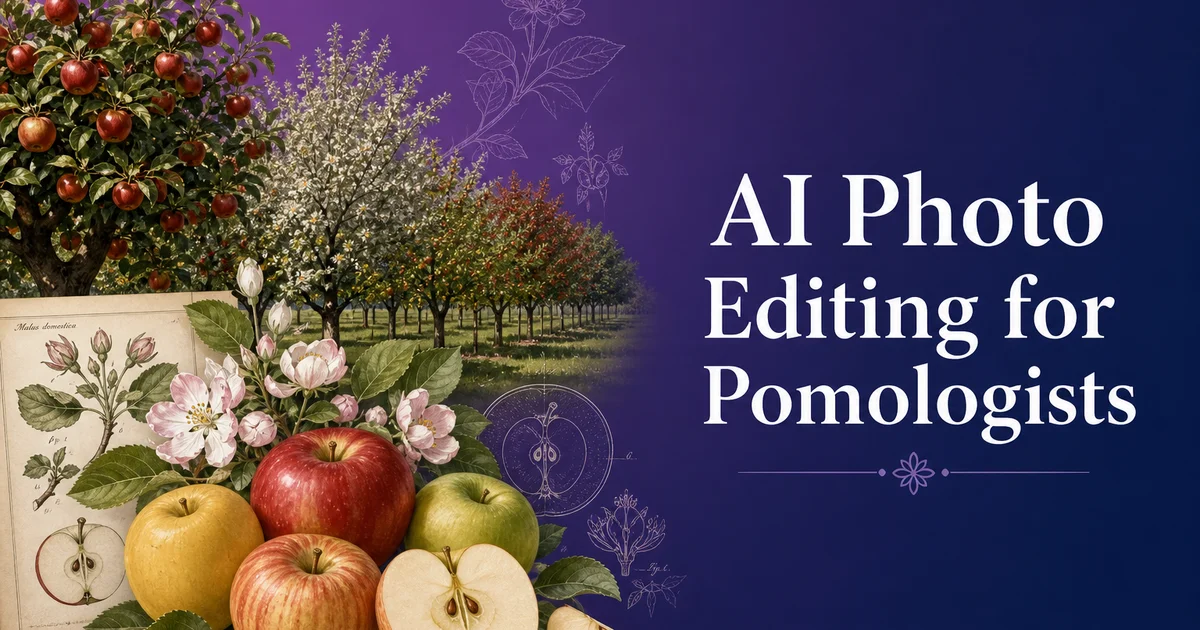
La pomologie — la science de la culture fruitière — repose sur les documents visuels plus que presque toute autre branche de l'horticulture. Depuis le XIXe siècle, lorsque l'USDA a commandé des milliers d'aquarelles détaillées pour documenter les variétés fruitières américaines, des documents visuels précis ont été essentiels à l'identification des variétés, au suivi des programmes de sélection, aux dossiers de maladies et à la vulgarisation. Aujourd'hui, ces documents sont photographiques plutôt que peints, mais les besoins restent les mêmes : précision colorimétrique, détail de surface net, présentation normalisée. Une qualité constante sur des centaines ou des milliers de spécimens.
Les défis pratiques de la photographie pomologique sont considérables. Les spécimens fruitiers sont photographiés dans des vergers, des stations de conditionnement, des laboratoires, des serres et des stations expérimentales — rarement en conditions de studio. L'éclairage va du soleil de midi du verger aux tubes fluorescents de laboratoire, chacun introduisant des dominantes de couleur qui faussent les subtiles différences de teinte distinguant une variété de pomme d'une autre. Les spécimens arrivent avec de la poussière, des marques de manipulation, des étiquettes collantes de verger et parfois des insectes. Le fruit photographié doit représenter fidèlement la variété, non les conditions de la séance photo particulière.
Les outils de retouche photo IA relèvent ces défis en assurant une correction colorimétrique cohérente et une normalisation de l'arrière-plan. Une amélioration des détails qui porte chaque image de spécimen à un niveau de qualité uniforme quelles que soient les conditions de prise de vue. Pour les pomologues gérant les dossiers de dizaines de variétés sur plusieurs saisons, les gains d'efficacité sont transformateurs. Ce qui exigeait autrefois des heures de travail manuel sous Photoshop par séance peut désormais être traité par lots en quelques minutes tout en conservant la précision scientifique qu'exigent les dossiers pomologiques.
- La correction colorimétrique neutralise les artefacts d'éclairage pour préserver les différences de teinte précises qui distinguent les variétés fruitières — couverture du rouge, couleur de fond et motifs de roussissure.
- La suppression de l'arrière-plan crée des présentations de spécimens normalisées à partir d'images captées dans les vergers, laboratoires, stations de conditionnement et stations expérimentales.
- L'amélioration IA restitue le détail de surface essentiel à l'identification des variétés — motifs de lenticelles, texture de l'épiderme, forme du calice et caractéristiques du pédoncule.
- Magic Eraser supprime les marques de manipulation, les étiquettes de terrain et la poussière sans altérer les caractéristiques naturelles du spécimen ni la documentation de son état.
- Le traitement par lots maintient une qualité constante sur des centaines de spécimens photographiés dans des conditions variables au fil des saisons.
Pourquoi la documentation visuelle est centrale en pomologie
L'identification des variétés fruitières a toujours été, en son cœur, visuelle. Les caractères qui distinguent une variété de pomme d'une autre. Le motif de couleur de l'épiderme, la distribution du rouge, la teinte de la couleur de fond, l'étendue de la roussissure, la visibilité des lenticelles, la forme du calice, la longueur du pédoncule et la forme d'ensemble — sont évalués principalement par examen visuel. Les descriptions écrites aident, mais la nuance précise de rouge d'une Honeycrisp comparée à une Fuji ou une Gala ne peut être adéquatement rendue par des mots. Les pomologues le savent depuis la fondation de la discipline, ce qui explique l'USDA Pomological Watercolor Collection. Plus de 7 000 peintures réalisées entre 1886 et 1942 — demeurent une ressource de référence utilisée par les scientifiques des fruits aujourd'hui.
Les dossiers pomologiques modernes dépassent largement l'identification des variétés. Les programmes de sélection photographient les sélections candidates sur plusieurs saisons pour suivre comment les caractères des fruits se développent et se stabilisent. Les chercheurs en maladies documentent la progression des symptômes par des séries photographiques chronologiques. Le motif et le rythme du feu bactérien sur le poirier, de la pourriture amère sur le pommier ou de la pourriture brune sur les fruits à noyau. Les agents de vulgarisation créent des guides visuels qui aident les producteurs à identifier les variétés, diagnostiquer les problèmes et prendre des décisions de gestion. Dans chaque cas, les photographies servent de données scientifiques, et leur précision affecte directement la fiabilité de la science.
Le passage des illustrations peintes à la photographie a apporté de l'efficacité mais aussi de nouveaux défis. Un aquarelliste pouvait normaliser la présentation de manière inhérente. En peignant chaque pomme sur le même fond blanc avec le même angle d'éclairage. Un photographe travaillant dans un verger sous une lumière variable, ou dans un laboratoire avec des tubes fluorescents, capte ce que l'environnement lui offre. Cette incohérence entre les séances rend la comparaison entre spécimens peu fiable, sauf si les photographies sont post-traitées vers une norme commune. Les outils de retouche IA fournissent cette normalisation efficacement, faisant en quelques secondes ce qu'un opérateur Photoshop minutieux mettrait des minutes à accomplir par image.
- L'identification des variétés fruitières dépend de caractéristiques visuelles — couleur de l'épiderme, motif du rouge, roussissure, densité des lenticelles — que les mots seuls ne peuvent décrire adéquatement.
- L'USDA Pomological Watercolor Collection de plus de 7 000 peintures démontre la centralité historique des documents visuels précis dans la science des fruits.
- La pomologie moderne utilise la photographie pour l'identification des variétés, le suivi des programmes de sélection, la documentation des maladies et la vulgarisation sur des milliers de spécimens.
- Le post-traitement IA normalise les images issues de conditions de prise de vue variables pour permettre une comparaison visuelle fiable entre spécimens et saisons.
Précision des couleurs pour l'identification des variétés et les registres de sélection
En pomologie, la couleur est une donnée. Le pourcentage de couverture du rouge à la surface d'une variété de pomme est un caractère mesurable que les sélectionneurs suivent au fil des générations. La teinte précise de ce rouge. Rouge bleuté contre rouge orangé contre rouge rosé — distingue les variétés au sein d'une même plage de couverture. La couleur de fond visible sous le rouge. Vert, vert-jaune, jaune pâle ou crème — indique le stade de maturité et l'identité variétale. Lorsqu'un programme croise deux variétés parentes et évalue la descendance, les caractères de couleur du fruit obtenu figurent parmi les principaux critères de sélection. Les photographies qui faussent ces couleurs compromettent le dossier de sélection.
La correction colorimétrique IA traite la source la plus courante de distorsion : la température de couleur de l'éclairage. La photographie en verger sous ciel bleu rend les fruits aux tons chauds plus froids et plus bleutés qu'ils n'apparaissent réellement. L'éclairage fluorescent de laboratoire ajoute une dominante verte qui brouille la distinction entre les teintes rouges et orangées. L'éclairage incandescent réchauffe tout l'espace colorimétrique, faisant paraître la couleur de fond verte plus jaune qu'elle ne l'est. L'IA identifie et neutralise ces dominantes en analysant l'image entière et en restaurant des points de référence neutres. Les fonds blancs paraissent vraiment blancs, les références grises vraiment grises, et les couleurs des fruits reviennent à leur réalité physique.
Pour les programmes de sélection devant comparer la couleur des fruits sur plusieurs saisons, la cohérence colorimétrique entre les séances importe plus que la précision absolue d'une séance isolée. Un décalage maîtrisé — par exemple, toutes les images légèrement plus chaudes que la réalité absolue — est acceptable tant qu'il est cohérent. Les comparaisons entre spécimens restent valides. Le traitement par lots IA réalise cette cohérence en appliquant des paramètres de correction identiques à toutes les images d'une séance. En fournissant des outils d'étalonnage qui permettent au pomologue d'accorder les profils de correction entre des séances couvrant des années de dossiers de programme de sélection.
- Le pourcentage de couverture du rouge, la teinte et la couleur de fond sont des critères de sélection mesurables que les photographies doivent représenter fidèlement pour conserver des dossiers valides.
- La correction colorimétrique IA neutralise les dominantes du ciel bleu, des tubes fluorescents et de l'incandescence qui faussent les distinctions de teinte sur lesquelles les pomologues s'appuient pour identifier les variétés.
- La cohérence entre les séances importe plus que la précision absolue — le traitement par lots IA assure une correction uniforme sur toute la série documentaire.
- Les outils d'étalonnage permettent d'accorder les profils de correction entre des séances couvrant plusieurs saisons de photographie de programme de sélection.
Documentation des maladies et suivi des symptômes
La pathologie pomologique repose sur les documents photographiques pour consigner l'aspect, la progression et la réponse au traitement des symptômes de maladie. Une infection de feu bactérien sur poirier débute par une lésion gorgée d'eau, progresse vers un flétrissement caractéristique en crosse des extrémités de pousses, et évolue vers la formation de chancres sur le bois plus âgé. Chaque stade nécessite des documents photographiques nets pour les dossiers de recherche, le matériel de référence diagnostique et les publications de vulgarisation. Les photographies doivent montrer les changements de couleur spécifiques, les motifs des tissus. La distribution spatiale des symptômes qui distingue une maladie d'une autre et un stade du suivant.
L'amélioration IA enrichit les dossiers de maladies en restituant les subtiles différences de couleur et de texture qui distinguent les symptômes des tissus sains. Les infections précoces apparaissent souvent comme de légers changements de couleur ou de texture difficiles à capter clairement avec un téléphone en conditions de terrain. Une lésion de tache bactérienne sur pêche peut apparaître comme une zone gorgée d'eau à peine visible avant de développer ses taches sombres et anguleuses caractéristiques. AI Enhance peut augmenter le contraste entre tissus atteints et sains juste assez pour rendre le symptôme précoce visible sur la photo sans l'exagérer artificiellement au-delà de son aspect réel.
La suppression de l'arrière-plan est surtout précieuse pour les dossiers de maladies car les symptômes photographiés au champ comportent souvent des arrière-plans indésirables. Feuilles voisines, fils de support, sol du verger, autres fruits — qui rivalisent visuellement avec le symptôme documenté. Isoler le fruit ou la feuille atteints sur un fond propre dirige l'attention du spectateur sur le symptôme lui-même. Pour les publications et le matériel de vulgarisation où plusieurs stades sont montrés côte à côte, des arrière-plans cohérents créent une présentation professionnelle qui aide les producteurs à comparer les stades et à identifier les symptômes dans leurs propres vergers.
- La documentation des maladies exige une capture nette des changements de couleur, des motifs des tissus et de la distribution spatiale à chaque stade de symptôme.
- L'amélioration IA restitue les subtiles différences de symptômes précoces — zones gorgées d'eau, légère décoloration — que les téléphones peinent à capter en conditions de terrain.
- La suppression de l'arrière-plan isole les spécimens atteints des environnements de terrain distrayants, dirigeant l'attention du spectateur sur les symptômes documentés.
- Des arrière-plans propres et cohérents permettent la comparaison côte à côte des stades dans les publications de vulgarisation et le matériel de référence diagnostique.
Construire des flux de travail efficaces pour la documentation de spécimens à grande échelle
Un seul essai d'évaluation variétale peut nécessiter de photographier des centaines de spécimens fruitiers individuels sur plusieurs dates de récolte, blocs de verger et traitements de porte-greffe. Un programme de sélection évaluant de nouvelles sélections photographie des milliers de spécimens par saison sur plusieurs sites d'essai. À cette échelle, la retouche manuelle image par image est irréaliste. Le pipeline documentaire doit traiter le volume sans sacrifier les normes de qualité qui rendent les images scientifiquement utiles. Le traitement par lots IA est la technologie qui rend possibles les flux de travail de photographie pomologique à grande échelle.
Le flux de travail optimal commence par une prise de vue normalisée : une station photo portable avec un fond blanc constant, un éclairage zénithal fixe, une charte de référence colorimétrique. Un appareil monté à une hauteur et un angle standard. Cette installation peut se déplacer entre sites de verger et paillasses de laboratoire, offrant des conditions de prise de vue cohérentes qui minimisent la correction nécessaire en post-traitement. Même avec cette normalisation, des facteurs environnementaux comme la lumière ambiante s'infiltrant dans la station, l'alimentation électrique variable affectant la température de couleur. Le comportement du capteur lié à la température introduisent assez de variation pour exiger une correction.
Traitez l'ensemble des images de la séance comme un lot via la retouche IA : appliquez un nettoyage de l'arrière-plan pour éliminer toute incohérence de fond, effectuez la correction colorimétrique en utilisant la charte de référence comme ancre d'étalonnage, améliorez le détail de surface à un niveau cohérent. Exportez vers la base de données dans un format et une résolution normalisés. Le pipeline par lots traite des centaines d'images avec le même profil de correction, produisant un ensemble uniformément traité prêt à l'emploi pour la saisie en base, l'analyse comparative ou la publication sans attention individuelle à chaque image.
- Les programmes de sélection et les essais variétaux génèrent des centaines à des milliers de photographies de spécimens par saison qui nécessitent un traitement cohérent à grande échelle.
- Les stations photo portables et normalisées à éclairage, fonds et positions d'appareil fixes minimisent la variation de prise de vue entre les sites.
- Le traitement par lots IA applique simultanément une correction colorimétrique, un nettoyage de l'arrière-plan et une amélioration uniformes à des séances entières.
- L'exportation normalisée vers le format et la résolution de base de données élimine la manipulation manuelle image par image et crée directement des archives prêtes à publier.
How to do it
- 1
Photograph fruit specimens with standardized lighting and scale reference
Set up a consistent photography station with diffused overhead lighting and a neutral white or gray background. Include a color calibration card and a centimeter ruler or known-size reference in each frame. Photograph each specimen from a standardized angle. Often a top-down view and a profile view — to enable consistent size comparison across varieties and growing seasons. Maintain the same camera settings and lighting for all specimens in a records series.
- 2
Remove background distractions for clean specimen documentation
Use Background Eraser to isolate the fruit specimen from the photography surface, lab bench, orchard setting, or field notebook. Clean backgrounds allow the specimen to be evaluated on its own traits without visual interference from the setting. This is mainly important when comparing specimens across different photography sessions or locations where background consistency was not possible during capture.
- 3
Enhance color accuracy and surface detail for scientific documentation
Use AI Enhance to correct color casts from artificial lighting and recover surface detail that phone cameras flatten. Accurate color representation is critical in pomology. The specific shade of red blush coverage, the green-to-yellow ground color transition, and the presence of russeting or lenticel patterns are all varietal spotting markers. Boost should improve clarity and color accuracy without altering the specimen's actual look.
- 4
Remove distracting elements while preserving specimen integrity
Use Magic Eraser to remove handling artifacts like finger smudges on fruit skin, sticky labels from the orchard, soil marks from field collection. Any other elements that are not part of the specimen itself. Be careful to preserve natural features like insect damage, disease symptoms, or growth irregularities when these are part of the records purpose. Remove only extraneous artifacts that do not represent the specimen's actual condition.
- 5
Export standardized images for databases and publications
Save specimen images in TIFF or PNG format for archival databases, maintaining maximum color accuracy and detail. Use consistent file naming that encodes variety name, specimen number, date, and view angle. For publication submissions, export at the journal's required resolution and format specifications. For web databases and extension publications, create optimized JPEG versions at standardized dimensions that load efficiently while keeping enough detail for variety spotting.
Sources
- USDA Pomological Watercolor Collection — USDA National Agricultural Library
- Digital Imaging Standards for Plant Science Documentation — American Phytopathological Society
- Fruit Phenotyping with Computer Vision: Current Methods and Applications — Frontiers in Plant Science