
Retouche photo IA pour les horlogers — Magic Eraser
Guide complet de retouche photo IA pour les horlogers et les maîtres horlogers. Apprenez la suppression d'arrière-plan, l'amélioration des détails, le nettoyage de poussière et les techniques de traitement par lots pour une photographie de produits horlogers professionnelle.
SEO & Growth
Vérifié par Magic Eraser Editorial ·
Sommaire
- Les défis photographiques uniques des horloges et des montres
- Suppression d'arrière-plan pour les annonces professionnelles de garde-temps
- Amélioration des détails et l'art de révéler l'artisanat en pixels
- Suppression de poussière, nettoyage d'empreintes et documentation honnête de l'état
- Construire un catalogue visuel cohérent sur toutes les plateformes de vente
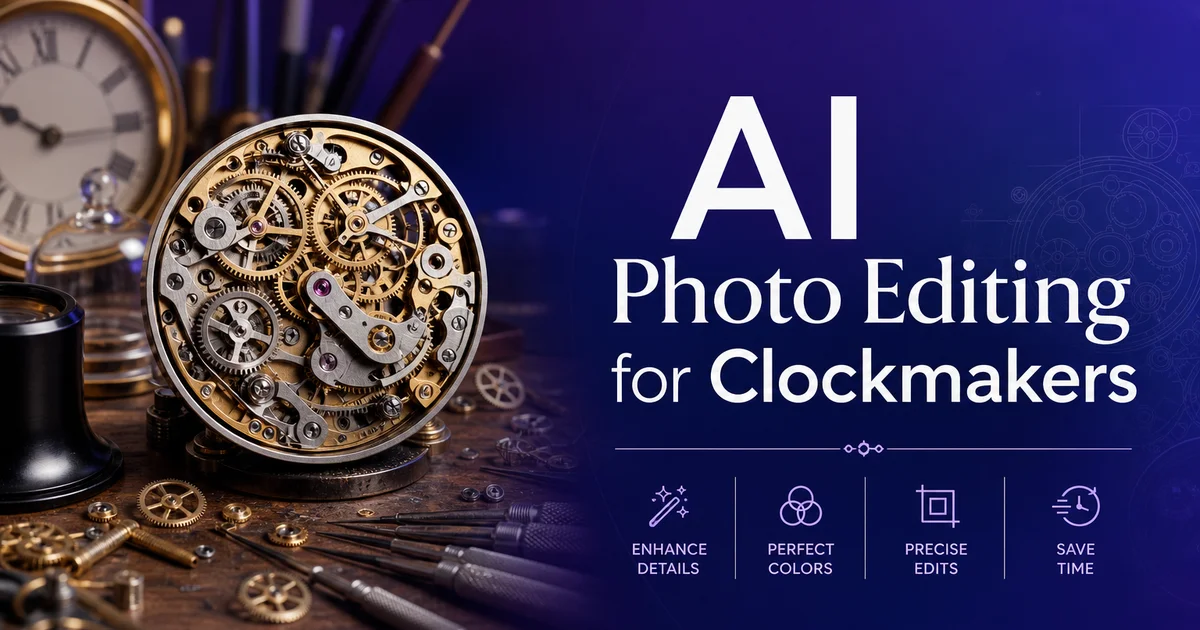
Les horlogers et les maîtres horlogers opèrent sur un marché où la qualité de la photographie de produits détermine directement si un acheteur potentiel fait suffisamment confiance à une annonce pour engager des centaines ou des milliers de dollars dans un achat. Une montre de poche vintage photographiée sur un établi encombré avec un éclairage inégal et de la poussière visible sur le verre communique de la négligence. Si le vendeur ne prend pas la peine de présenter correctement la pièce, l'acheteur se demande ce qui d'autre a été négligé. À l'inverse, la même montre photographiée avec un arrière-plan propre et isolé, un éclairage uniforme révélant l'état du cadran, des détails nets permettant l'inspection de la finition du mouvement — communique une compétence experte et une attention à la qualité. Dans une industrie entièrement fondée sur la précision et l'artisanat, la photographie de produits est le premier signal indiquant si un fabricant ou un revendeur répond aux standards.
Le défi pour la plupart des horlogers est qu'ils sont des artisans, pas des photographes. Leur expertise réside dans le démontage, la réparation et le réglage des mouvements mécaniques — des compétences développées au fil d'années d'apprentissage et de pratique qui laissent peu de temps pour maîtriser la discipline entièrement distincte de la photographie commerciale de produits. De nombreux horlogers prennent des photos adéquates mais non professionnelles avec leurs téléphones sous l'éclairage de l'atelier, produisant des images qui ne parviennent pas à mettre en valeur la qualité de leur travail. L'écart entre l'apparence réelle du garde-temps et son apparence dans les photos d'annonces coûte des ventes, réduit les prix que les clients sont prêts à payer et mine la réputation professionnelle que le savoir-faire de l'artisan mérite.
Les outils de retouche photo alimentés par l'IA comblent cet écart en automatisant les aspects les plus techniquement exigeants du post-traitement de la photographie de produits. Suppression d'arrière-plan, amélioration des détails, nettoyage de poussière et d'empreintes digitales, correction des couleurs et cohérence par lots — des tâches qui nécessiteraient une expertise majeure en Photoshop et des heures de travail manuel par image — peuvent désormais être accomplies en quelques minutes avec des résultats qui atteignent ou dépassent ce que la plupart des horlogers pourraient réaliser manuellement même avec une expérience d'édition substantielle. Ce guide présente un flux de travail photographique complet assisté par l'IA, conçu spécifiquement pour les horlogers, couvrant les défis uniques de la photographie de surfaces métalliques réfléchissantes, d'éléments en verre transparent et des détails à micro-échelle dont les acheteurs ont besoin pour évaluer l'état et la qualité.
- Background Eraser isole les garde-temps des environnements d'atelier encombrés, créant des images de produits propres avec des arrière-plans blancs, transparents ou aux couleurs de la marque, adaptés au commerce en ligne et au marketing.
- AI Enhance affine les détails fins sur toute la faible profondeur de champ typique de la macrophotographie, récupérant simultanément la netteté du texte de cadran, des finitions de mouvement et des gravures de boîtier.
- Magic Eraser supprime les particules de poussière, les empreintes digitales et les micro-rayures qui deviennent proéminentes en macrophotographie sans affecter la texture de surface authentique et la patine du garde-temps.
- Le traitement par lots applique des retouches cohérentes sur l'ensemble des catalogues d'inventaire, maintenant un professionnalisme visuel sur plusieurs plateformes de vente, des sites personnels à Chrono24 et eBay.
- Le flux de travail complet transforme les photos prises au téléphone dans l'atelier en images de produits professionnelles en quelques minutes, comblant l'écart entre l'expertise horlogère et les compétences en photographie commerciale.
Les défis photographiques uniques des horloges et des montres
Les garde-temps combinent pratiquement tous les défis photographiques difficiles en un seul sujet. Les boîtiers et bracelets en métal poli sont des surfaces hautement réfléchissantes qui agissent comme des miroirs courbes, capturant et affichant l'ensemble de l'environnement studio sur leurs surfaces. Le photographe, l'appareil photo, les lumières du plafond et le désordre environnant apparaissent tous sous forme de reflets déformés qui entrent en concurrence avec le sujet réel. Le verre ou le cristal saphir ajoute une autre couche de reflet tout en exigeant simultanément que l'appareil photo fasse la mise au point à travers pour atteindre le cadran en dessous, créant un défi de mise au point sur deux plans que la photographie en une seule prise gère mal. La combinaison d'une surface extérieure réfléchissante et d'une surface intérieure détaillée séparées par quelques millimètres de cristal transparent est pratiquement unique à la photographie horlogère.
L'échelle est le deuxième défi majeur. Les détails significatifs que les acheteurs doivent inspecter — la qualité du guilloché sur un cadran, le polissage des ponts de mouvement, la netteté des poinçons de boîtier, l'état du matériau luminescent sur les aiguilles — existent à des échelles de un à cinq millimètres. Capturer ces détails nécessite de la macrophotographie ou de la quasi-macrophotographie avec les défis associés : une profondeur de champ très faible, une sensibilité aux vibrations de l'appareil photo et la nécessité d'un positionnement précis de l'éclairage à des distances de travail rapprochées. La plupart des horlogers ne disposent pas des objectifs macro spécialisés, des rails de mise au point et de l'équipement d'éclairage qu'utilisent les photographes professionnels de produits, ce qui donne des images qui capturent l'aspect général du garde-temps mais perdent les détails fins qui témoignent de la qualité.
La documentation de l'état présente un troisième défi spécifique au commerce horloger. Les acheteurs de montres d'occasion ou vintage doivent évaluer l'état avec précision à partir des photographies. La différence entre une documentation d'état honnête et une photographie d'exposition flatteuse est majeure. Les rayures, la patine, le vieillissement du cadran et l'usure du boîtier sont des indicateurs d'état que les acheteurs s'attendent à voir représentés avec précision, ni cachés ni embellis au-delà de la réalité. L'horloger a besoin d'outils de retouche qui éliminent les artefacts photographiques — poussière, empreintes digitales, arrière-plan encombré — tout en préservant les caractéristiques d'état authentiques que l'acheteur doit évaluer honnêtement.
- Les surfaces métalliques polies et le verre créent des reflets complexes capturant l'ensemble de l'environnement studio, nécessitant un éclairage soigné et un post-traitement pour minimiser les effets miroir distrayants.
- Les détails d'état significatifs existent à des échelles de un à cinq millimètres, exigeant des capacités de macrophotographie que l'équipement de la plupart des horlogers ne peut fournir adéquatement.
- La faible profondeur de champ aux distances macro signifie que les surfaces de cadran et les verres au-dessus ne peuvent pas être tous deux nets en une seule exposition sans techniques spécialisées d'empilement de mise au point.
- La retouche doit éliminer les artefacts photographiques tout en préservant les caractéristiques d'état authentiques — rayures, patine et usure — dont les acheteurs ont besoin pour une évaluation honnête de l'état.
Suppression d'arrière-plan pour les annonces professionnelles de garde-temps
L'amélioration la plus impactante que la plupart des horlogers peuvent apporter à leur photographie de produits est de supprimer l'arrière-plan d'atelier et de présenter le garde-temps sur un fond propre et cohérent. La différence entre une montre photographiée sur un établi entouré d'outils, de plateaux de pièces et de loupes, et la même montre isolée sur un blanc pur, est la différence entre un cliché d'atelier et une image de produit professionnelle. Les plateformes de commerce en ligne montrent systématiquement que les annonces avec des arrière-plans blancs propres reçoivent plus de vues, un meilleur engagement et de meilleurs taux de conversion que celles avec des arrière-plans décontractés, car la présentation soignée signale un professionnalisme commercial.
Background Eraser gère la détection de bords complexe nécessaire pour isoler proprement les garde-temps — l'un des scénarios de détourage les plus difficiles en photographie de produits. Les boîtiers de montres ont des profils de bords complexes avec des couronnes, des poussoirs et des cornes faisant saillie à différents angles. Les maillons de bracelet créent des motifs répétés de métal et d'ombre qui peuvent tromper la détection de bords. Les cadrans squelettes et à cœur ouvert ont des zones où l'arrière-plan est visible à travers le mouvement, nécessitant que l'IA distingue entre les zones ajourées intentionnelles et l'arrière-plan réel. L'IA de Background Eraser relève ces défis en comprenant la structure tridimensionnelle du garde-temps plutôt qu'en s'appuyant uniquement sur la détection de bords basée sur la couleur.
Pour les horlogers qui vendent sur plusieurs plateformes, Background Eraser prend en charge différents formats de sortie pour différentes destinations. Les arrière-plans blancs purs répondent aux exigences des plateformes comme eBay et Amazon qui imposent des images de produits sur fond blanc. Les exports PNG transparents permettent de placer le garde-temps sur n'importe quelle couleur d'arrière-plan de site web ou de l'intégrer dans des supports marketing et des visuels pour les réseaux sociaux. Les arrière-plans de couleur unie aux couleurs de la marque créent une identité visuelle cohérente pour les fabricants qui vendent principalement via leur propre site web ou leurs réseaux sociaux. La possibilité de produire les trois variantes à partir d'une seule photographie source élimine le travail de retouche redondant.
- Les arrière-plans blancs propres améliorent systématiquement les vues, l'engagement et les taux de conversion sur les plateformes de commerce en ligne par rapport aux arrière-plans de photographie d'atelier décontractés.
- L'IA gère les bords complexes des garde-temps, y compris les couronnes saillantes, les motifs de maillons de bracelet et les zones ajourées des cadrans squelettes qui posent problème aux méthodes traditionnelles de détection de bords.
- Plusieurs formats de sortie — arrière-plan blanc, PNG transparent et couleurs de marque unies — répondent aux différentes exigences des plateformes à partir d'une seule photographie source.
- Des arrière-plans cohérents sur l'ensemble du catalogue d'inventaire créent une identité visuelle professionnelle qui renforce la confiance des acheteurs dans la compétence commerciale du fabricant ou du revendeur.
Amélioration des détails et l'art de révéler l'artisanat en pixels
L'artisanat qui définit la haute horlogerie existe à des échelles qui défient les équipements photographiques grand public. Les Côtes de Genève décorant un pont de mouvement s'étendent sur des fractions de millimètre. Le chanfreinage d'un composant en acier est à peine visible à l'œil nu. La finition perlage d'une platine crée un motif de cercles chevauchants de seulement un à deux millimètres de diamètre chacun. Ces détails de finition représentent des heures de travail manuel qualifié et comptent parmi les principaux indicateurs de qualité que les acheteurs avertis évaluent. Pourtant, ils apparaissent fréquemment comme des textures floues et indistinctes dans les photographies prises avec du matériel grand public standard à des distances de prise de vue normales.
AI Enhance résout ce problème en affinant intelligemment les détails au niveau micro tout en maintenant un aspect naturel d'ensemble. Plutôt que d'appliquer un filtre de netteté global qui amplifie le bruit et crée des halos autour des bords — le résultat courant des approches classiques de masque flou — AI Enhance identifie les détails structurels porteurs d'informations significatives et augmente sélectivement leur clarté. Les lignes parallèles des Côtes de Genève deviennent individuellement distinguables. Les bords chanfreinés des ponts révèlent leur poli miroir. Les cercles concentriques du perlage deviennent individuellement comptables. Le texte du cadran devient lisible jusqu'aux plus petits marqueurs des sous-cadrans. Ces améliorations permettent aux photographies de communiquer la qualité de finition que l'horloger a investie dans la pièce.
La fidélité des couleurs est tout aussi importante pour l'évaluation de l'état et la confiance des acheteurs. De nombreuses photographies d'atelier souffrent de dominantes de couleur causées par les conditions d'éclairage mixte typiques des ateliers horlogers. Un éclairage de travail incandescent chaud combiné à des plafonniers fluorescents froids et à la lumière naturelle occasionnelle des fenêtres crée un rendu des couleurs incohérent qui fausse les couleurs de cadran, les tons des métaux de boîtier et les matériaux de bracelet. La correction des couleurs d'AI Enhance normalise la balance des blancs et compense l'éclairage mixte, garantissant qu'un cadran blanc apparaît blanc plutôt que jaunâtre, que l'or rose apparaît dans son véritable rose chaud plutôt qu'orange, et que les aiguilles bleues apparaissent dans la nuance correcte d'acier bleui.
- Les Côtes de Genève, le perlage et le chanfreinage existent à des échelles sub-millimétriques que les équipements photographiques grand public restituent fréquemment comme des textures floues et indistinctes plutôt que comme des détails de finition nets.
- AI Enhance affine sélectivement les détails structurels porteurs d'informations de qualité significatives sans l'amplification du bruit et les artefacts de halo des filtres de netteté conventionnels.
- La correction des couleurs normalise la balance des blancs dans les conditions d'éclairage mixte de l'atelier, garantissant une représentation fidèle des couleurs de cadran, des tons des métaux de boîtier et des matériaux de bracelet.
- La photographie de détails améliorée permet aux annonces de communiquer la qualité de finition manuelle que les acheteurs avertis évaluent comme indicateurs principaux de l'artisanat.
Suppression de poussière, nettoyage d'empreintes et documentation honnête de l'état
La macrophotographie haute résolution révèle chaque particule et imperfection sur les surfaces d'un garde-temps. La distinction entre les artefacts photographiques et les véritables problèmes d'état est cruciale dans le commerce horloger. Une fibre de poussière posée sur le verre n'est pas un défaut de la montre — elle s'est déposée quelques instants avant la prise de vue et sera retirée avant l'expédition. Une trace d'empreinte digitale sur le fond de boîtier poli résulte de la manipulation pendant la photographie, pas d'un problème d'état permanent. Un fil visible sur le cadran derrière le verre a pu s'introduire lors d'un service récent et serait retiré lors du réglage final. Ces artefacts photographiques déforment l'état du garde-temps et peuvent soit effrayer les acheteurs qui les confondent avec des défauts, soit attirer des plaintes d'acheteurs qui s'attendaient aux imperfections vues dans les photos.
Magic Eraser supprime ces artefacts photographiques de manière propre et précise, permettant de documenter fidèlement l'état véritable du garde-temps. Pointez l'outil sur une particule de poussière sur le verre et elle disparaît, révélant le détail du cadran en dessous. Sélectionnez la trace d'empreinte digitale sur le fond de boîtier et la surface polie est restaurée sans altérer la finition sous-jacente. Supprimez la fibre de la zone du cadran et la surface propre montre l'état réel. L'IA comprend la différence entre un artefact posé sur une surface et la texture de la surface elle-même, supprimant le premier tout en préservant la seconde — une distinction qui exige une compétence majeure pour être réalisée manuellement dans Photoshop.
La documentation honnête de l'état exige de préserver les véritables caractéristiques d'usure que les acheteurs doivent évaluer. Les rayures sur le boîtier résultant d'années d'utilisation sont des indicateurs d'état, pas des artefacts. Elles doivent rester visibles dans les photographies car elles affectent l'évaluation de l'état par l'acheteur et donc la valeur de la pièce. La patine sur un cadran vintage, la dégradation du matériau luminescent liée à l'âge et les marques de service sur les bords du fond de boîtier sont autant de caractéristiques authentiques qui doivent être documentées honnêtement. Le flux de retouche de l'horloger devrait utiliser Magic Eraser exclusivement pour les artefacts photographiques tout en laissant les véritables caractéristiques d'état intactes, maintenant la relation de confiance avec les acheteurs qui soutient une réputation professionnelle dans le métier.
- La macrophotographie révèle poussière, empreintes digitales et fils qui sont des artefacts photographiques plutôt que de véritables problèmes d'état, pouvant déformer la présentation du garde-temps aux acheteurs.
- Magic Eraser distingue entre les artefacts posés sur les surfaces et les surfaces elles-mêmes, supprimant les premiers tout en préservant la texture et la qualité de finition authentiques.
- La documentation honnête de l'état exige de préserver les rayures, la patine, la dégradation du matériau luminescent et les marques de service dont les acheteurs ont besoin pour une évaluation précise de l'état.
- Une discipline de retouche claire — suppression des artefacts photographiques tout en préservant les véritables caractéristiques d'usure — maintient la relation de confiance essentielle à la réputation commerciale professionnelle.
Construire un catalogue visuel cohérent sur toutes les plateformes de vente
Les horlogers et les marchands de montres vendent souvent sur plusieurs plateformes simultanément — leur propre site web, eBay, Chrono24, Instagram, et parfois des forums spécialisés et des réseaux de revendeurs — et le public de chaque plateforme se forge une impression basée sur la cohérence visuelle des annonces du vendeur. Un revendeur dont les annonces présentent des arrière-plans uniformes, une qualité d'éclairage cohérente, des dimensions d'image similaires et des niveaux de détail équivalents sur chaque pièce de son inventaire apparaît organisé, professionnel et digne de confiance. Un revendeur dont les annonces montrent des arrière-plans différents, des niveaux de qualité variables et une présentation incohérente apparaît désorganisé, suscitant des préoccupations inconscientes quant à savoir si la même incohérence s'applique à ses pratiques commerciales, à l'évaluation de l'état et à la qualité du service.
Le traitement par lots via les outils de retouche IA rend la cohérence du catalogue réalisable sans l'investissement en temps par image que la retouche manuelle exige. Après avoir optimisé les paramètres pour un garde-temps — couleur d'arrière-plan, intensité d'amélioration, rigueur du nettoyage, paramètres de correction des couleurs et dimensions d'exportation — les mêmes paramètres peuvent être appliqués à chaque pièce suivante de l'inventaire. Un horloger photographiant vingt montres pour la vente peut traiter l'ensemble du lot dans le temps qu'il aurait auparavant fallu pour retoucher manuellement deux ou trois pièces, obtenant des résultats cohérents sur l'ensemble du catalogue plutôt que d'investir l'effort de retouche uniquement dans les pièces les plus précieuses tout en laissant les annonces de moindre valeur avec des clichés d'atelier non retouchés.
Les exigences de sortie spécifiques aux plateformes ajoutent une complexité que le traitement par lots gère efficacement. Le propre site web de l'horloger pourrait nécessiter des images de 2000 pixels sur le côté le plus long avec une couleur d'arrière-plan de marque. eBay exige des arrière-plans blancs avec des contraintes de dimensions spécifiques. Chrono24 a ses propres spécifications d'image. Les publications Instagram nécessitent un ratio de recadrage carré à 1080 pixels. Produire manuellement quatre versions de chaque image de produit pour chaque plateforme est d'une durée prohibitive pour une petite entreprise. Le traitement par lots avec des modèles d'exportation spécifiques aux plateformes génère toutes les variantes nécessaires à partir d'une seule source retouchée, garantissant que chaque plateforme reçoit des images correctement formatées répondant à ses exigences techniques tout en maintenant la cohérence visuelle sur l'ensemble de la présence multiplateforme du vendeur.
- La cohérence visuelle sur toutes les annonces renforce la confiance des acheteurs — des arrière-plans, un éclairage et des niveaux de détail uniformes signalent une compétence professionnelle et des pratiques commerciales dignes de confiance.
- Le traitement par lots applique des paramètres optimisés sur l'ensemble des catalogues d'inventaire en une fraction du temps que la retouche manuelle exige, rendant la cohérence réalisable pour les petites entreprises.
- Les modèles d'exportation spécifiques aux plateformes génèrent des variantes correctement formatées pour les sites web, eBay, Chrono24 et Instagram à partir d'une seule image source retouchée.
- Une présentation visuelle cohérente sur plusieurs plateformes de vente renforce l'identité de marque professionnelle du revendeur ou du fabricant, quel que soit l'endroit où les acheteurs rencontrent leurs annonces.
How to do it
- 1
Photograph your timepiece against a neutral background with even lighting
Position the clock or watch on a clean surface with diffused lighting that minimizes harsh reflections on glass crystals and polished metal surfaces. Clockwork photography presents unique challenges because the subjects combine highly reflective materials. Polished brass, chrome, gold plating, and glass — with intricate fine detail at very small scales. Use a tripod and remote trigger to avoid camera shake during the close-up exposures required to capture dial details, hand engravings, and movement components. Shoot multiple angles including the face straight on, the case profile, the movement from behind. Detail shots of complications, engravings, and hallmarks.
- 2
Remove distracting backgrounds using Background Eraser for clean product isolation
Use Background Eraser to isolate the timepiece from its photographed setting, replacing the background with pure white for e-commerce listings, transparent PNG for website integration, or a selected brand color for marketing materials. The AI identifies the complex edges of clock cases. Crown guards, pushers, lugs, bracelet links, and the thin profiles of watch hands visible through the crystal — and creates clean cutouts that preserve these intricate details. For clocks with open movement displays or skeleton dials, the AI distinguishes between the see-through areas of the mechanism and the actual background, keeping the visual depth of the movement visible while removing the studio setting behind it.
- 3
Enhance fine details of dials, engravings, and movement components with AI Enhance
Run AI Enhance on close-up shots to sharpen the fine details that buyers and collectors need to evaluate. The printing quality of dial text, the finishing of movement bridges and screws, the depth and crispness of case engravings, and the condition of luminous material on hands and indices. Watch and clock detail photography often suffers from slight softness caused by the shallow depth of field required for macro distances. AI Enhance recovers sharpness across the depth plane, ensuring that both the dial surface and the crystal above it appear crisp rather than one being sharp and the other slightly soft. Is the typical limitation of single-shot macro photography.
- 4
Use Magic Eraser to remove dust, fingerprints, and surface imperfections
Apply Magic Eraser to eliminate the dust particles, fingerprints. Micro-scratches that are nearly invisible to the naked eye but become prominently visible in high-resolution macro photography. Polished watch cases show every fingerprint as a smudged patch, crystal surfaces reveal dust specks as dark spots against reflections. Dial surfaces display lint fibers that landed between the crystal and dial during assembly. Magic Eraser removes these distractions without affecting the underlying finish quality, keeping the genuine surface texture and patina of the timepiece while eliminating artifacts that would misrepresent the condition to potential buyers.
- 5
Create consistent catalog imagery across your entire inventory with batch processing
Apply your optimized editing workflow to your full inventory using batch processing to maintain visual consistency across all product listings. Consistent background color, lighting balance, detail sharpness. Image dimensions across every timepiece listing create a expert catalog look that builds buyer confidence. Save your preferred settings as a reusable template. Background color, boost intensity, and export dimensions — so that new inventory additions receive the same treatment as existing listings. This consistency is mainly important for clockmakers and watchmakers who sell across multiple platforms including their own website, eBay, Chrono24. Social media, where visual professionalism directly correlates with buyer trust and willingness to purchase high-value items.
Sources
- Product Photography Best Practices for E-Commerce — Shopify
- Macro Photography Techniques for Small Object Detail — Digital Photography School