
Retouche photo IA pour detailing auto : meilleures photos avant/après
Comment les entreprises de detailing automobile utilisent la retouche photo par IA pour une documentation avant/après professionnelle, du contenu marketing sur les réseaux sociaux et la construction d'un portfolio qui attire de nouveaux clients et des contrats de flotte.

Product Marketing
Vérifié par Magic Eraser Editorial ·
Sommaire
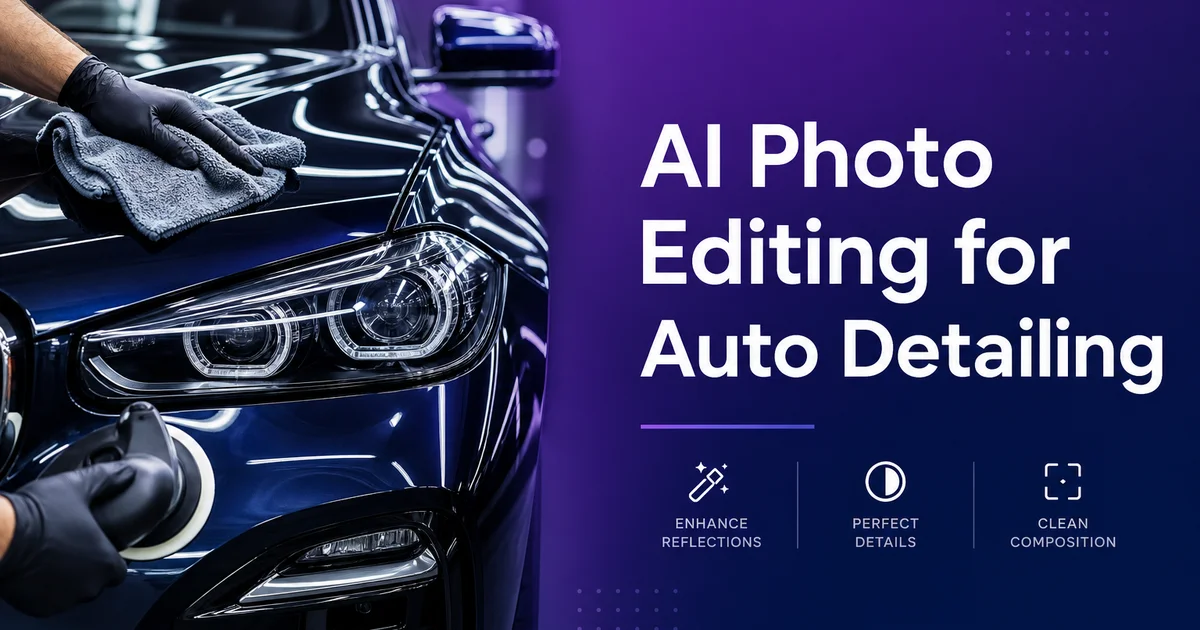
Le detailing automobile est une activité fondée sur le changement visible. Un client apporte un véhicule avec des marques de tourbillon incrustées dans le vernis, des taches d'eau gravées dans les vitres et un an de taches de café imprégnées dans la sellerie. Deux heures plus tard, la peinture reflète comme un miroir, les vitres sont cristallines et l'intérieur sent le neuf. Ce changement est votre produit, et la manière la plus efficace de le vendre au prochain client est de le montrer. Pas de le décrire — le montrer.
Le problème est que les appareils photo des téléphones sont très mauvais pour capturer ce qui rend le detailing impressionnant. La finition miroir d'un capot fraîchement poli apparaît comme une surface plate et légèrement brillante. Le noir profond des garnitures plastiques restaurées ressemble au gris délavé d'avant. Les résultats du nettoyage intérieur sont invisibles sur des photos où l'exposition automatique de l'appareil écrase les ombres en noir. Vous savez que le travail est excellent parce que vous le voyez en personne. Vos photos Instagram donnent l'impression que vous n'avez presque rien fait.
La retouche photo par IA comble l'écart entre l'apparence réelle de votre travail et son rendu à l'écran. Magic Eraser supprime le désordre de l'allée, les tuyaux d'arrosage et le monospace du voisin de vos photos. AI Enhance fait ressortir la profondeur de peinture, la restauration des garnitures et les détails intérieurs que les appareils photo des téléphones aplatissent. Le résultat est une photo qui représente honnêtement votre travail réel. Pas exagérée, mais enfin visible comme un client debout à côté du véhicule la verrait.
- Les photos avant/après sont le format marketing avec le meilleur taux de conversion pour les entreprises de detailing automobile.
- Les appareils photo des téléphones aplatissent les qualités visuelles qui rendent le detailing impressionnant — finitions miroir, noirs profonds et clarté restaurée.
- Magic Eraser supprime le désordre d'arrière-plan des allées, parkings et lieux de travail mobiles.
- AI Enhance récupère la profondeur de peinture, le contraste des garnitures et les détails intérieurs que les appareils photo ne parviennent pas à capturer.
- Une documentation professionnelle et cohérente construit des portfolios qui remportent des contrats de flotte et des partenariats avec des concessionnaires.
Pourquoi un excellent travail de detailing est mal rendu en photo
Les qualités qui rendent un véhicule fraîchement traité impressionnant en personne sont exactement celles que les appareils photo des téléphones peinent à capturer. La correction de peinture élimine les micro-rayures et marques de tourbillon qui dispersent la lumière, produisant une surface qui reflète comme un miroir. En personne, vous pouvez voir les alentours clairement reflétés dans le capot — signe que la surface est optiquement lisse. Sur une photo de téléphone, cette finition miroir se compresse en une version légèrement plus brillante de l'aspect plat et voilé qu'avait la peinture avant. La plage dynamique de l'appareil ne peut pas gérer le contraste extrême entre le reflet lumineux du ciel et la couleur profonde de la peinture. Il fait un compromis et le résultat paraît médiocre.
Le detailing intérieur présente le problème inverse. Le travail est réel — moquettes nettoyées à la vapeur, cuir conditionné, surfaces désinfectées, plastiques restaurés — mais il se déroule dans un espace clos où les appareils photo des téléphones basculent par défaut sur des réglages inadaptés au sujet. L'exposition automatique éclaircit le tableau de bord mais écrase le plancher dans l'ombre. La balance des blancs automatique dérive sous l'éclairage intérieur aux tons chauds. Le résultat est une photo où le volant paraît acceptablement propre mais où tout le reste disparaît dans l'obscurité. Le client qui compare vos photos avant/après pense que vous n'avez nettoyé que le volant.
Ce ne sont pas des problèmes de qualité de votre travail. Ce sont des problèmes de traduction de la réalité tridimensionnelle vers un écran de téléphone bidimensionnel. Vos yeux s'adaptent instantanément lorsque vous vous penchez dans l'habitacle. Vous voyez la moquette propre au plancher, le cuir conditionné sur la banquette arrière, le ciel de toit restauré. L'appareil photo prend une seule décision d'exposition pour l'ensemble du cadre et perd tout ce qui n'est pas dans la plage de luminosité moyenne. L'amélioration IA corrige ce problème de traduction, récupérant les détails que vos yeux voient mais que votre appareil photo rate.
- Les finitions de peinture miroir se compressent en un éclat plat sur les photos de téléphone en raison de la plage dynamique limitée.
- Les résultats du nettoyage intérieur disparaissent quand l'exposition automatique écrase les zones d'ombre en noir.
- La traduction d'une vision tridimensionnelle en photographie bidimensionnelle perd les qualités que le detailing produit.
- L'amélioration IA corrige les limitations de l'appareil photo sans exagérer les résultats réels.
Photographier le travail de detailing pour un impact maximal
Avant d'éditer, vous avez besoin d'une bonne matière première. Le facteur le plus important en photographie de detailing est la cohérence de l'éclairage entre les prises avant et après. Si vous photographiez le véhicule sale dans votre garage sous des néons et le véhicule fini au soleil, le changement semble faux même s'il est réel. Le spectateur attribue l'amélioration au changement d'éclairage plutôt qu'au detailing. Photographiez les deux au même endroit, à la même heure de la journée, sous les mêmes conditions de ciel autant que possible.
Les jours couverts sont le meilleur allié du detailer pour la photographie. Une couverture nuageuse uniforme élimine les reflets durs et les points chauds sur la peinture tout en fournissant suffisamment de lumière pour montrer l'état de surface. L'éclairage doux et diffus révèle les marques de tourbillon et les rayures sur la photo avant sans créer de reflets surexposés. Il montre la surface lisse et corrigée sur la photo après sans cacher le résultat derrière l'éblouissement. Si vous devez photographier en plein soleil, positionnez le véhicule de sorte que le soleil soit derrière vous et légèrement sur le côté, éclairant les panneaux uniformément plutôt que de créer une seule traînée lumineuse sur le capot.
Les photos de détail racontent l'histoire que les plans larges ne peuvent pas raconter. Une photo du véhicule entier montre la propreté générale, mais un gros plan d'une section de peinture montrant la clarté du reflet, une roue avant et après la décontamination ferrique, ou un siège en cuir avec le conditionnement visible dans le grain — ces photos transmettent le savoir-faire. Prenez trois à cinq paires de détails par véhicule : la zone la plus abîmée avant traitement à côté de la même zone après, la roue la plus sale avant et après, et une paire de détail intérieur. Ces gros plans sont votre contenu de réseaux sociaux le plus partageable car ils montrent le changement à une échelle où la différence est indéniable.
- Éclairez les photos avant et après de manière identique — même lieu, même heure de la journée, mêmes conditions de ciel.
- Les jours couverts fournissent un éclairage idéal qui révèle l'état de surface sans reflets durs.
- Les gros plans de détail sur des zones spécifiques transmettent un savoir-faire que les plans du véhicule entier ne peuvent pas communiquer.
- Prenez trois à cinq paires de détails par véhicule pour le contenu des réseaux sociaux et du portfolio.
Édition pour les réseaux sociaux et construction de portfolio
Les réseaux sociaux génèrent plus d'acquisition de nouveaux clients pour les entreprises de detailing automobile que tout autre canal marketing. Le format avant/après est intrinsèquement engageant. Les spectateurs adorent le contenu de transformation, et le detailing automobile offre certaines des transformations les plus satisfaisantes de toute l'industrie des services. Une publication avec révélation par balayage montrant un véhicule négligé transformé en finition de qualité showroom génère de l'engagement, des partages et le type précis de commentaire qui convertit : des personnes qui identifient des amis et demandent les tarifs.
Le flux de travail d'édition pour le contenu des réseaux sociaux est simple. Nettoyez l'arrière-plan avec Magic Eraser pour que le véhicule se détache seul sur un fond épuré. Appliquez AI Enhance pour faire ressortir la profondeur de peinture et la qualité de surface que l'appareil photo du téléphone a aplaties. Pour les photos avant, soyez honnête — montrez l'état réel sans le faire paraître pire qu'il n'était, mais sans non plus laisser l'exposition automatique de l'appareil minimiser les problèmes visibles. Pour les photos après, laissez l'amélioration montrer ce que vos yeux voient en personne : les reflets, la profondeur, le contraste restauré entre les garnitures et la peinture.
Construisez votre portfolio systématiquement en éditant et sauvegardant les trois à cinq meilleures images de chaque intervention. Organisez-les par type de service — les travaux de correction de peinture montrent des compétences différentes des travaux de restauration intérieure. Un forfait de lavage de flotte montre des capacités différentes d'un detailing complet avec revêtement céramique. En six mois de documentation régulière, vous construisez une bibliothèque visuelle qui montre votre polyvalence, votre régularité et votre qualité. Quand un concessionnaire ou un gestionnaire de flotte demande une proposition, ce portfolio est plus persuasif que n'importe quelle grille tarifaire ou description de services.
- Le contenu de transformation avant/après génère plus d'engagement et de demandes clients que tout autre format.
- Nettoyez les arrière-plans avec Magic Eraser et améliorez les surfaces avec AI Enhance pour chaque contenu.
- Soyez honnête dans les photos avant — montrez l'état réel sans exagération artificielle.
- Archivez systématiquement trois à cinq images éditées par intervention pour construire un portfolio complet au fil du temps.
Remporter des contrats de flotte et des partenariats avec des concessionnaires grâce à la documentation
Les entreprises de detailing automobile qui passent du stade d'opération solo à celui d'entreprises rentables avec des employés et des contrats de flotte sont presque toujours celles qui disposent d'une documentation de niveau professionnel. Quand une société de gestion immobilière a besoin d'un detailer pour sa flotte de 40 véhicules, elle ne choisit pas sur la base de l'offre la moins chère. Elle choisit sur la base de la qualité et de la fiabilité démontrées. Un detailer qui présente un portfolio de travaux avant/après constamment excellents sur des dizaines de véhicules, organisé par type de service et catégorie de véhicule, démontre à la fois compétence et professionnalisme d'une manière qu'un concurrent offrant les mêmes services mais ne montrant aucune documentation ne peut tout simplement pas égaler.
Les partenariats avec les concessionnaires suivent la même logique. Un concessionnaire de véhicules d'occasion a besoin que son inventaire soit bien rendu en photo pour les annonces en ligne. Il a besoin que ce soit fait efficacement et de manière constante. Montrer au responsable du concessionnaire votre portfolio de résultats de correction de peinture extérieure, de transformations de nettoyage en profondeur intérieur et de travaux de restauration de roues — le tout avec des photos de qualité professionnelle — vous positionne comme un partenaire qui comprend les standards visuels que son activité exige. La qualité du detailing compte, mais c'est la documentation qui vous ouvre la porte.
L'investissement dans la retouche photo par IA rapporte des dividendes à ce niveau. Quelques minutes par véhicule consacrées à l'édition de vos photos de documentation produisent des supports marketing qui servent pour les réseaux sociaux aujourd'hui et les propositions commerciales demain. Le detailer qui passe cinq minutes à éditer les photos de chaque intervention construit un portfolio que le detailer qui n'édite jamais ses photos ne peut pas concurrencer, quelle que soit la qualité réelle du travail de detailing de chacun. Dans une activité de services, la qualité perçue suit la qualité documentée, et la qualité documentée suit la présentation professionnelle.
- Les gestionnaires de flotte et les concessionnaires choisissent les detailers sur la base de la qualité documentée, pas de l'offre la moins chère.
- Des portfolios organisés par type de service et catégorie de véhicule démontrent compétence et professionnalisme.
- Une documentation professionnelle vous ouvre la porte à des conversations de partenariat que les grilles tarifaires ne peuvent pas initier.
- Les minutes consacrées à l'édition des photos de chaque intervention s'accumulent en un avantage concurrentiel qu'aucun concurrent sans documentation ne peut égaler.
How to do it
- 1
Photograph vehicles before and after detailing in consistent conditions
Capture before photos in the same location and lighting as after photos. The best setup is outdoors on an overcast day or in a shaded area where even lighting shows the paint condition without harsh reflections. Walk around the vehicle and photograph it from the same four to six angles every time. Front three-quarter, rear three-quarter, driver side profile, and detail shots of problem areas like swirl marks, water spots, or interior stains. Consistency between before and after shots is what makes the change convincing.
- 2
Remove background distractions and environmental clutter with Magic Eraser
Auto detailing photos are taken wherever the work happens — driveways, parking lots, garage bays, and mobile locations. These settings are full of visual distractions: other vehicles, trash cans, garden hoses, extension cords, product bottles, and shop equipment. Use Magic Eraser to clean these elements from the background so the vehicle is the sole focus of every image. Remove license plates for customer privacy. Erase water puddles, leaf debris, and parking lot stains that undermine the clean display.
- 3
Enhance paint clarity and interior detail with AI Enhance
Apply AI Enhance to make the detailing results pop. For exterior shots, AI boost deepens the paint reflection and clarity that detailing produces. The mirror-like finish on a freshly polished hood, the deep black of restored trim, the crystal-clear windows after water spot removal. For interior shots, it recovers detail in shadowed areas like footwells, between seats. Under dashboards where your cleaning work is real but hard to see in a phone photo taken through the window.
- 4
Create before/after comparison content for social media
Arrange before and after photos in side-by-side or swipe-reveal formats for Instagram, TikTok, and Facebook. The before photo should show the vehicle's actual condition. The swirl marks under direct light, the stained seats, the dirty wheel wells — without making it look artificially worse than it was. The after photo should show your actual results with the boost bringing out the quality of your work that phone cameras often fail to capture. Label the photos with the services performed so viewers understand what was done.
- 5
Export for Google Business Profile, website portfolio, and print materials
Save high-resolution images for your website gallery organized by service type. Paint correction, ceramic coating, interior restoration, wheel and tire detailing. Export optimized versions for Google Business Profile where potential customers in your area will see your work first. Create a separate set for printed materials. Business cards with a before/after on the back, flyers for local businesses and car dealerships, and a portfolio binder for in-person consultations with fleet clients.