
Retouche photo par IA pour les concessionnaires automobiles : vendez plus de voitures avec de meilleures photos d'annonces
Comment les concessionnaires automobiles utilisent la retouche photo par IA pour créer des photos d'inventaire professionnelles. Couvre la photographie en parc, la suppression d'éléments indésirables, le remplacement d'arrière-plan, la fidélité des couleurs de peinture et la distribution multiplateforme pour AutoTrader, Cars.com et les réseaux sociaux.

Product Marketing
Vérifié par Magic Eraser Editorial ·
Sommaire
- Pourquoi la qualité des photos d'inventaire détermine le succès en ligne des concessionnaires
- Suppression de l'encombrement du parc, des autocollants et des distractions d'arrière-plan
- Remplacement d'arrière-plan pour un aspect studio cohérent
- Fidélité des couleurs de peinture et amélioration de l'intérieur
- Distribution multiplateforme et optimisation des annonces
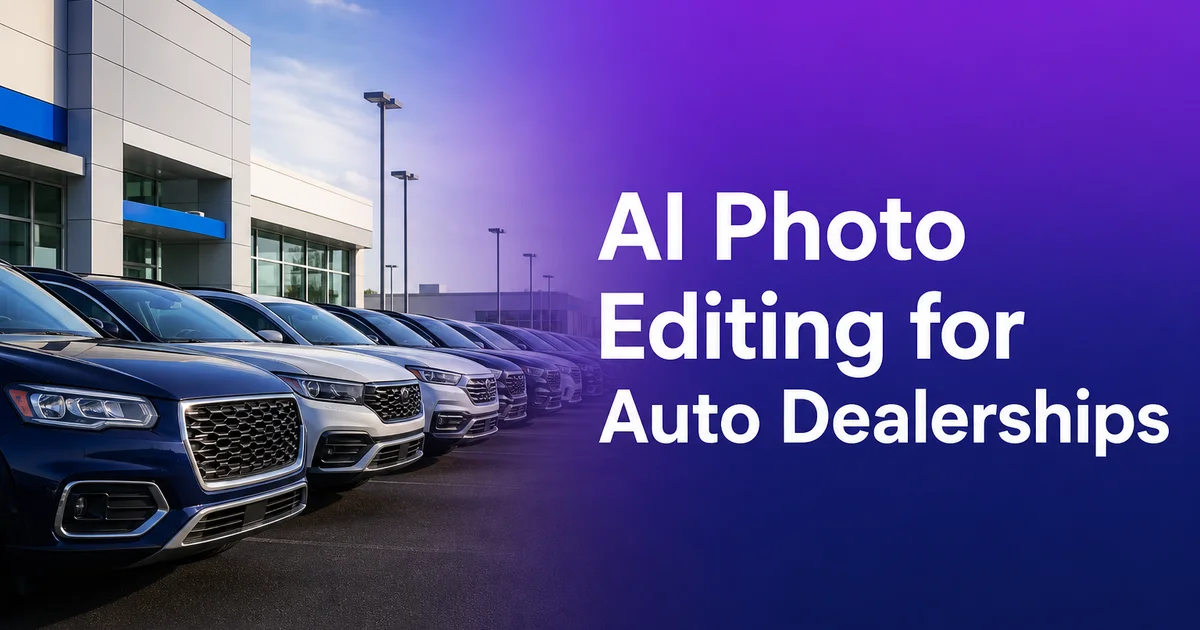
Le secteur de la vente au détail automobile a connu un changement fondamental dans la façon dont les acheteurs découvrent et évaluent les véhicules. Les recherches de Cox Automotive montrent que l'acheteur moyen consacre plus de quatorze heures à des recherches en ligne avant de se rendre chez un concessionnaire. Plus de quatre-vingts pour cent de ce temps de recherche est consacré à l'examen des photos de véhicules. Les photos d'annonces ne sont pas de simples illustrations. Elles constituent le principal outil de vente qui détermine si un acheteur clique pour lire les détails, appelle pour planifier un essai routier ou fait défiler vers l'annonce suivante. Un concessionnaire avec des photos d'inventaire de mauvaise qualité est invisible pour l'acheteur automobile moderne, quelle que soit la compétitivité de ses prix ou l'excellence de ses véhicules.
Le défi pour les concessionnaires réside dans l'échelle. Un concessionnaire indépendant typique fait tourner de cinquante à deux cents véhicules par mois. Les concessions franchisées peuvent avoir trois cents unités ou plus en inventaire actif à tout moment. Chaque véhicule nécessite de quinze à trente photos de qualité professionnelle couvrant les angles extérieurs, les détails intérieurs, les points forts mécaniques et les rapports d'état. Cela représente des milliers d'images individuelles par mois, et le coût de la photographie automobile professionnelle — pouvant atteindre cinquante à cent dollars par véhicule — rend impraticable pour de nombreux concessionnaires d'atteindre une qualité constante sur l'ensemble de leur inventaire.
La retouche photo par IA transforme l'économie et la qualité de la photographie d'inventaire des concessionnaires. Les mêmes photos de parc que le personnel commercial prend déjà avec des smartphones peuvent être nettoyées, améliorées et standardisées en quelques minutes par véhicule au lieu de plusieurs heures. La suppression d'objets élimine l'encombrement du parc, les étiquettes de prix et les véhicules voisins. Le remplacement d'arrière-plan crée un aspect studio cohérent sans studio physique. L'amélioration des couleurs garantit que la peinture apparaît fidèle et que les intérieurs sont attrayants. Ce guide couvre le flux de travail complet de retouche photo par IA pour les concessionnaires automobiles, de la prise de vue à la distribution multiplateforme des annonces.
- Plus de quatre-vingts pour cent du temps de recherche des acheteurs automobiles est consacré à l'examen des photos — la qualité des images d'annonces détermine directement quels véhicules reçoivent des demandes de renseignements.
- La suppression d'objets par IA élimine l'encombrement du parc, les autocollants de pare-brise, les plaques de concessionnaire et les véhicules voisins pour isoler chaque voiture comme unique point focal.
- Le remplacement d'arrière-plan crée une apparence studio cohérente pour chaque véhicule sans investir dans un studio photo physique.
- La reproduction fidèle de la couleur de peinture grâce à la correction colorimétrique par IA prévient la déception des acheteurs et renforce la confiance dans les annonces.
- L'exportation multiplateforme garantit une qualité d'image constante sur le site du concessionnaire, AutoTrader, Cars.com, CarGurus et les réseaux sociaux.
Pourquoi la qualité des photos d'inventaire détermine le succès en ligne des concessionnaires
La corrélation entre la qualité des photos d'annonces et la vitesse de vente est bien documentée dans le commerce automobile. Les véhicules avec des photos de qualité professionnelle reçoivent nettement plus de vues, de sauvegardes et de demandes que des véhicules identiques avec une photographie amateur. Les données de la NADA montrent que les concessionnaires qui investissent dans la qualité photo réduisent sensiblement le nombre moyen de jours en parc, et l'effet se cumule sur l'ensemble de l'inventaire. Un concessionnaire où chaque véhicule dispose de photos soignées projette un professionnalisme qui bénéficie à l'ensemble de la marque, tandis qu'un concessionnaire avec une qualité photo inconstante envoie un signal de négligence qui peut compromettre même ses unités les mieux photographiées.
La raison en est la psychologie de l'acheteur. L'achat d'une voiture est souvent la deuxième transaction la plus importante qu'un consommateur effectue, et le risque perçu est élevé. Les acheteurs utilisent chaque signal disponible pour évaluer la fiabilité avant de s'engager à visiter un concessionnaire. Des photos propres, bien éclairées et professionnellement composées indiquent que le concessionnaire est fier de son inventaire et fonctionne avec un souci du détail. À l'inverse, des photos sombres et encombrées prises sur le parc avec des reflets, des autocollants et des véhicules voisins dans le cadre suggèrent un concessionnaire qui lésine. Et s'il lésine sur la présentation, sur quoi d'autre pourrait-il lésiner ?
Le paysage concurrentiel rend cela encore plus critique. Un acheteur recherchant une Honda Civic 2024 sur AutoTrader ou Cars.com voit des dizaines d'annonces quasi identiques de différents concessionnaires. Les écarts de prix entre les annonces concurrentes sont souvent marginaux. Les photos d'annonces deviennent le principal facteur de différenciation. Elles sont la raison pour laquelle un acheteur clique sur une annonce plutôt qu'une autre, contacte un concessionnaire plutôt qu'un autre, et finalement se rend dans un showroom plutôt qu'un autre. Remporter le clic est la première vente, et elle se fait entièrement par les images.
- Les véhicules avec des photos professionnelles reçoivent davantage de vues, de sauvegardes et de demandes que des véhicules identiques avec des images amateurs.
- La qualité photo signale la fiabilité du concessionnaire — les acheteurs interprètent la présentation visuelle comme un indicateur de la qualité opérationnelle.
- Lorsque les annonces concurrentes ont des prix similaires, la qualité photo devient le principal facteur de différenciation qui remporte le clic initial.
- Une qualité photo constante sur l'ensemble de l'inventaire renforce la marque du concessionnaire dans son intégralité, pas seulement les annonces individuelles.
Suppression de l'encombrement du parc, des autocollants et des distractions d'arrière-plan
La photographie sur le parc d'un concessionnaire est intrinsèquement encombrée. Les véhicules sont garés en rangées avec d'autres véhicules d'inventaire visibles de tous côtés. Des autocollants de prix, des étiquettes d'addendum et des badges de concessionnaire ornent les pare-brise et les pare-chocs. Des numéros de repérage sont collés sur les vitres. Les cadres de plaques d'immatriculation portent la marque du concessionnaire qui peut ne pas correspondre aux directives d'affichage de la plateforme d'annonces. Des lampadaires, des bords de bâtiments, des poubelles et des véhicules de clients dans la voie de service apparaissent tous dans les zones d'arrière-plan. Ce bruit visuel est si omniprésent que de nombreux concessionnaires ne le remarquent plus. Mais les acheteurs voient chaque distraction, et chacune dilue l'impression professionnelle que l'annonce doit créer.
Magic Eraser traite chacun de ces éléments de manière systématique. Passez le pinceau sur l'autocollant de prix du pare-brise, et l'IA reconstruit le verre et le tableau de bord visible à travers. Supprimez les véhicules voisins de l'arrière-plan, et le revêtement du parc ou le ciel s'étend naturellement. Effacez le ruban de repérage de la vitre latérale, et le verre devient propre et transparent. Chaque suppression prend quelques secondes, et un nettoyage complet de l'extérieur d'un véhicule — suppression de tous les autocollants, véhicules voisins et encombrement de fond — prend souvent de cinq à dix minutes pour une personne expérimentée dans le flux de travail.
Les photos intérieures bénéficient du même traitement. Supprimez les housses de protection que certains concessionnaires laissent pendant le processus de photographie. Effacez les tapis de sol en papier placés pour les trajets de service. Nettoyez tous les effets personnels laissés par le propriétaire précédent qui ont été oubliés lors du reconditionnement. Une bouteille d'eau dans le porte-gobelet, un badge de stationnement sur le pare-soleil, un désodorisant accroché au rétroviseur. Ces petits détails comptent car les photos intérieures sont l'endroit où l'acheteur se projette mentalement dans le véhicule. Tout objet étranger brise cette immersion psychologique.
- Les autocollants de pare-brise, les numéros de lot et les badges de concessionnaire sont les suppressions prioritaires pour une présentation d'annonce soignée.
- Les véhicules voisins en arrière-plan donnent l'impression que la voiture présentée est une parmi tant d'autres plutôt que le produit vedette.
- Le nettoyage intérieur supprime les housses de service, les tapis en papier et les effets personnels résiduels qui brisent l'immersion mentale de l'acheteur.
- Un nettoyage complet de l'extérieur d'un véhicule prend de cinq à dix minutes avec un flux de travail maîtrisé.
Remplacement d'arrière-plan pour un aspect studio cohérent
L'amélioration visuelle la plus impactante qu'un concessionnaire puisse apporter à ses photos d'inventaire est le remplacement de l'arrière-plan du parc par un décor propre et cohérent. Background Eraser isole le véhicule de l'environnement du concessionnaire et permet son remplacement par n'importe quel fond. Un dégradé studio neutre, un sol de showroom en béton, un décor extérieur pittoresque, ou même une couleur de marque unie correspondant à l'identité visuelle du concessionnaire. Le résultat est des photos d'inventaire qui semblent avoir été prises dans un studio photo automobile professionnel, atteignant le standard visuel des photos de presse du constructeur sans l'infrastructure physique.
La cohérence des arrière-plans est importante pour le comportement de navigation. Lorsqu'un acheteur fait défiler la page d'inventaire d'un concessionnaire, les véhicules photographiés sur le même fond épuré créent un affichage harmonieux et soigné qui paraît intentionnel et professionnel. Les véhicules photographiés sur des fonds de parc aléatoires — l'un devant la baie de service, un autre devant l'enseigne du concessionnaire voisin, un troisième devant l'enclos à bennes — créent une expérience visuelle chaotique qui nuit à la qualité perçue. Le fond style studio transforme une page d'inventaire d'une collection désordonnée de clichés de parc en un catalogue de produits soigné.
Adaptez l'arrière-plan au segment du véhicule pour un impact maximal. Les véhicules de luxe bénéficient de décors studio sombres et dramatiques qui mettent en valeur la profondeur de la peinture et la sculpture de la carrosserie. Les camionnettes et SUV paraissent authentiques sur des paysages extérieurs qui renforcent leur positionnement de capacité. Les véhicules économiques et familiaux fonctionnent bien avec des fonds lumineux et épurés qui transmettent valeur et accessibilité. Les voitures de sport et de performance ressortent sur des fonds sombres avec un éclairage dramatique subtil qui met en valeur le style agressif. Cette stratégie d'arrière-plan adaptée au segment crée une résonance émotionnelle que la photographie statique en parc ne peut pas atteindre.
- Les arrière-plans style studio transforment les pages d'inventaire de clichés de parc chaotiques en catalogues de produits soignés.
- La cohérence des arrière-plans sur toutes les annonces crée une navigation harmonieuse qui renforce le professionnalisme du concessionnaire.
- Des arrière-plans adaptés au segment — sombre pour le luxe, extérieur pour les utilitaires, lumineux pour les familiaux — créent une résonance émotionnelle.
- Le standard visuel des photos de presse du constructeur est atteignable sans infrastructure de studio physique.
Fidélité des couleurs de peinture et amélioration de l'intérieur
La fidélité des couleurs est l'aspect technique le plus important de la photographie d'annonces automobiles, car la couleur est souvent le filtre principal que les acheteurs utilisent lors de leurs recherches. Un acheteur recherchant spécifiquement un Mazda CX-5 rouge ignorera les annonces où le véhicule apparaît orange à cause de la lumière chaude de l'après-midi ou bordeaux à cause d'une sous-exposition. Pire encore, un acheteur qui sélectionne un véhicule sur la base d'une représentation de couleur inexacte et arrive chez le concessionnaire pour découvrir une teinte différente se sentira trompé, compromettant la confiance avant même le début de la conversation de vente. AI Enhance corrige la balance des blancs pour garantir que la couleur photographiée corresponde le plus fidèlement possible au code peinture spécifié par le constructeur.
L'amélioration de l'intérieur répond aux défis spécifiques de la photographie d'habitacles. Les intérieurs de voiture sont des espaces clos avec un éclairage mixte. Un soleil intense à travers le pare-brise, des ombres profondes sous le tableau de bord, et une lumière réfléchie rebondissant sur les surfaces en cuir et en plastique de manière imprévisible. AI Enhance équilibre ces expositions pour que le tableau de bord, la console centrale, les sièges arrière et le coffre soient tous éclairés uniformément et clairement visibles. Les textures du cuir doivent être suffisamment nettes pour transmettre la qualité, les garnitures en bois et en métal doivent montrer leur grain et leur finition. Les écrans d'infodivertissement doivent être lisibles sans paraître artificiellement lumineux.
Appliquez systématiquement l'amélioration des couleurs sur toutes les photos du même véhicule afin que la peinture paraisse identique des prises de vue extérieures aux prises de vue intérieures. Les acheteurs font mentalement des recoupements entre les images d'une même annonce. Si l'extérieur montre un bleu profond tandis que le gros plan du montant de porte apparaît turquoise, l'incohérence crée un doute subconscient sur la fiabilité de l'annonce. Traitez l'ensemble des photos de chaque véhicule avec le même profil d'amélioration pour maintenir la cohérence.
- La fidélité de la couleur de peinture prévient la déception des acheteurs et protège la confiance — une couleur inexacte est la plainte numéro un dans l'achat de véhicules en ligne.
- L'amélioration de l'intérieur équilibre l'éclairage mixte de l'habitacle pour montrer clairement les détails du tableau de bord, de la console et du coffre.
- Un traitement des couleurs cohérent sur toutes les photos du même véhicule prévient les incohérences de recoupement qui érodent la confiance de l'acheteur.
- Les textures du cuir, les finitions de garniture et les écrans d'infodivertissement doivent être nets et lisibles sans éclaircissement artificiel.
Distribution multiplateforme et optimisation des annonces
Un concessionnaire automobile moderne distribue son inventaire sur une douzaine de plateformes ou plus. Son propre site web, AutoTrader, Cars.com, CarGurus, TrueCar, Facebook Marketplace, Craigslist, Google Vehicle Listings et des places de marché spécifiques. Chaque plateforme a des spécifications d'image différentes : AutoTrader recommande des rapports d'aspect et des résolutions minimales spécifiques, Cars.com a ses propres exigences de taille. Facebook Marketplace compresse les images différemment des plateformes automobiles spécialisées. L'exportation des photos retouchées dans des tailles optimisées par plateforme garantit que la qualité améliorée survive au processus de téléchargement et de compression sur chaque destination.
Le séquençage des photos est aussi important que la qualité. La première image d'une annonce est la photo vedette qui apparaît dans les résultats de recherche et détermine si l'acheteur clique pour en savoir plus. Il doit s'agir de l'angle le plus flatteur du véhicule — souvent la vue trois-quarts avant — avec un fond propre et des couleurs fidèles. Les images suivantes doivent suivre une séquence logique : angles extérieurs, puis vue d'ensemble de l'intérieur, puis photos de détails des caractéristiques notables, puis le rapport d'état. Cette séquence reproduit la façon dont un acheteur ferait le tour du véhicule en personne, créant une expérience de showroom virtuel à travers la galerie photo.
Les réseaux sociaux étendent la portée des photos d'inventaire soignées au-delà des acheteurs actifs vers les visiteurs passifs qui ne sont peut-être pas sur le marché aujourd'hui mais se souviendront du concessionnaire quand ils le seront. Les publications Instagram et Facebook mettant en vedette les plus belles photos de véhicules retouchées — notamment les prises de vue spectaculaires sur fond studio, les comparaisons avant-après, et les annonces de nouveaux arrivages — construisent la présence de marque du concessionnaire et attirent des abonnés qui deviendront de futurs acheteurs. Les mêmes photos retouchées par IA qui alimentent les plateformes d'annonces servent doublement de contenu pour les réseaux sociaux, maximisant le retour sur l'investissement en retouche.
- Exportez des tailles optimisées par plateforme pour AutoTrader, Cars.com, CarGurus, Facebook Marketplace et le site web du concessionnaire.
- L'image vedette — généralement une vue trois-quarts avant — détermine le taux de clics et doit être la photo retouchée la plus réussie.
- Le séquençage des photos doit reproduire la façon dont un acheteur fait le tour d'un véhicule : angles extérieurs, intérieur, caractéristiques, détails de l'état.
- La réutilisation des photos d'inventaire sur fond studio pour les réseaux sociaux renforce la présence de marque et attire de futurs acheteurs.
How to do it
- 1
Photograph each vehicle using consistent angles and lighting
Shoot every vehicle from the same set of angles. Front three-quarter, rear three-quarter, driver side profile, passenger side profile, interior dashboard, rear cargo, and key feature close-ups. Use natural daylight or a well-lit indoor showroom with consistent white balance. Avoid harsh midday sun that creates strong shadows under the vehicle and reflections on glass and paint. Early morning or overcast conditions produce the most even, flattering light for automotive photography.
- 2
Remove lot clutter and background distractions with Magic Eraser
Open each vehicle photo in Magic Eraser and brush over everything that is not the car. Price stickers on windshields, dealer plate frames, neighboring vehicles visible in the background, parking lot light poles, trash cans, traffic cones, and any signage that clutters the frame. The AI reconstructs the pavement, sky, and surrounding setting so the vehicle stands alone as the focal point of the image.
- 3
Replace or clean up backgrounds for a professional studio appearance
Use Background Eraser to isolate the vehicle from the dealership lot and replace the background with a clean, neutral studio setting. A smooth gradient, a concrete showroom floor, or a scenic outdoor setting that matches the vehicle's market positioning. Luxury sedans benefit from upscale urban backdrops, trucks and SUVs look natural against outdoor landscapes. Sports cars pop against dark studio backgrounds that emphasize paint color and body lines.
- 4
Enhance paint color, interior details, and overall image quality
Run each image through AI Enhance to correct white balance so paint colors appear accurate to the actual vehicle, boost contrast to make body lines and design details stand out. Sharpen interior images so leather textures, dashboard controls, and infotainment screens are crisp and readable. Accurate color representation is critical — a buyer who arrives expecting the deep blue they saw online and finds a car that looks gray in person will lose trust in the entire listing.
- 5
Export sized versions for every listing platform and marketing channel
Save edited photos at full resolution for the dealership website. Create optimized versions sized for third-party listing platforms. AutoTrader, Cars.com, CarGurus, and Facebook Marketplace each have specific image size needs and aspect ratios. Generate social media versions for Instagram, Facebook, and Google Business Profile. Consistent, high-quality images across every platform where a potential buyer might discover the vehicle reinforce the dealership's professionalism and build trust before the first phone call or showroom visit.
Sources
- 2025 Car Buyer Journey Study — Cox Automotive
- Digital Retailing and Online Vehicle Shopping Trends — National Automobile Dealers Association
- Visual Content Impact on Automotive Purchase Decisions — Google