
How AI Photo Enhancement Works
Learn the fundamentals of how AI models analyze and improve photos automatically.
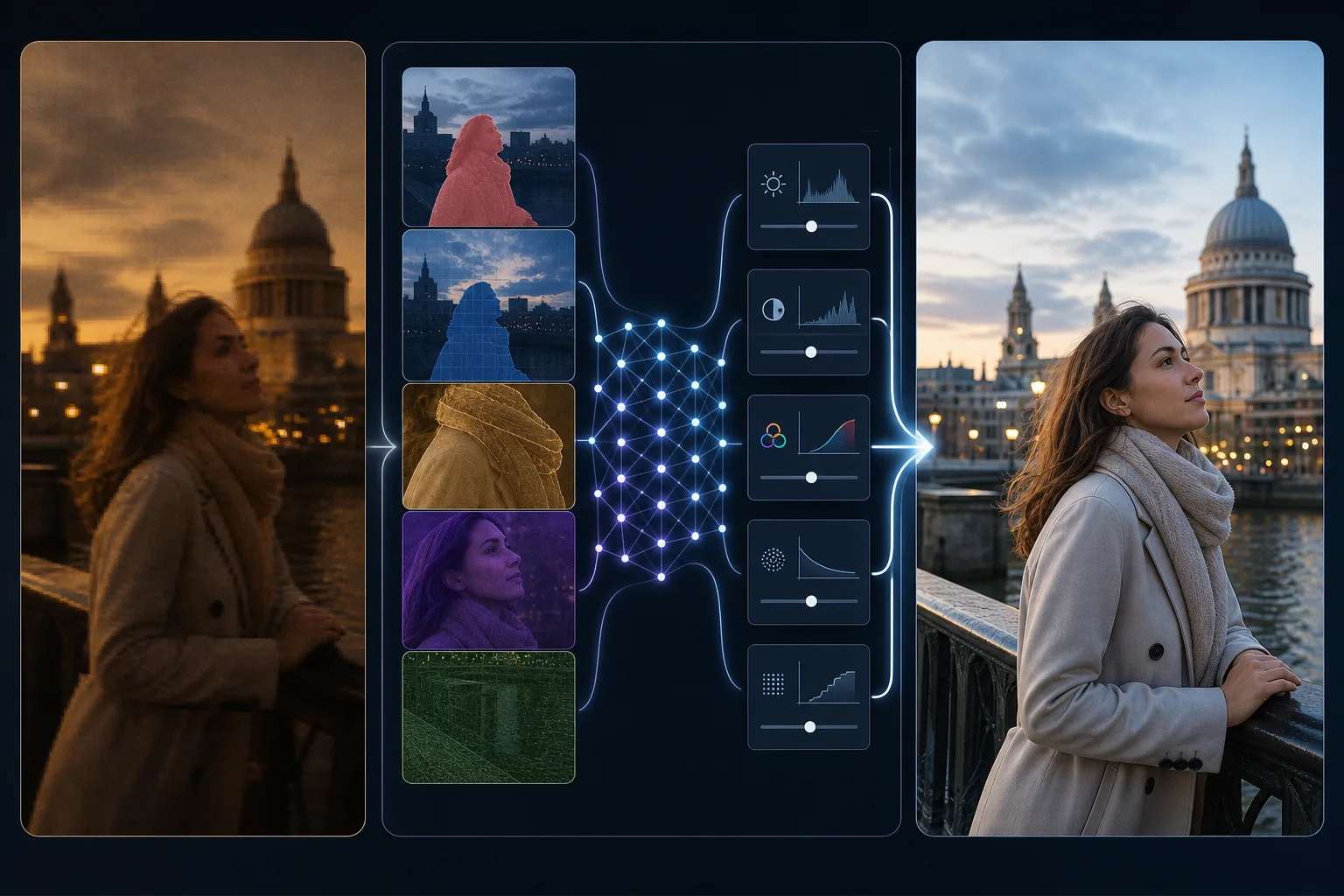
Lesson context before the long read
Review the result preview above, then scan the learning objectives below before reading the full lesson. Updated 2026-05-17.
Example visual uses an existing public asset: /content-images/ai-understanding-enhancement-academy.webp.
Learning Objectives
- 1Understand how neural networks are trained to recognize and correct image quality issues
- 2Identify which types of photo problems AI enhancement handles best and where it has limitations
- 3Recognize the difference between destructive filters and intelligent AI-based corrections
What AI enhancement corrects automatically
AI photo enhancement uses deep learning models trained on millions of image pairs: a degraded version and its high-quality counterpart. During training, the model learns patterns that connect blurry images to sharp ones, underexposed photos to well-lit ones, and low-resolution files to detailed originals. When you run the enhancement tool on your photo, the model applies these learned patterns to predict what the high-quality version of your specific image should look like.
When auto-enhance produces the best results
Unlike traditional filters that apply the same mathematical transformation to every image, AI enhancement adapts to the content of each photo individually. A landscape photo receives different treatment than a close-up portrait because the model understands that sky textures, skin tones, and fabric patterns each require different correction strategies. This context-awareness is what makes AI enhancement produce more natural results than one-size-fits-all adjustment sliders.
Limitations of one-click enhancement
AI enhancement works best on photos that have a clear quality issue like underexposure, moderate blur, or color cast. It is less effective on photos with extreme damage such as severe motion blur across the entire frame or images that are almost entirely black. Understanding these boundaries helps you set realistic expectations and choose the right tool for each editing task. When AI enhancement reaches its limits, combining it with manual adjustments gives you the best of both worlds.
Key Takeaways
- ✓AI models learn image correction patterns from millions of degraded-to-high-quality image pairs
- ✓Unlike static filters, AI adapts its corrections based on the specific content of each photo
- ✓AI enhancement works best on moderate quality issues and can be combined with manual edits for extreme cases