YouTube Thumbnail Editing for Creators
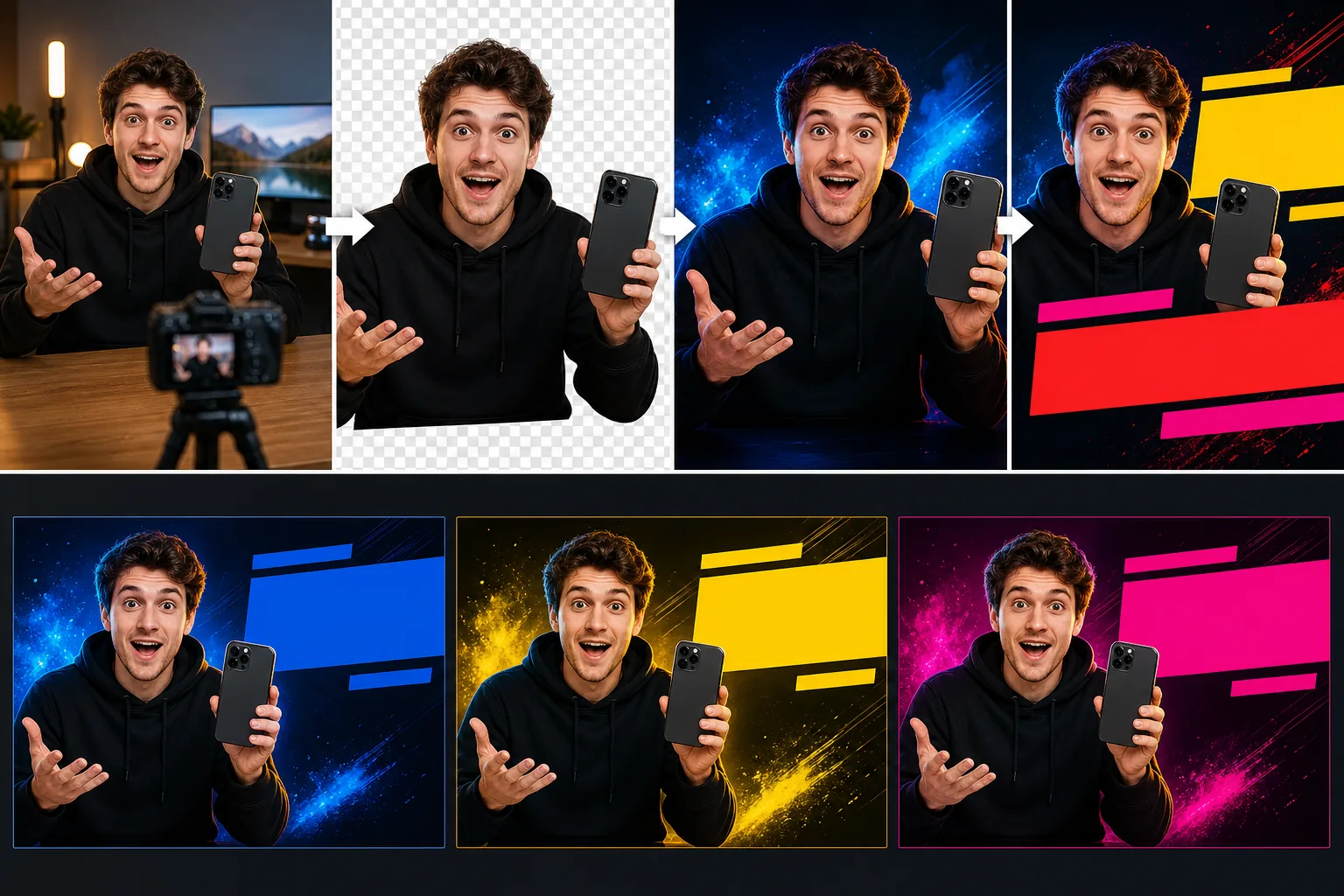
YouTube thumbnails decide 50-70% of the click decision in the first 1-2 seconds of feed exposure. Magic Eraser handles the workflow that lets creators ship higher-CTR thumbnails in 25-40 minutes per video: subject isolation via Background Eraser, dark-mode-feed color contrast via AI Filter, clean text-overlay surfaces via AI Fill, and 2-3 distinct variants ready for YouTube's native Test & Compare in under 30 minutes.
지금 사용해보기Thumbnails take 30-60 minutes per video in Photoshop
Traditional thumbnail design in Photoshop or Affinity Photo is 30-60 minutes per thumbnail just for the initial design, plus another 20-30 minutes per variant if you want to A/B test. For a channel shipping 2-3 videos a week, that's 3-6 hours per week on thumbnail design alone — the single largest non-editing time sink for most growth-stage channels.
Phone selfie base photos kill CTR before the design starts
Most thumbnail bases start as phone selfies where the eyes are looking at the screen (not the lens), the hands are out of frame (holding the phone), and there's no scale reference. These three issues violate the subject-framing rules that have predicted high-CTR thumbnails since 2015. No amount of editing recovers a base photo that breaks all three; the result is a thumbnail that looks finished but underperforms by 30-50% versus a properly-shot base.
Thumbnails disappear in YouTube's dark-mode feed
Dark mode adoption on YouTube reached ~60% of viewing sessions in 2026. Thumbnails using muted colors, dark-grey backgrounds, or sophisticated low-saturation palettes simply disappear into the feed background and lose impressions before the viewer even sees them. The fix is high-saturation primary colors (yellow / orange / red / magenta / electric blue / lime), but pushing saturation that hard in traditional editors requires fiddling with curves and HSL panels for 10-15 minutes per thumbnail.
Text overlays kill readability at mobile feed scale
The thumbnail editor view is 1280×720, but the mobile feed view is 320×180. Text that looks elegant at the editor scale becomes unreadable at the feed scale — too small, too thin, too many words. The 3-5 word maximum and 80-100 pixel minimum size at 1280×720 are non-negotiable for mobile feed performance, but it's hard to evaluate them in the editor without exporting and previewing on a phone every time.
사용 방법
Shoot a base photo that follows the subject-framing rules
Before opening any editor, get the base photo right: direct eye contact (with the camera lens, not the screen), visible hands or arms in frame implying action, and a clear scale reference so the viewer's brain understands what's in the frame in under 1 second. Use a phone tripod or a stable surface with a 5-second timer; no amount of AI editing recovers a base photo that breaks these rules.
Isolate the subject with Background Eraser
Upload the base photo to Background Eraser. The tool isolates the subject in 15-30 seconds with edge precision that matches a 15-minute manual masking pass in Photoshop. The replacement background should be a solid color block, a simple gradient, or a single thematic element — never a competing focal point that pulls attention away from the subject.
Color-grade for dark-mode-feed contrast with AI Filter
Run AI Filter with saturation pushed +30-50% above the natural photo, ambient shadow recovery dialed back, and contrast increased by +15-20%. The output should look mildly over-saturated when viewed in isolation on a clean monitor — that's correct calibration for the actual viewing environment, where ~60% of viewers are in dark mode and the thumbnail needs to pop against a dark-grey feed.
Add the 3-5 word text overlay with AI Fill cleanup
Lock the text to 3-5 words maximum, sized at least 80-100 pixels tall in the 1280×720 export (which scales to ~20-25 pixels on the mobile feed — still readable, not overwhelming). Use AI Fill to remove distracting background details behind the text so the typography sits on a clean controlled surface. The text-area background should be a solid color block, a simple gradient, or an out-of-focus subject area; anything else creates visual interference at feed scale.
Generate 2-3 distinct variants for YouTube's Test & Compare
Re-run AI Filter with a different color grade (cinematic teal-orange vs warm cozy vs cool sleek vs vintage muted vs high-contrast punchy) and re-run AI Fill with different text-area treatments to produce 2-3 visually distinct variants from the same base photo. Total time: 20-30 minutes for all three variants. Upload them to YouTube Studio's Test & Compare feature and let the platform auto-rotate impressions across them for the recommended 2-week minimum window.
Read Test & Compare results and refresh underperformers on a 14-day cadence
After the test window closes, evaluate the winning variant's CTR against your channel's baseline for similar-topic videos. If it underperforms by 20%+ versus baseline, refresh with a single-variable change (new color palette OR new text overlay OR new subject framing — not all three) and run a fresh Test & Compare round. Channels that refresh underperformers on a 14-day cadence typically recover 10-30% of the original CTR loss over 60-90 days, which translates to 25-100% view-count recovery via the recommendation algorithm's amplification.
자주 묻는 질문
How much faster is AI thumbnail editing vs Photoshop?+
Roughly 5x faster end-to-end. A Photoshop thumbnail design pass typically takes 30-60 minutes for the initial design plus another 20-30 minutes per variant. The AI workflow (Background Eraser + AI Filter + AI Fill) takes 25-40 minutes for 2-3 distinct variants ready for Test & Compare. For a channel shipping 2-3 videos per week, that's the difference between 3-6 hours per week on thumbnails (Photoshop) and 1.0-1.5 hours per week (AI workflow), with the saved time redeploying to actual video content production.
What are the subject framing rules I should follow before editing?+
Three rules that have predicted high-CTR thumbnails from 2015 through 2026: direct eye contact with the camera lens (not the screen), visible hands or arms in frame implying action or motion, and a clear scale reference so the viewer's visual cortex parses the subject instantly. Phone selfies typically violate all three (eyes on screen, hands holding phone, no scale). No amount of AI editing recovers a base photo that breaks these rules — reshoot with a tripod or stable surface and a 5-second timer before starting the design.
Why does dark mode matter so much for thumbnail design?+
Dark mode adoption on YouTube reached ~60% of viewing sessions by 2026. Thumbnails using muted colors or dark-grey backgrounds disappear into the dark-mode feed background; thumbnails using cream or light-grey disappear into the light-mode feed. The empirical fix is high-saturation primary colors (yellow / orange / red / magenta / electric blue / lime) that contrast against both feed environments. The output should look slightly over-saturated when viewed in isolation on a clean monitor — that's correct calibration for actual feed viewing, not a mistake.
How many words should be on a YouTube thumbnail?+
3-5 words maximum. Past 5 words, the average viewer treats the entire text block as visual clutter and skips reading it entirely, so the text becomes negative-value rather than positive-value. The text should be readable in 1 second at the 320-pixel mobile feed scale, which means the largest text should be at least 80-100 pixels tall in the 1280×720 export (scaling to ~20-25 pixels on mobile — readable but not overwhelming). AI Fill removes distracting background details behind the text so the typography stays on a clean controlled surface.
What is YouTube's Test & Compare and how should I use it?+
YouTube Studio's Test & Compare feature (rolled out in 2024 and matured through 2025-2026) lets creators ship up to 3 thumbnail variants per video and have YouTube auto-rotate them across feed impressions to identify the highest-CTR variant. The discipline: ship 2-3 visually distinct directions per video (different color palette OR different subject framing OR different text overlay — not micro-variations like 'slightly larger text'), respect the platform's 2-week minimum test window even when day 3-5 looks conclusive, and read the winning variant's CTR against your channel's baseline for similar topic videos.
How often should I refresh underperforming thumbnails?+
Run a Test & Compare round every 14 days on videos that underperform the channel baseline by 20%+. The refresh isn't a complete redesign — it's a single-variable change (new color palette OR new text overlay OR new subject framing) so the next round produces interpretable data. Channels that refresh underperformers on this cadence typically recover 10-30% of the original CTR loss over 60-90 days as the YouTube recommendation algorithm re-evaluates the video's signal, which translates to 25-100% view-count recovery via algorithm amplification — the compounding view delta is far larger than the raw CTR delta would suggest.
Does this workflow work for any video category?+
Yes, with one category exception. The high-saturation color discipline applies to most categories (gaming, tech, education, lifestyle, business, fitness, etc.) where viewers expect vibrant thumbnails. Music, ASMR, and slow-living channels are the exception — viewers searching these categories actively filter against high-saturation thumbnails because they read as 'wrong category.' For these channels, the workflow inverts: stay muted overall, but use a single high-saturation accent (a small high-saturation element) to give the pre-conscious filter something to lock onto. The subject framing rules and text discipline apply to every category without exception.
관련 사용 사례
전문가들이 실제 워크플로에서 이러한 도구를 어떻게 활용하는지 확인하세요.
개인 물품, 주차된 차량, 공사 장비가 잔뜩 찍힌 매물 사진은 매수자의 관심을 떨어뜨립니다. Magic Eraser는 AI로 매물 사진을 즉시 깔끔하게 만들어 줍니다 — 포토샵 기술 불필요.
지저분한 배경과 정리되지 않은 상품 사진은 매일 매출을 갉아먹습니다. Magic Eraser로 몇 초 만에 프로 수준의 상품 이미지를 만들 수 있습니다. 포토샵 실력이 필요 없습니다. 업로드하고, 불필요한 부분을 지우고, 바로 등록하세요.
여행 사진에 모르는 사람이 찍혔나요? 셀카 배경이 지저분한가요? 포토샵으로 몇 시간씩 낭비하지 마세요. Magic Eraser는 불필요한 요소를 제거하고, 배경을 정리하고, 모든 플랫폼 포맷에 맞게 사진을 확장합니다 — 탭 한 번이면 끝.
여권 및 비자 사무소는 매일 수천 장의 사진을 배경 불량으로 반려합니다. Magic Eraser는 모든 배경을 제거하고 흰색, 밝은 회색 또는 파란색 등 필요한 색상으로 몇 초 만에 교체합니다.
캡션이 가득한 스크린샷, 날짜가 찍힌 오래된 사진, 텍스트로 덮인 이미지로 고민이신가요? Magic Eraser의 AI 텍스트 제거 도구가 불필요한 텍스트를 지우고 배경을 자연스럽게 복원하여 깨끗하고 전문적인 사진으로 만들어 드립니다.
눈길을 사로잡는 콜라주, 배너, 전단지가 필요하지만 디자이너를 고용할 예산도, 포토샵을 배울 시간도 없으신가요? Magic Eraser의 레이아웃 도구, AI 배경 생성, 원클릭 누끼 기능으로 몇 분 만에 스크롤을 멈추게 하는 마케팅 비주얼을 만들 수 있습니다.
경쟁사와 똑같은 스톡 사진에 지치셨나요? 매 게시물마다 디자이너에게 수십만 원을 쓰지 마세요. AI Create가 간단한 텍스트 프롬프트로 독창적인 일러스트, 아트워크, 비주얼을 생성하고 — AI Filter와 AI Enhance가 완벽하게 다듬어줍니다. 매일, 모든 플랫폼에 맞는 유니크한 브랜드 콘텐츠.
Wedding photos deserve perfection, but manual retouching takes hours. Magic Eraser helps photographers and couples remove distracting elements, clean backgrounds, and enhance details so every shot looks its best.
Yearbook photos need consistent backgrounds, even lighting, and clean portraits. Magic Eraser helps schools, studios, and parents get professional-looking results without expensive retouching workflows.
Vehicle listings with clean, professional photos sell faster. Magic Eraser helps dealers, private sellers, and automotive marketers remove background clutter, fix reflections, and enhance car images without a photo studio.
Great food photos drive orders and engagement, but messy tables, utensils, and background clutter ruin the shot. Magic Eraser helps restaurants, food bloggers, and delivery platforms clean up food images fast.
A clean, professional headshot matters for LinkedIn profiles, team pages, and corporate directories. Magic Eraser helps individuals and companies produce polished portraits without a studio reshoot.
Pet photos rarely come out the way you want. The dog moves, the cat is half in shadow, the background is full of clutter. Magic Eraser handles all of that in seconds — background swaps, leash removal, blur cleanup, sharper fur — without manual masking or expensive software.
Empty listings sit on the market longer because buyers struggle to visualize the space. Virtual staging with AI fills the rooms with furniture in the style your buyer wants — modern, transitional, coastal, traditional — in minutes per room instead of days. Magic Eraser handles the pre-staging cleanup (paint touch-ups, painter's tape, debris) and the post-staging polish (lighting refinement, edge cleanup).
Dish photos move delivery and dine-in revenue more than menu copy ever will. Magic Eraser turns phone-shot food photos into delivery-platform-ready images: clean the cluttered table, enhance the dish, swap to a brand-consistent background, and export to DoorDash, Uber Eats, Yelp, and Instagram specs without a food photographer.
Travel photos are the most-edited and most-shared images on most cameras — and the hardest to fix manually. Crowds at every landmark, harsh midday sun, lens glare from phone cameras pressed against bus windows, dim interiors, and decades-old film scans that finally need restoration. Magic Eraser handles every common travel-photo failure mode in seconds, on the same phone you took the photo with.
Pinterest is a visual search engine, not a social feed — pins keep earning impressions for 6-18 months on evergreens and 2-5 years on seasonal evergreens like holiday recipes and gift guides. That long-tail traffic only compounds if every pin is built for the 2:3 vertical canvas at 1000×1500 displayed at ~320px on mobile (85%+ of Pinterest traffic). Magic Eraser's AI tools turn a landscape source photo library into pin-ready vertical compositions in 2-3 minutes per pin instead of 20-40 minutes in Photoshop.
Online course businesses live or die by their visual production quality. The sales-page hero photo, the instructor headshot in the bio section, the in-lesson screenshots, the social-promo carousels driving traffic to the sales page, and the email-newsletter inline imagery in the launch sequence — every one of those surfaces directly affects conversion, completion, and refund rates. Magic Eraser handles the full course-creator image workflow without a designer on staff, on the same laptop or phone you record courses with.
Podcasting is a uniquely visual-poor medium that lives or dies by its visual surfaces. The cover art is the most-viewed surface of every podcast brand, displayed at 56-100px in feed where new listeners decide whether to tap in under a second. The supporting graphic set per episode (Instagram squares, Stories, TikTok, YouTube audiogram covers, email-newsletter inline imagery) is where the show's growth happens between episodes. Magic Eraser handles the full podcaster visual stack — 3000×3000 cover art, host-portrait libraries, per-episode guest graphics, per-season AI refreshes, supporting graphic sets — without a designer on staff, on the laptop or phone you record episodes with.
Indie authors compete with traditional publishing on Amazon's discovery surface where the same algorithms, the same readers, and the same 100-150px mobile-thumbnail decision window apply equally to both. The difference is the production budget — traditional publishers have in-house art departments and marketing teams; indie authors have to handle covers, author headshots, BookTok and Instagram promo, A+ Content modules, and series-consistent visual identity themselves. Magic Eraser preps the full self-published author visual stack — book covers that survive the thumbnail render, author headshots for back covers and bios, social-promo across BookTok / Instagram / Pinterest, Amazon A+ Content modules, and series-consistent presets across 3-12 books — in minutes per asset instead of $400-1500 of designer time per book.
Newsletter writing in 2026 is platform-fragmented across Substack (35M+ subscribers), beehiiv, ConvertKit, Ghost, and Beehiiv-adjacent indie tools — and the visual surfaces have multiplied with each platform's discovery features (Substack Notes, beehiiv Boost, Ghost's recommendation network). Newsletter writers need post hero images that survive every platform's render pipeline, author photos that work across bylines and email signatures, microblog imagery for the discovery-driving feed surfaces, and email-newsletter inline graphics that render across Gmail / Apple Mail / Outlook. Magic Eraser preps the full newsletter visual stack — phone-to-publish in minutes per asset — without a designer on staff.
Dental practices rely on visual proof more than almost any other healthcare vertical — prospective patients evaluate smile transformations, office environment, and team professionalism before ever calling the front desk. The challenge is that clinical photography happens under operatory lighting with clamps, bibs, cheek retractors, and background clutter that undermines the professional impression the photo needs to convey. Magic Eraser cleans up clinical before-and-after shots, standardizes team headshots against consistent backgrounds, and prepares office interior photos for Google Business Profile, social media, and website use — all while keeping the dental team focused on patient care rather than photo production.
Insurance claims live and die on photographic evidence — adjusters, underwriters, and claims examiners make coverage and settlement decisions based on photos that were often taken in poor lighting, at awkward angles, with smartphones, by stressed policyholders moments after a loss event. The gap between what the damage actually looks like and what the claims photo conveys is a direct source of disputes, delays, and underpayments. Magic Eraser and AI Enhance bridge that gap by improving photo clarity, removing irrelevant visual distractions, and ensuring damage details are visible enough to support accurate assessment without altering the evidentiary content of the image.
Cultural institutions worldwide are racing to digitize fragile photograph collections before physical deterioration makes them unrecoverable — but raw scans of century-old prints arrive with fading, foxing, tears, stains, scratches, and color shifts that make them unsuitable for public-facing digital collections, educational materials, or exhibition displays. The traditional restoration workflow requires a trained conservator spending 30-90 minutes per image in Photoshop, which makes large-scale digitization projects cost-prohibitive. AI Enhance and Magic Eraser reduce per-image restoration time to 2-5 minutes, making it practical to process collections of thousands of photographs within realistic institutional budgets and timelines.
Fashion influencers operate in a visual-first economy where feed consistency, photo quality, and content volume directly determine brand-partnership rates, follower growth, and affiliate revenue. The production reality is that most outfit shoots happen in bedrooms, parking lots, coffee shops, and hotel lobbies — not studios — and the gap between where the photo was taken and where it needs to look like it was taken is the core editing challenge. Background Eraser, AI Filter, and AI Enhance transform location-constrained outfit photos into feed-consistent, brand-ready content at the volume Instagram's algorithm and brand partners demand.
An interior designer's portfolio is the primary sales tool for landing new clients — prospective homeowners and commercial clients evaluate design sensibility, style range, and attention to detail entirely through project photography. The challenge is that completed projects are photographed in occupied spaces where client belongings, everyday clutter, power cords, and personal items compete with the design work for visual attention. Magic Eraser removes the distractions that undermine design photography, AI Enhance corrects the mixed-lighting conditions endemic to interior spaces, and AI Fill extends tight compositions to show the full spatial context of the design.
School yearbook production means processing 300-2,000+ student portraits, 200-500 event and activity photos, and dozens of candid shots into a cohesive publication — typically managed by a yearbook advisor and a student committee working on a compressed timeline with limited editing skills and no professional photo-production budget. The biggest visual challenge is consistency: portrait photos arrive from picture day with varying background quality, event photos are shot by student photographers in gymnasium lighting, and candids include background clutter that distracts from the moment being captured. Background Eraser, AI Enhance, and Magic Eraser make it possible to produce a professionally consistent yearbook without professional editing skills or budget.
Nonprofits compete for donor attention in the same visual channels as brands with six-figure marketing budgets — Instagram, email, direct mail, and event presentations. The photos that drive donations are the ones that show impact clearly and emotionally: the community garden thriving, the after-school program in action, the families served by the food bank. But most nonprofits capture these moments with volunteers' smartphones in unglamorous settings, and the resulting photos need significant cleanup before they're suitable for donor-facing communications. Background Eraser, AI Enhance, and design tools bridge the gap between volunteer-captured reality and donor-ready visual storytelling without requiring a graphic designer on staff.
Transformation photos are the single most persuasive marketing asset a personal trainer or fitness coach has — prospective clients make enrollment decisions based on visual proof that the training program delivers real results for real people. The challenge is that before photos are typically taken with a smartphone in a gym locker room or home bathroom with poor lighting, cluttered backgrounds, and no attention to composition, while after photos are taken weeks or months later in a different location with different lighting. The inconsistency between before and after conditions makes it harder for viewers to evaluate the actual physical transformation. AI Enhance and Magic Eraser standardize lighting, backgrounds, and clarity so the before-and-after comparison communicates the real results without visual noise.
A tattoo artist's portfolio is the primary factor clients use when choosing an artist — prospective clients scroll through Instagram feeds and portfolio websites evaluating line quality, color saturation, shading technique, and style fit before they ever contact the shop. The gap between the tattoo's actual quality and what the portfolio photo conveys costs artists bookings every day. Studio lighting creates glare on fresh ink and skin, smartphone cameras soften the fine line detail that distinguishes skilled work, and studio backgrounds with equipment, ink bottles, and supply clutter distract from the artwork. AI Enhance and Magic Eraser close this gap so the portfolio photo represents the tattoo's actual quality.
Documenting a classic car restoration from disassembly through completion serves three critical purposes: proving the scope and quality of work to the owner or future buyer, building the build-thread content that attracts new restoration commissions, and satisfying the photographic-evidence requirements for concours judging and marque-club certifications. The challenge is that restoration shops are optimized for metalwork and paint, not photography — the lighting is industrial, the backgrounds are cluttered with parts, tools, and other projects, and the person capturing the photos is usually the restorer between work steps rather than a photographer. AI Enhance and Magic Eraser transform shop-floor documentation captures into presentation-quality photos that serve all three purposes.
Construction progress photography serves multiple critical functions simultaneously — client update reports, lender draw-request documentation, subcontractor coordination records, dispute resolution evidence, code-inspection support, and the firm's portfolio marketing. The photos are captured by project managers and superintendents on smartphones during site walks, in conditions optimized for building rather than photography: dust, scaffolding, temporary lighting, weather exposure, and the constant visual clutter of an active construction site. Magic Eraser and AI Enhance transform these site-walk captures into documentation that communicates clearly to every audience — clients, lenders, inspectors, attorneys, and prospective customers — without requiring a photographer on the project budget.
Jewelry is one of the most photographically demanding product categories — customers purchasing a $200 ring or a $5,000 necklace online are making the decision almost entirely from photos, and they expect to see the precise color of the gemstone, the quality of the metalwork, the clasp mechanism, and the scale on a human hand or neck. The technical challenge is that jewelry is small, reflective, and transparent in ways that confuse smartphone cameras and even entry-level DSLRs: gemstones refract light unpredictably, polished metal reflects everything in the environment, and the scale demands macro-level sharpness that consumer cameras struggle to deliver. Background Eraser, AI Enhance, and Magic Eraser solve the three core jewelry-photography problems — background consistency, detail sharpness, and reflection cleanup — so independent jewelers and Etsy sellers can produce catalog-quality product photos without a dedicated studio.
Online plant sales have grown into a multi-billion-dollar category, and nurseries competing for orders on their own e-commerce sites, Etsy, Amazon, and wholesale platforms need product photos that accurately represent foliage color, plant health, and specimen size — the three attributes customers evaluate when deciding whether to pay $12 for a 4-inch pot or $85 for a specimen-size plant. The photography challenge is that plants are photographed in greenhouse environments with filtered light, surrounded by hundreds of other plants competing for visual attention, and the foliage color that defines a cultivar's appeal shifts dramatically under different light temperatures. Background Eraser and AI Enhance produce the clean, color-accurate catalog photography that drives online plant sales without requiring a photo studio separate from the growing operation.
Family photographs are often the most emotionally significant artifacts in a genealogy research project — they put faces to the names on census records, give physical context to the immigration stories, and connect living family members to ancestors they never met. But the physical photographs that carry this connection are deteriorating in shoeboxes, albums with acid-adhesive pages, and envelopes passed between relatives over decades. Fading, water damage, foxing, torn edges, and surface scratches make many of these photos difficult to share in their current condition. AI Enhance and Magic Eraser restore scanned family photos to a quality that can be shared with relatives, published in family history books, displayed at reunions, and preserved digitally for generations that will never see the physical originals.
Event photographers face a unique production bottleneck: hundreds to thousands of images captured in a single session under mixed lighting, crowded venues, and unpredictable conditions — all due for delivery within 24-72 hours. The margin between a profitable event photography business and an unsustainable one lives in post-production speed. Magic Eraser handles the repetitive cleanup work — removing photobombers, exit signs, stray cables, and branded clutter from venue backgrounds — so you can focus on color grading and creative selects instead of pixel-level retouching.
Property managers are not photographers — but they photograph more frequently than most professionals. Every unit turn requires listing photos, every move-in and move-out needs inspection documentation, every maintenance issue demands visual evidence, and every owner report benefits from property-condition imagery. Across a portfolio of 20-200 units, that is thousands of photos per year captured on phone cameras under fluorescent lighting in occupied or half-turned units. Magic Eraser transforms phone-camera property photos into listing-ready imagery and clear maintenance documentation without hiring photographers for routine work.
Sports photography demands technical precision under the worst possible conditions — fast-moving subjects under stadium mixed lighting, shooting through chain-link fences and safety netting, capturing peak action moments at 1/1000s+ shutter speeds that force high ISO and thin depth of field. The captures that survive the cull often need significant post-production: fence removal, noise reduction from high-ISO shooting, distraction cleanup from sideline clutter, and enhancement to recover detail the camera sacrificed for shutter speed. Magic Eraser and AI Enhance handle these sports-specific post-production challenges so the final images match the intensity of the moment captured.
Veterinary practices live and die by trust — pet owners choose their vet based on perceived warmth, competence, and genuine care for animals. The visual communication of that trust happens through the practice's website, social media, and Google Business Profile, where photos of happy patients, caring staff, and a clean welcoming facility signal everything words cannot. The problem is that veterinary clinics are clinical environments: stainless steel tables, medical equipment, fluorescent overhead lighting, and animals that are often anxious or restrained. Magic Eraser's Background Eraser and AI Enhance transform clinical snapshots into the warm, approachable imagery that builds the trust pet owners are looking for.
Antique dealers move inventory constantly — acquiring at estate sales, auctions, and picker networks, then listing across multiple platforms (eBay, Ruby Lane, Etsy, 1stDibs, Chairish, LiveAuctioneers, their own website) with photos that must communicate condition, provenance quality, and value. The photography challenge is unique: items are photographed in cluttered booths, packed storage units, and show floors where isolating a single item visually is nearly impossible without a dedicated studio setup most dealers do not have. Magic Eraser's toolset handles the antique dealer's specific photo challenges — isolating items from cluttered backgrounds, enhancing detail in patina and maker's marks, and removing price tags and display clutter for clean catalog presentation.
Daycare centers and preschools take more photos than almost any other small business — daily activity documentation for parents, enrollment marketing for their website and social media, seasonal event documentation, and milestone celebrations. The challenge is that classrooms are visually chaotic environments: primary-colored furniture, cluttered art stations, snack remnants, cubbies overflowing with backpacks, and other children who may not have photo release permission in the background. Background Eraser creates clean, warm compositions that focus on the activity and the child, while AI Enhance corrects the fluorescent classroom lighting that makes every phone photo look institutional.
For hair stylists and colorists, the portfolio is the primary client-acquisition tool. New clients choose their stylist based on Instagram galleries, Google Business Profile photos, and the salon's website portfolio. The quality of these photos directly determines whether a potential client books a $150-$400 color appointment or scrolls past. The problem is that salon environments — mirrors reflecting the photographer, mixed warm and cool lighting that shifts color perception, cluttered station backgrounds, and other clients in frame — fight against accurate color representation at every turn. Magic Eraser's toolset solves the specific visual challenges that prevent salon photos from showcasing the actual quality of the work.
Landscape contractors sell their next project based on photos of their last one. Homeowners evaluating contractors compare portfolio images side by side — the contractor whose patio installation, retaining wall, or planting design looks cleanest and most professional in photos wins the bid, often regardless of price difference. The challenge is that landscape work is photographed on active job sites and in real neighborhoods where construction debris, neighbor clutter, parked cars, trash cans, garden hoses, and utility boxes all compete for attention in the frame. Magic Eraser removes the real-world distractions that undermine portfolio presentation, while AI Enhance compensates for overcast skies and harsh midday shadows that flatten the dimensionality of hardscape and planting work.
On dating apps, the profile photo is evaluated in 1-3 seconds during a swipe. The lighting, sharpness, composition, and background quality of the photo influence the swipe decision as much as physical attractiveness — a well-lit, clear photo with a clean background consistently outperforms a better-looking person photographed poorly. The problem is that most people do not have a library of high-quality solo photos with clean backgrounds and flattering lighting. They have group shots where they need to be isolated, photos with exes who need to be removed, and dimly-lit bar or restaurant photos that are their only recent full-body shots. Magic Eraser's toolset handles these specific dating-photo challenges without creating misleading or catfish-level alterations.
When a family is preparing for a funeral or memorial service, the search for the right photos happens under the worst possible emotional and time conditions. The ideal portrait — the one that captures the person as their family wants to remember them — is often a decades-old print, a faded snapshot from a family gathering, or the only good photo from a period when the person was healthy and vibrant. These source photos frequently need significant restoration: fading, color shifts, physical damage, and low resolution from the era they were captured. AI Enhance restores memorial photos with the dignity and care the moment requires, while Magic Eraser removes unwanted elements to create the portrait the family envisions.
Resale is a volume business — successful Poshmark, Depop, Mercari, and eBay clothing sellers list 20-100+ items per week, each requiring 4-8 photos that compete against both other resellers and brand-direct retail listings. The visual gap between a reseller's bedroom flat-lay and a brand's studio product shot is the gap between a quick scroll-past and a sale. Background Eraser and Magic Eraser close that gap at the speed and scale resale economics demand, turning phone photos of thrift-sourced inventory into marketplace-competitive product listings without a studio, a lightbox, or per-item editing time that would destroy the margin on a $15 shirt.
Handmade sellers compete against mass-produced alternatives on visual presentation — and the price premium of handcrafted work only holds when the product photos communicate the material quality, craftsmanship detail, and tactile appeal that distinguish a $45 handmade ceramic mug from a $12 factory version. Most makers photograph their work on kitchen tables, workshop benches, or craft-fair booth surfaces using phone cameras that flatten texture and lose the material detail that justifies the price. Background Eraser creates clean, professional product presentations, while AI Enhance reveals the wood grain, fiber texture, glaze variation, and handmade character that makes the work worth the premium.
Musicians and bands need a constant supply of visual assets — electronic press kit photos for venue and festival submissions, social media content to maintain audience engagement between releases, gig posters and flyers for upcoming shows, and merchandise designs for an increasingly important revenue stream. Professional photo shoots cost $300-$1,500 per session, and the results age quickly as lineups change, looks evolve, and the visual identity needs refreshing for each release cycle. Background Eraser isolates band and artist photos from venue and rehearsal-space clutter. AI Filter applies stylized treatments that establish visual identity. AI Enhance recovers detail from low-light live performance captures. Together, they maintain a professional visual presence on the budget reality of working musicians.
관련 비교
Magic Eraser와 유사한 도구의 비교를 확인하세요.
TouchRetouch는 객체 및 결점 제거에 특화된 인기 유료 모바일 앱입니다. Magic Eraser는 설치 없이 모든 기기에서 무료 AI 편집을 제공합니다. 기능, 가격, 사용 편의성을 비교해 보세요.
Cleanup.pictures는 빠른 객체 제거를 위한 무료 웹 도구입니다. Magic Eraser는 8가지 AI 편집 도구, 모바일 앱, 고급 처리 기능을 제공합니다. 두 도구를 비교해 보세요.
remove.bg는 강력한 API와 Photoshop, Figma 플러그인을 제공하는 배경 제거 시장 리더입니다. Magic Eraser는 객체 제거, 생성 채우기, AI 향상, 디자인 등 8가지 AI 도구를 하나의 편집기에서 제공합니다.
서로 다른 강점을 가진 두 가지 강력한 AI 사진 편집기. Magic Eraser는 더 넓은 범위의 생성형 AI 도구를 제공하고, Photoroom은 이커머스 상품 사진과 일괄 처리에 뛰어납니다. 어떤 것이 내 워크플로우에 맞는지 확인해 보세요.
관련 가이드
이 워크플로와 관련된 더 많은 가이드와 에디토리얼 콘텐츠를 확인하세요.