
Como Criar um Efeito Tunbridge Ware com AI Photo Editing — Magic Eraser
Tutorial passo a passo para criar o efeito de mosaico de madeira com grão final (end-grain) Tunbridge ware usando AI photo editing. Transforme fotografias no característico estilo mosaico pixelizado desta histórica arte decorativa inglesa em madeira.

Product Marketing
Revisado por Magic Eraser Editorial ·
Índice
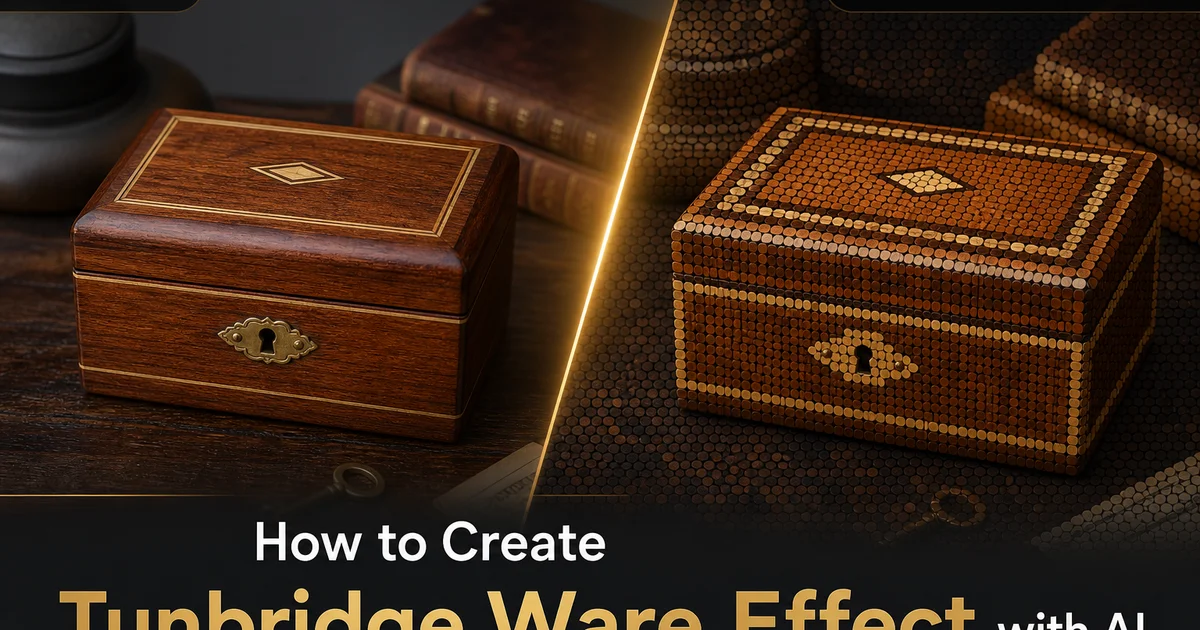
O Tunbridge ware é uma das mais notáveis tradições de marcenaria decorativa já desenvolvidas. Uma forma de mosaico de madeira com grão final originária da área de Tunbridge Wells em Kent, Inglaterra, que atingiu seu auge de sofisticação nos séculos XVIII e XIX. A técnica funciona montando finos bastões de madeira naturalmente colorida em feixes cuja seção transversal forma um desenho, depois fatiando o feixe como um pão para produzir folheados finos onde o padrão aparece no grão final dos bastões montados. O resultado é um mosaico feito inteiramente de cores naturais da madeira. Sem corantes, tintas ou stain — onde cada pequeno quadrado na imagem é a seção transversal de um bastão diferente de madeira cuidadosamente selecionada, criando imagens e padrões com um calor e qualidade material que nenhum processo de impressão pode replicar.
A característica visual que torna o Tunbridge ware tão distinto é sua pixelização inerente. Como cada elemento do design é um bastão de madeira separado com seção transversal quadrada ou retangular, a imagem é naturalmente composta de quadrados coloridos discretos dispostos em uma grade. Em seu núcleo está o mesmo princípio de uma tela digital de pixels, mas alcançado através de materiais físicos dois séculos antes da invenção do pixel. Essa estrutura de grade dá às imagens Tunbridge ware sua nitidez característica e qualidade gráfica, com amplas áreas de cor construídas a partir de minúsculos quadrados agregados e detalhes finos resolvidos até o limite do tamanho da seção transversal do bastão. Os melhores Tunbridge ware usavam bastões tão pequenos quanto 1mm de lado, alcançando notável detalhamento pictórico através de meios puramente mecânicos.
As ferramentas de AI photo editing podem simular o efeito Tunbridge ware convertendo fotografias em mosaicos baseados em grade restritos à paleta de cores naturais da madeira que os artesãos tradicionais usavam. O processo envolve pixelização para criar a estrutura da grade, remapeamento de cores para substituir cores sintéticas por tons naturais de madeira. Aplicação de textura para adicionar o caráter do grão final da madeira que faz cada quadrado do mosaico ser lido como um material físico em vez de um pixel colorido. Este guia percorre o processo completo, explicando a história do artesanato que informa cada decisão de design e fornecendo técnicas práticas para alcançar uma aparência autêntica de Tunbridge ware usando ferramentas de AI editing.
- A pixelização converte fotografias de tom estável na grade regular de quadrados coloridos discretos que caracteriza o mosaico de grão final Tunbridge ware, com o tamanho da grade controlando a aparente seção transversal do bastão.
- O remapeamento da paleta de cores restringe todo o espectro cromático aos tons de madeira naturalmente disponíveis. Branco azevinho, vermelho cerejeira, marrom nogueira, amarelo laburno e preto ébano — que definiram o artesanato tradicional.
- AI Enhance adiciona textura de grão final de madeira a cada quadrado do mosaico, transformando pixels coloridos planos em superfícies materiais que mostram anéis de crescimento e padrões de veios específicos de cada espécie de madeira.
- Background Eraser isola os sujeitos da imagem de origem antes da conversão, garantindo que o padrão do mosaico seja construído sobre formas limpas sem desordem ambiental afetando o design final.
- Magic Eraser remove elementos indesejados da imagem de origem antes da conversão do mosaico, pois qualquer detalhe presente na origem será traduzido na grade do mosaico de madeira.
O artesanato do Tunbridge ware: entendendo a técnica por trás do efeito
A produção do Tunbridge ware começa com a seleção da madeira por sua cor natural, não por suas propriedades estruturais. Os artesãos tradicionais do Tunbridge ware — conhecidos como stickware makers — mantinham inventários de dezenas de espécies de madeira escolhidas puramente por suas propriedades cromáticas. Madeiras locais forneciam muitas das cores-chave: azevinho para branco puro, cerejeira para vermelho quente, cerne de teixo para vermelho-marrom escuro, carvalho para marrom dourado, nogueira para marrom escuro e sicômoro para creme. Madeiras importadas e especiais expandiam a paleta: ébano para preto verdadeiro, purpleheart para violeta-púrpura, laburno para amarelo brilhante e lignum vitae para marrom-esverdeado escuro. Tons verdes eram obtidos tratando azevinho com acetato de ferro, um processo químico que era o único desvio da cor puramente natural na tradição do Tunbridge ware.
O processo de montagem é o coração da engenharia do artesanato. Cada bastão de madeira colorida é cortado com seção transversal uniforme. Geralmente quadrada, entre 1mm e 3mm de lado — e exatamente o mesmo comprimento. Esses bastões são então montados lado a lado em um bloco de padrão, seguindo um desenho em papel quadriculado onde cada quadrado da grade representa um bastão. Os bastões são colados formando um feixe rígido cuja seção transversal mostra o design completo. O feixe é então fatiado perpendicularmente aos bastões, como cortar fatias de um pão, com cada fatia sendo um folheado de mosaico completo geralmente com 1-2mm de espessura. Um único feixe montado pode produzir dezenas de folheados de mosaico idênticos, tornando a técnica tanto intensiva em mão de obra na configuração quanto notavelmente eficiente na produção.
As propriedades visuais do mosaico resultante têm características específicas que distinguem o Tunbridge ware de imitações pintadas ou impressas. Como cada quadrado é uma superfície natural de madeira com grão final, ele mostra o padrão de anéis de crescimento de sua espécie específica. Arcos concêntricos apertados em madeiras duras de crescimento lento, padrões mais amplos em espécies mais rápidas e os distintos raios medulares visíveis em alguns carvalhos. A superfície tem uma ligeira textura física da diferente dureza de cada espécie de madeira, fazendo com que se desgastem em ritmos ligeiramente diferentes e criando um micro-relevo que capta a luz de forma irregular. E a cor é uma propriedade da própria madeira em vez de um revestimento de superfície, então tem o calor, a profundidade e a ligeira variação do material natural. Não há dois bastões de azevinho exatamente do mesmo branco, não há dois bastões de nogueira exatamente do mesmo marrom.
- O Tunbridge ware tradicional usava dezenas de espécies de madeira selecionadas puramente pela cor natural — azevinho para branco, cerejeira para vermelho, nogueira para marrom, laburno para amarelo, ébano para preto.
- Bastões cortados com seção transversal uniforme de 1-3mm são montados seguindo um design em papel quadriculado, colados em um feixe e fatiados perpendicularmente para produzir dezenas de folheados de mosaico idênticos.
- Superfícies de grão final mostram padrões de anéis de crescimento únicos para cada espécie de madeira, criando micro-textura que distingue o verdadeiro Tunbridge ware de imitações impressas ou pintadas.
- As cores naturais da madeira têm calor e variação inerentes — não há dois bastões da mesma espécie exatamente idênticos, dando ao Tunbridge ware uma qualidade viva ausente em mídias sintéticas.
Convertendo fotografias para a grade de mosaico Tunbridge ware
O primeiro passo técnico para criar um efeito Tunbridge ware é converter os tons estáveis e gradientes suaves de uma fotografia em uma grade regular de quadrados coloridos discretos. Este processo de pixelização é o equivalente digital do que o artesão Tunbridge ware faz ao traduzir uma pintura ou desenho em uma grade de bastões de madeira. Cada área estável de cor se torna uma coleção de quadrados adjacentes compartilhando os mesmos tons ou similares. O tamanho da grade que você escolhe determina a resolução e escala aparentes do mosaico: grades mais finas com mais quadrados menores produzem imagens mais detalhadas que referenciam os mais refinados Tunbridge ware históricos. Grades mais grossas com menos quadrados maiores criam resultados mais ousados e gráficos que enfatizam a natureza de mosaico do meio.
A seleção da imagem de origem afeta grandemente a qualidade da conversão Tunbridge ware. Imagens que funcionam melhor têm separação clara entre sujeito e fundo, zonas de cor distintas e formas composicionais fortes que permanecem distintas após a pixelização. Os sujeitos tradicionais do Tunbridge ware incluíam paisagens, flores, castelos, borboletas, pássaros e bordas geométricas. Sujeitos escolhidos porque se liam claramente através do meio mosaico. Fotografias com gradientes sutis, texturas finas e detalhes que dependem de alta resolução perderão seu caráter principal quando pixelizadas. Antes de converter, avalie sua imagem de origem semicerrarizando os olhos. As formas e cores que permanecem visíveis através dos olhos semicerrados são o que sobreviverá à conversão em mosaico, e se essas formas não formarem uma imagem distinta ou atraente, escolha uma fonte diferente.
O alinhamento da grade é importante para a qualidade do efeito final. No Tunbridge ware autêntico, todos os bastões estão alinhados na mesma grade retilínea. Não há bastões diagonais, bastões em ângulos irregulares ou variação no tamanho dos bastões dentro de uma única peça. Isso significa que a grade de pixelização deve ser perfeitamente regular: quadrados de igual tamanho em linhas e colunas perfeitamente alinhadas sem rotação ou distorção. Muitas ferramentas de pixelização oferecem opções que inclinam ou randomizam a grade. Estas produzem resultados que parecem efeitos de mosaico genéricos em vez de Tunbridge ware especificamente. A regularidade estrita da grade é uma das características visuais definidoras do meio e deve ser preservada com precisão.
- O tamanho da grade determina a resolução aparente do mosaico — grades mais finas referenciam os Tunbridge ware históricos mais sofisticados, enquanto grades mais grossas criam interpretações gráficas mais ousadas.
- Imagens de origem precisam de formas claras e zonas de cor distintas que permaneçam reconhecíveis após a pixelização — o teste de semicerrar os olhos revela o que sobreviverá à conversão em mosaico.
- Os sujeitos tradicionais do Tunbridge ware incluíam paisagens, flores, castelos, borboletas e bordas geométricas escolhidos especificamente por sua legibilidade através do meio mosaico.
- A regularidade da grade é essencial — linhas e colunas perfeitamente alinhadas de quadrados de igual tamanho sem rotação ou randomização distinguem o efeito Tunbridge ware de filtros de mosaico genéricos.
Mapeamento da paleta de cores da madeira e aplicação de textura de grão final
A etapa de remapeamento da paleta de cores é o que transforma uma fotografia pixelizada em algo que se lê como Tunbridge ware em vez de uma imagem genérica de baixa resolução. O objetivo é substituir as cores arbitrárias da grade pixelizada pela paleta limitada específica de tons naturais de madeira que os artesãos Tunbridge ware usavam historicamente. Essa restrição é tanto uma necessidade técnica para realismo quanto um benefício estético. Os tons de madeira quentes e orgânicos criam uma harmonia visual que as cores sintéticas não conseguem igualar, e a paleta limitada força a imagem a um esquema de cores simplificado que enfatiza composição e forma sobre detalhes fotográficos. Comece definindo sua paleta de madeira com valores de cor específicos amostrados de espécies reais de madeira: azevinho cerca de #F5F0E8, cerejeira #B5453A, nogueira #4A3728, laburno #D4A930, teixo #8B3A2A, carvalho #C4953A, sicômoro #E8DCC8 e ébano #1A1210.
O algoritmo de remapeamento deve encontrar a cor da paleta mais próxima para cada quadrado da grade. Com dois ajustes que melhoram a aparência natural. Primeiro, adicione uma ligeira variação aleatória ao valor de cor de cada quadrado. Mais ou menos alguns pontos percentuais de luminosidade e saturação — para simular a variação natural entre bastões individuais da mesma espécie de madeira. Não há dois pedaços de cerejeira exatamente do mesmo vermelho. Essa variação é parte do que faz o Tunbridge ware parecer um material natural em vez de uma grade impressa. Segundo, permita que o remapeamento use dithering entre quadrados adjacentes quando a cor de origem cai entre duas cores da paleta, misturando quadrados mais claros e mais escuros para criar um tom intermediário da mesma forma que os artesãos Tunbridge ware misturavam espécies de madeira dentro de uma zona de cor para obter efeitos de gradiente.
A aplicação de textura de grão final é o passo final que vende a ilusão material. Cada quadrado da grade no mosaico completo deve mostrar o característico padrão de anéis de crescimento visível quando um bastão de madeira é visto em seção transversal. Esta textura varia por espécie: madeiras duras de crescimento lento mostram arcos de anéis de crescimento apertados, quase concêntricos. Espécies de porosidade anelar como o carvalho mostram os característicos poros grandes do lenho inicial contra o lenho tardio mais denso. E espécies de porosidade difusa como o azevinho mostram uma textura mais uniforme com limites de anéis menos pronunciados. AI Enhance pode sobrepor a textura certa na escala certa para cada quadrado, com a orientação da textura variando aleatoriamente de quadrado para quadrado, já que bastões individuais em um feixe Tunbridge ware seriam cada um orientado por si só. A textura deve ser visível mas sutil. Presente o suficiente para transmitir madeira em vez de cor plana, mas contida o suficiente para não competir com o próprio padrão do mosaico.
- Defina uma paleta de madeira específica com valores amostrados de madeira real — azevinho #F5F0E8, cerejeira #B5453A, nogueira #4A3728, laburno #D4A930, ébano #1A1210 — restringindo a imagem a tons orgânicos.
- A variação aleatória por quadrado de alguns pontos percentuais em luminosidade e saturação simula as diferenças naturais de cor entre bastões individuais da mesma espécie de madeira.
- O dithering entre quadrados adjacentes imita a técnica Tunbridge ware de misturar bastões de madeira mais claros e mais escuros dentro de uma zona para obter tons intermediários e efeitos de gradiente.
- A textura de grão final varia por espécie simulada — arcos apertados para madeira dura de crescimento lento, poros pronunciados para carvalho de porosidade anelar, textura uniforme para azevinho de porosidade difusa — com rotação aleatória por quadrado.
Aplicações criativas e técnicas avançadas do efeito Tunbridge Ware
O efeito Tunbridge ware se traduz poderosamente para fotografia de produtos que têm uma conexão com artesanato, herança ou materiais naturais. Uma tigela de cerâmica feita à mão, uma carteira de couro artesanal ou uma faca de cozinha forjada à mão fotografadas em estilo normal e depois convertidas para a estética de mosaico Tunbridge ware criam uma metáfora visual de artesania que ressoa com consumidores que valorizam qualidade artesanal. O tratamento em mosaico comunica que este é um produto feito com o mesmo cuidado e atenção da tradição de arte decorativa que referencia. Para marcas com posicionamento heritage, imagens de produto com efeito Tunbridge ware criam conteúdo distinto para mídias sociais, ilustrações para embalagens, imagens hero para sites que definem o tom visual de toda a experiência da marca.
Padrões geométricos de borda eram tão importantes quanto centros pictóricos no Tunbridge ware tradicional. Incluir bordas em suas composições digitais fortalece a referência histórica. As bordas clássicas do Tunbridge ware usavam padrões geométricos tessellados: tumbling blocks (uma ilusão de cubo tridimensional), pontas Van Dyke (chevrons em ziguezague), grega e várias grades de diamante e estrela. Esses padrões são bastante simples de construir digitalmente porque seguem regras geométricas estritas dentro da grade retilínea. Construir uma borda Tunbridge ware ao redor de um mosaico pictórico central cria uma composição completa que referencia as caixas decorativas, caddies de chá. Mesas que eram os veículos tradicionais do artesanato, fundamentando o efeito em seu contexto histórico.
A escala e o contexto de exibição afetam o quão convincentemente o efeito Tunbridge ware é lido como material em vez de filtro. Mostrar o mosaico em uma escala onde os quadrados individuais são claramente visíveis. Cerca de 3-5mm na tela — permite que os espectadores percebam a estrutura da grade e a textura da madeira que definem o meio. Colocar a imagem do mosaico em um contexto que referencia aplicações tradicionais do Tunbridge ware. Como painel decorativo na tampa de uma caixa, centro de mesa com borda em uma superfície de mesa ou faixa incrustada ao redor de um objeto de madeira torneado — ativa o reconhecimento material do espectador e faz a imagem digital ser lida como uma fotografia de um objeto físico. Adicionar um leve brilho superficial e sombra que sugere uma superfície de madeira laqueada completa a ilusão material, transformando o que começou como uma fotografia no que parece ser uma peça de madeira decorativa antiga.
- Fotografia de produto convertida em mosaico Tunbridge ware cria metáforas visuais de artesania que ressoam com consumidores conscientes de herança e diferenciam a imagem da marca.
- Bordas geométricas — tumbling blocks, pontas Van Dyke, grega, grades de diamante — fundamentam o mosaico no Tunbridge ware histórico e completam a composição decorativa.
- Escala de exibição de 3-5mm por quadrado da grade permite que os espectadores percebam as seções transversais individuais dos bastões de madeira e a textura de grão final que definem o caráter material do meio.
- Apresentação contextual como painéis decorativos, tampas de caixa ou incrustações em faixa ativa o reconhecimento material e faz o efeito digital ser lido como fotografia de uma obra de madeira física.
How to do it
- 1
Select a source image with clear shapes and defined color regions for the wood mosaic conversion
Choose a photograph whose visual content can be well represented through the rectilinear grid of Tunbridge ware mosaic. Landscapes with distinct sky, foliage, and ground zones work well because the traditional technique excels at rendering broad color areas through aggregated tiny wood squares. Portraits, botanical illustrations, and architectural facades also translate well. Avoid images with fine detail that would be lost at the scale of individual mosaic sticks. Tunbridge ware has an inherent resolution limit determined by the cross-section size of the wood strips, often 1-2mm square, so the source image should read clearly even when simplified to that level of granularity.
- 2
Apply pixelation to simulate the end-grain mosaic grid structure of Tunbridge ware
Use AI editing tools to convert the smooth gradients and steady tones of your photograph into a regular grid of discrete color squares that simulate the look of a Tunbridge ware cross-section. Each square represents one stick of naturally colored wood seen in end grain. The grid should be perfectly regular with consistent square dimensions across the entire image. The pixelation level determines the apparent resolution of the mosaic. Smaller squares suggest finer craftsmanship with thinner wood strips, while larger squares suggest a bolder, more graphic interpretation. Traditional Tunbridge ware often used sticks between 1mm and 2mm square, producing images with remarkable detail considering the purely mechanical medium.
- 3
Map the color palette to natural wood species used in traditional Tunbridge ware
Replace the full color spectrum of the pixelated image with the limited palette of naturally colored woods that Tunbridge ware craftsmen historically used. Traditional workers sourced local and imported timbers for their natural colors: holly for white, cherry and yew for reds, oak and walnut for browns, holly stained with iron acetate for gray-green, laburnum for bright yellow. Ebony or bog oak for black. Use AI color adjustment to remap each pixelated square to the closest matching natural wood tone, constraining the entire image to this organic palette. The warmth and slight irregularity of natural wood tones. Compared to synthetic colors — is what gives the finished effect its distinctive handcrafted character.
- 4
Add end-grain wood texture to each mosaic square using AI Enhance
Apply AI Enhance to overlay subtle end-grain wood texture onto each color square in the mosaic grid. In real Tunbridge ware, every square in the mosaic is the cross-section of a wood stick, so each tiny square shows the growth ring pattern of its specific wood species. Tight concentric rings in slow-grown hardwoods, broader rings in faster-growing species, and the distinctive ray patterns visible in some oaks and beeches. Adding this micro-texture transforms the effect from a simple pixelated image into something that reads as a physical material — wood rather than colored squares. The texture should be subtle enough not to overwhelm the mosaic pattern but visible enough to convey the organic material quality.
- 5
Export the Tunbridge ware effect with optimal settings for the intended application
Save the finished Tunbridge ware effect image with settings optimized for its intended use. For digital display on websites and social media, PNG format preserves the crisp grid lines between mosaic squares without the compression artifacts that JPEG introduces at block boundaries. For print applications such as craft packaging, decorative panels, or stationery, export at 300 DPI or higher in CMYK color space, noting that the natural wood tones reproduce beautifully in print because they fall well within the CMYK gamut. For applications on physical products like phone cases, coasters, or decorative boxes that echo the original Tunbridge ware format, ensure the output resolution is enough for the physical print size.
Fontes
- Tunbridge Ware: The Art of End-Grain Wood Mosaic — Victoria and Albert Museum
- Historic Woodworking Techniques and Material Identification — Worshipful Company of Turners
- Digital Mosaic and Tessellation Techniques for Graphic Design — Adobe Creative Cloud Design Guide