
Como Criar o Efeito Raku Pottery com AI — Magic Eraser
Transforme fotos em arte de cerâmica raku com efeitos de esmalte craquelado, lustre metálico e fumaça de carbono gerados por AI. Guia passo a passo para transferência de estilo autêntico de cerâmica raku a partir de qualquer fotografia.
SEO & Growth
Revisado por Magic Eraser Editorial ·
Índice
- Como a simulação de raku com AI difere das sobreposições genéricas de textura craquelada
- Efeitos de lustre metálico e atmosfera de redução
- Escolhendo a variante raku certa para diferentes assuntos
- Ajustando padrões de craquelê e realismo da textura superficial
- Aplicações criativas: impressões para galeria, mockups de produto e mídia mista
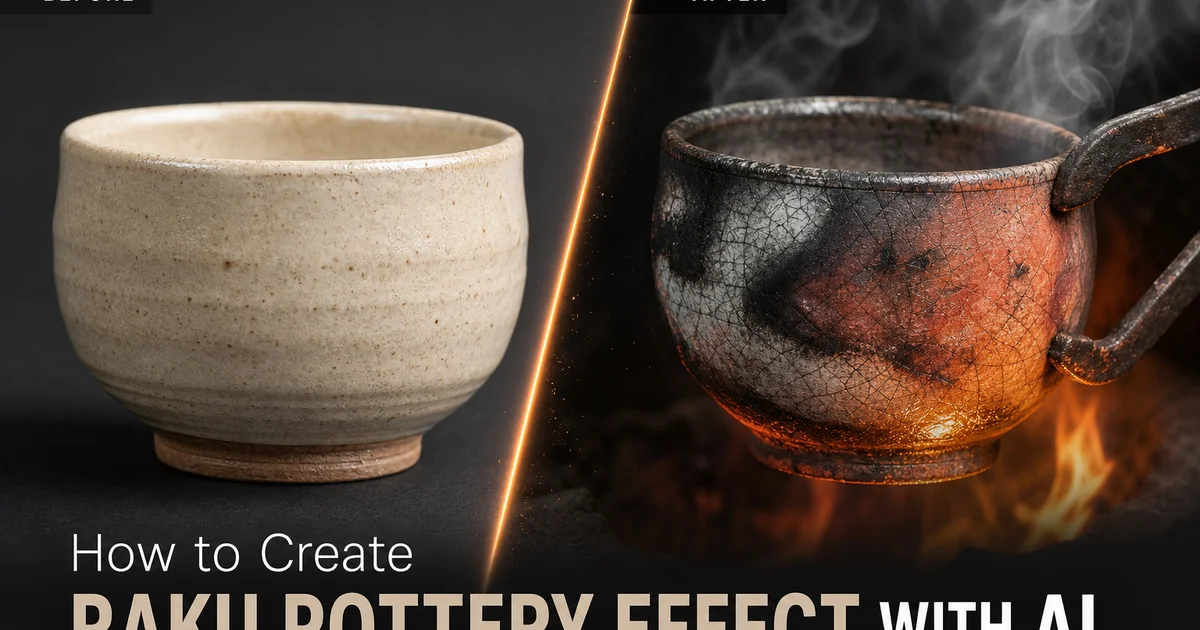
A cerâmica raku é uma das tradições cerâmicas visualmente mais dramáticas do mundo, definida por seus esmaltes craquelados imprevisíveis, superfícies de lustre metálico e efeitos de fumaça de carbono que emergem de um processo de queima japonês centenário adaptado e expandido por ceramistas ocidentais. A técnica raku envolve remover a cerâmica do forno na temperatura máxima e mergulhá-la em material combustível — serragem, jornal, folhas — onde o choque térmico racha o esmalte fundido enquanto a atmosfera de redução retira oxigênio dos compostos metálicos, produzindo os reflexos iridescentes de cobre, ouro e púrpura que tornam as superfícies raku diferentes de qualquer outro acabamento cerâmico. Essa interação entre caos controlado e química dos materiais cria superfícies genuinamente impossíveis de replicar por pintura manual ou esmaltagem convencional. É precisamente isso que torna o raku um alvo tão forte para a transferência de estilo artístico com AI.
Tentativas digitais anteriores de simular efeitos raku dependiam de sobreposições genéricas de textura craquelada e mapas de gradiente metálico aplicados uniformemente em toda a imagem. Essas abordagens falham porque ignoram a física que torna o raku visualmente distinto. Os verdadeiros padrões de craquelê raku não são aleatórios. Eles seguem linhas de tensão determinadas pela geometria da forma, pela espessura da camada de esmalte e pela severidade do choque térmico. O lustre metálico aparece onde o esmalte é mais fino e os gases de redução penetram mais eficazmente — correspondendo a superfícies convexas e bordas, em vez de áreas côncavas. O carbono preto concentra-se nos canais do craquelê onde os gases de combustão infiltram o esmalte fraturado. Qualquer simulação que não leve em conta essas relações físicas produz resultados que parecem uma sobreposição de textura em vez de uma superfície cerâmica real.
A transferência de estilo raku com AI muda isso analisando a estrutura tridimensional da imagem de origem antes de gerar o efeito cerâmico. A AI identifica a curvatura da superfície, a direção da luz e os gradientes tonais, então aplica padrões de craquelê que seguem a geometria de tensão inferida, posiciona o lustre metálico nos realces convexos onde a redução seria mais intensa e concentra a fumaça de carbono nos canais de craquelê rebaixados e áreas de sombra. O resultado é uma transformação raku que respeita a lógica física do processo de queima, produzindo imagens que ceramistas reconhecem como resultados raku plausíveis em vez de filtros digitais genéricos. Este guia mostra como usar AI Filter e AI Enhance para criar efeitos de cerâmica raku que capturam o caos controlado desta extraordinária tradição cerâmica.
- A AI analisa a curvatura da superfície e os gradientes tonais para gerar padrões de craquelê que seguem linhas realistas de tensão térmica, em vez de aplicar sobreposições aleatórias de textura.
- Múltiplos predefinições raku simulam diferentes resultados de queima, incluindo cobre fosco, lustre metálico, preto retido por carbono e técnicas de horsehair raku.
- O posicionamento do lustre metálico responde ao mapeamento de luz e sombra, concentrando efeitos iridescentes cobre-ouro-púrpura nas superfícies convexas onde a redução é mais intensa.
- Os controles de densidade do craquelê variam de fissuras dramáticas esparsas que lembram grés de queima lenta a redes intrincadas e finas características de choque térmico severo.
- AI Enhance aprimora a definição das linhas de craquelê e a microtextura da superfície para produzir a qualidade tridimensional tátil do verdadeiro esmalte cerâmico, em vez de uma sobreposição digital plana.
Como a simulação de raku com AI difere das sobreposições genéricas de textura craquelada
Os filtros genéricos de textura craquelada funcionam sobrepondo um padrão pré-fabricado de linhas em toda a imagem com densidade e orientação uniformes. O craquelê não tem relação com o conteúdo da imagem. O mesmo padrão de linhas cobre um rosto, um fundo e uma área de realce de forma idêntica. Isso imediatamente parece artificial para qualquer pessoa familiarizada com o verdadeiro craquelê cerâmico, porque a verdadeira craquelagem é um fenômeno estrutural que responde à geometria e à física da superfície. Em um vaso esférico, as linhas de craquelê irradiam dos pontos de máxima tensão de curvatura. Em um prato plano, elas formam uma rede bastante uniforme. Em um cilindro, tendem a linhas verticais paralelas porque a tensão é circunferencial. Nenhum padrão de sobreposição único pode capturar essas variações porque o padrão deve responder à forma sob o esmalte.
A simulação de raku com AI começa com estimativa de profundidade e análise de normais de superfície da imagem de origem. A AI infere quais áreas são convexas, côncavas, planas ou curvas e gera padrões de craquelê que respondem à geometria inferida. Áreas convexas recebem craquelê mais denso e irregular porque sofrem o estresse térmico mais severo quando o esmalte quente encontra o ar frio. Áreas côncavas recebem craquelê esparso e mais largo porque a espessura do esmalte acumulado fornece mais massa térmica para resistir à fratura. Áreas planas obtêm uma rede bastante regular porque a tensão se distribui uniformemente. Essa geração sensível à geometria significa que o próprio padrão de craquelê compartilha a forma tridimensional do sujeito, assim como o verdadeiro craquelê raku faz na cerâmica real.
A diferença é mais visível nas zonas de transição onde a curvatura da superfície muda. A borda de uma tigela, o ombro de um vaso, a ponte do nariz em um retrato. Sobreposições genéricas não mostram nenhuma mudança no comportamento do craquelê através dessas transições. A simulação com AI intensifica a densidade do craquelê nas mudanças de curvatura onde o estresse térmico atinge o pico, produzindo o característico agrupamento de linhas finas que os ceramistas chamam de stress crazing. Essa precisão física é o que separa um efeito raku convincente de uma textura digital. O craquelê torna-se informação estrutural em vez de ruído de superfície, contando ao observador sobre a forma sob o esmalte, assim como faz na cerâmica real.
- Sobreposições genéricas de craquelê aplicam padrões uniformes independentemente do conteúdo da imagem — as mesmas linhas cobrem rostos, fundos e realces de forma idêntica.
- A AI começa com estimativa de profundidade e análise de normais de superfície, gerando craquelê que responde à convexidade, concavidade e curvatura inferidas.
- Áreas convexas recebem craquelê denso e irregular devido ao estresse térmico, enquanto áreas côncavas com esmalte acumulado obtêm fraturas esparsas e mais largas, correspondendo à física cerâmica real.
- Zonas de transição nas mudanças de curvatura mostram agrupamento intensificado de craquelê que comunica a forma tridimensional, transformando o craquelê em informação estrutural em vez de ruído de superfície.
Efeitos de lustre metálico e atmosfera de redução
O lustre metálico da cerâmica raku é talvez sua característica visualmente mais marcante e a mais difícil de simular digitalmente porque depende do ângulo de visão, da direção da luz e da estrutura microcristalina dos óxidos metálicos reduzidos na superfície do esmalte. No verdadeiro raku, o óxido de cobre no esmalte reduz-se a cobre elementar durante a redução pós-queima, formando uma fina película metálica que produz reflexos iridescentes variando entre cobre, ouro, magenta e verde-azulado dependendo da espessura da película e da geometria de observação. Este é o mesmo fenômeno óptico que cria as cores em manchas de óleo e bolhas de sabão — interferência de filme fino — e produz cores que não podem ser representadas por um único valor RGB porque mudam com a perspectiva.
A AI imita isso tratando o lustre metálico como um efeito de realce dependente do ângulo de visão, em vez de uma substituição de cor estática. Áreas de realce onde a normal da superfície aponta mais diretamente para a fonte de luz inferida recebem o efeito metálico mais forte, com a cor mudando através do espectro cobre-ouro-magenta com base no ângulo entre a normal da superfície e a direção da luz. Áreas em ângulo rasante — onde a superfície se curva afastando-se do observador — recebem tons metálicos mais frios de verde-azulado e púrpura, replicando a mudança de cor por interferência de filme fino que ocorre em ângulos de visão oblíquos. Áreas de sombra não recebem nenhum tratamento metálico, mostrando em vez disso a superfície fosca preto-carbono que fica abaixo da película metálica em áreas onde a redução foi incompleta.
A atmosfera de redução também produz efeitos distintos de fumaça que aparecem dentro e ao redor da rede de craquelê. Quando a cerâmica entra no material combustível de redução, a fumaça e as partículas de carbono infiltram cada trinca no esmalte, manchando permanentemente o corpo de argila exposto abaixo. A AI replica isso escurecendo o interior dos canais de craquelê com tons quentes preto-carbono que sangram ligeiramente no esmalte circundante, criando a característica rede de linhas escuras sobre superfícies metálicas ou foscas. Nas áreas não esmaltadas, o efeito de fumaça produz padrões irregulares de cinza quente e marrom que seguem a textura da superfície do corpo de argila, distinguindo-se das linhas de craquelê mais nítidas nas superfícies esmaltadas.
- O lustre metálico é tratado como um efeito de realce dependente da visão com mudança de cor através de cobre-ouro-magenta com base na orientação da normal da superfície em relação à fonte de luz.
- Superfícies em ângulo rasante recebem tons mais frios de verde-azulado e púrpura, replicando as mudanças de cor por interferência de filme fino observadas no verdadeiro esmalte de cobre reduzido.
- Áreas de sombra mostram preto-carbono fosco onde a redução foi incompleta, contrastando com o brilho metálico nas superfícies convexas iluminadas.
- Os canais de craquelê recebem uma mancha quente preto-carbono que sangra no esmalte circundante, replicando a infiltração de fumaça característica da redução pós-queima.
Escolhendo a variante raku certa para diferentes assuntos
O raku cobre fosco é a variante mais distinta, apresentando superfícies ricas em cobre-vermelho a bronze, finas redes de craquelê e áreas de preto carbono fosco onde a redução foi incompleta. Este estilo funciona excecionalmente bem para retratos porque os tons quentes de cobre complementam a pele, o padrão de craquelê adiciona interesse visual sem obscurecer as feições e as áreas pretas foscas fornecem contraste dramático nas regiões de sombra. A AI mapeia áreas de realce quente para acabamento metálico cobre-bronze e áreas de sombra fria para preto carbono fosco, criando uma separação tonal que enfatiza a modelagem tridimensional de rostos e formas.
O raku de carbono retido inverte a paleta típica do raku, produzindo superfícies craqueladas brancas ou cinza claro onde a fumaça de carbono foi retida sob um esmalte transparente ou translúcido. O resultado é uma rede de linhas de craquelê escuras sobre um fundo claro, lembrando porcelana envelhecida ou mármore. Esta variante é particularmente eficaz para assuntos arquitetônicos e naturezas-mortas onde a fina rede de linhas escuras enfatiza a estrutura geométrica e o detalhe superficial sem a intensidade visual do lustre metálico. A AI ajusta a cor das linhas de craquelê para um cinza-marrom quente e torna a superfície do esmalte circundante branco frio, produzindo a delicada qualidade antiga que torna o raku de carbono retido popular para azulejos decorativos e peças de parede.
O horsehair raku representa a variante mais minimalista: uma superfície branca ou de argila nua com delicados rastros de fumaça criados colocando crina de cavalo, penas ou outro material orgânico na superfície quente da cerâmica. O material orgânico queima ao contato, deixando finas linhas escuras que seguem o drapeado e o enrolamento do material original. A AI imita isso gerando finas linhas curvas de fumaça através das áreas claras da imagem, com comportamento das linhas seguindo a gravidade e padrões naturais de drapeado em vez das redes geométricas de craquelê do raku esmaltado. Este estilo é mais adequado para composições minimalistas, silhuetas de retratos e assuntos onde marcas elegantes e esparsas melhoram a imagem subjacente sem sobrecarregá-la.
- O raku cobre fosco mapeia realces quentes para acabamento metálico cobre-bronze e sombras frias para preto carbono fosco, ideal para retratos com separação tonal dramática.
- O raku de carbono retido produz linhas de craquelê escuras em superfícies claras lembrando porcelana envelhecida, eficaz para arquitetura e assuntos geométricos.
- O horsehair raku gera finas linhas curvas de fumaça em superfícies brancas seguindo padrões naturais de drapeado e gravidade para composições minimalistas.
- Cada variante responde a diferentes tipos de assunto — a AI sugere o estilo mais apropriado com base na análise do conteúdo da imagem.
Ajustando padrões de craquelê e realismo da textura superficial
A densidade do padrão de craquelê é o controle individual mais impactante no kit de ferramentas do efeito raku porque determina se o resultado se lê como uma superfície de grés levemente craquelada ou uma peça raku intensamente fraturada. Baixa densidade de craquelê produz algumas linhas de fissura ousadas amplamente espaçadas, lembrando cerâmica de queima lenta onde o esmalte teve tempo de aliviar a tensão gradualmente através de alguns caminhos de fratura principais. Isso produz uma qualidade gráfica ousada que funciona bem em grande escala e à distância. Alta densidade de craquelê gera a intrincada rede de finas linhas que se cruzam, característica do choque térmico severo — toda a superfície do esmalte fratura-se simultaneamente em centenas de pequenas ilhas. Isso produz uma rica qualidade tátil que recompensa a observação próxima, mas pode parecer ruidosa em tamanhos pequenos de reprodução.
O controle de largura das linhas de craquelê trabalha em conjunto com a densidade para determinar o caráter da rede de fraturas. Linhas de craquelê largas com baixa densidade criam uma aparência dramática semelhante a mosaico onde grandes ilhas de esmalte são separadas por proeminentes canais escuros. Isso lembra o craquelê da antiga cerâmica chinesa ge ware ou azulejos de banheiro fortemente craquelados. Linhas de craquelê estreitas com alta densidade criam a rede refinada, quase rendada, vista no melhor raku ocidental onde o padrão de fratura é denso mas cada linha individual é delicada. A AI previne combinações fisicamente impossíveis — você não pode ter linhas largas em densidade muito alta porque as ilhas de esmalte seriam menores que os canais entre elas, o que não ocorre na cerâmica real.
A textura superficial além da rede de craquelê adiciona a camada final de realismo. O verdadeiro esmalte raku não é uma superfície lisa e plana entre as linhas de craquelê. Ele tem uma sutil qualidade ondulada do modo como o vidro fundido fluiu antes de solidificar, com cristas ligeiramente elevadas ao longo das bordas do craquelê onde a tensão superficial do esmalte líquido recuou da fratura. A AI imita isso adicionando sutil modulação de realces e sombras ao longo das bordas do craquelê e através das superfícies das ilhas de esmalte, criando a impressão de uma superfície física com profundidade em vez de um padrão impresso. Esta microtextura é mais visível em impressões de grande formato e displays digitais de alta resolução, fornecendo a qualidade tátil que faz os espectadores quererem tocar a superfície.
- Baixa densidade de craquelê com fissuras ousadas lembra grés de queima lenta com impacto gráfico em grande escala, enquanto alta densidade cria as redes intrincadas do raku de choque térmico severo.
- Largura e densidade das linhas de craquelê trabalham juntas — linhas largas com baixa densidade criam efeitos de mosaico enquanto linhas estreitas com alta densidade produzem padrões refinados semelhantes a renda.
- A AI previne combinações de craquelê fisicamente impossíveis onde as ilhas de esmalte seriam menores que os canais que as separam.
- A simulação de microtextura adiciona sutil modulação de realces e sombras ao longo das bordas do craquelê, criando a impressão de uma superfície de esmalte tridimensional com profundidade real.
Aplicações criativas: impressões para galeria, mockups de produto e mídia mista
Retratos transformados em raku criam impressionantes impressões para galeria que unem fotografia e arte cerâmica. A combinação de um sujeito humano distinto com um tratamento de superfície inconfundivelmente cerâmico cria tensão cognitiva que prende a atenção do observador. O cérebro processa simultaneamente um rosto familiar e um material impossível, produzindo o tipo de intriga visual que faz os visitantes da galeria pararem para examinar a obra de perto. Imprima em papel de arte fosco em vez de papel fotográfico brilhante para realçar a qualidade cerâmica. Considere formatos grandes onde o detalhe do craquelê e a simulação da textura metálica podem ser apreciados a curta distância de visualização.
Designers de produto e ceramistas usam fotos transformadas em raku como ferramentas de visualização para pré-visualizar como diferentes técnicas raku podem parecer em formas específicas de vasos antes de se comprometerem com a queima real. Fotografe uma peça em verde ou uma forma biscoitada, aplique diferentes predefinições raku e avalie qual estilo de esmalte melhor se adequa à geometria da forma e ao propósito pretendido. Embora a simulação AI não possa prever resultados exatos do forno — o raku é inerentemente imprevisível — ela fornece uma aproximação útil de como diferentes abordagens podem parecer e ajuda a restringir o alcance experimental antes de consumir materiais e tempo de forno em queimas de teste.
Composições digitais de mídia mista combinam textura raku com outros elementos para criar obras de arte que não poderiam existir fisicamente: um retrato onde o rosto transita do realismo fotográfico para a superfície cerâmica raku, uma paisagem onde o céu se torna uma cúpula de esmalte craquelado, ou uma natureza-morta onde alguns objetos mantêm sua natureza fotográfica enquanto outros se transformam em cerâmica. Essas composições aproveitam a capacidade da AI de aplicar seletivamente o efeito raku a regiões mascaradas enquanto mantêm o detalhe fotográfico em outras áreas. A zona de transição entre regiões cerâmicas e fotográficas é tratada pela AI para criar um gradiente natural em vez de um limite rígido, produzindo composições surrealistas que mantêm coerência visual.
- Retratos raku em papel de arte fosco criam impressões de qualidade de galeria onde o tratamento cerâmico em sujeitos humanos produz tensão cognitiva convincente.
- Ceramistas usam fotos de peças em verde transformadas em raku para pré-visualizar resultados de queima e restringir abordagens experimentais antes de comprometer materiais e tempo de forno.
- Composições de mídia mista aplicam seletivamente efeitos raku a regiões mascaradas enquanto preservam o detalhe fotográfico, criando obras surrealistas com transições naturais cerâmica-foto.
- A impressão de grande formato revela microdetalhes do craquelê e a simulação de textura metálica que realçam a qualidade tridimensional tátil do efeito cerâmico.
How to do it
- 1
Upload your photo and assess its suitability for raku pottery transformation
Open your image in AI Filter and examine whether the subject has surfaces that will translate well into a raku pottery aesthetic. Objects with smooth curved surfaces — vases, bowls, portraits, rounded architecture — work best because raku glaze naturally flows and pools along curves. The AI needs areas of tonal variation to place crackle patterns convincingly. Flat evenly-lit images produce less strong results than those with natural shadow gradients and highlights where metallic luster and glaze pooling can appear most realistically.
- 2
Select the raku glaze style and configure crackle pattern density
Choose from raku presets that simulate different firing outcomes. Copper matte with fine crackle networks, metallic luster with bold irregular crazing, carbon-trapped black with white crackle lines, or horsehair raku with delicate smoke trails on white surfaces. Adjust the crackle density slider to control how many fissure lines appear across the surface: low density produces a few dramatic cracks like slow-cooled stoneware. High density creates the intricate web of fine lines characteristic of rapid thermal shock reduction firing.
- 3
Adjust metallic luster intensity and color palette for authentic kiln results
Control the metallic luster to determine how much iridescent sheen appears on the simulated glaze surface. Real raku produces unpredictable metallic effects where copper compounds reduce in the post-firing reduction atmosphere, creating flashes of copper, gold, purple, and green across the surface. The AI mimics this by mapping highlight areas to metallic color shifts while shadow regions receive matte carbon-black treatment. Adjust the color temperature to favor warm copper-gold tones or cool silver-purple tones depending on the aesthetic you want to achieve.
- 4
Use AI Enhance to refine crackle detail and surface texture depth
After the initial raku conversion, apply AI Enhance to sharpen the crackle line definition and increase the tactile quality of the glaze surface texture. Real raku pottery has extraordinary surface complexity. The crackle lines are physically recessed channels filled with carbon, the metallic areas have visible crystalline grain, and the matte areas have a soft granular quality. Boost brings out these micro-details that sell the illusion of a three-dimensional ceramic surface rather than a flat filter overlay.
- 5
Export the final raku artwork and compare against reference pottery images
Save the finished image at full resolution and compare it with photographs of actual raku pottery to verify realism of the effect. Check that crackle lines follow the surface topology naturally. They should cluster more densely in areas of convex curvature where thermal stress concentrates and appear wider in flat expanses. Verify that metallic luster appears in highlight zones rather than uniformly. That carbon black smoke effects concentrate in crackle channels and recessed areas as they would from actual post-firing reduction in combustible material.
Fontes
- The Art and Science of Raku Ceramics: Glaze Chemistry and Firing Techniques — Ceramics Monthly — The American Ceramic Society
- Neural Style Transfer for Ceramic Surface Simulation — arXiv — Computer Vision and Pattern Recognition
- Crackle Glaze Formation: Physical Mechanisms and Aesthetic Applications — Journal of the European Ceramic Society