
Como Criar o Efeito Miniatura com IA — Magic Eraser
Aprenda a criar impressionantes efeitos miniatura tilt-shift e diorama usando edição de fotos com IA. Guia passo a passo abordando simulação de profundidade de campo, realce de cores e truques de escala que fazem cenas reais parecerem minúsculos modelos.

Product Marketing
Revisado por Magic Eraser Editorial ·
Índice
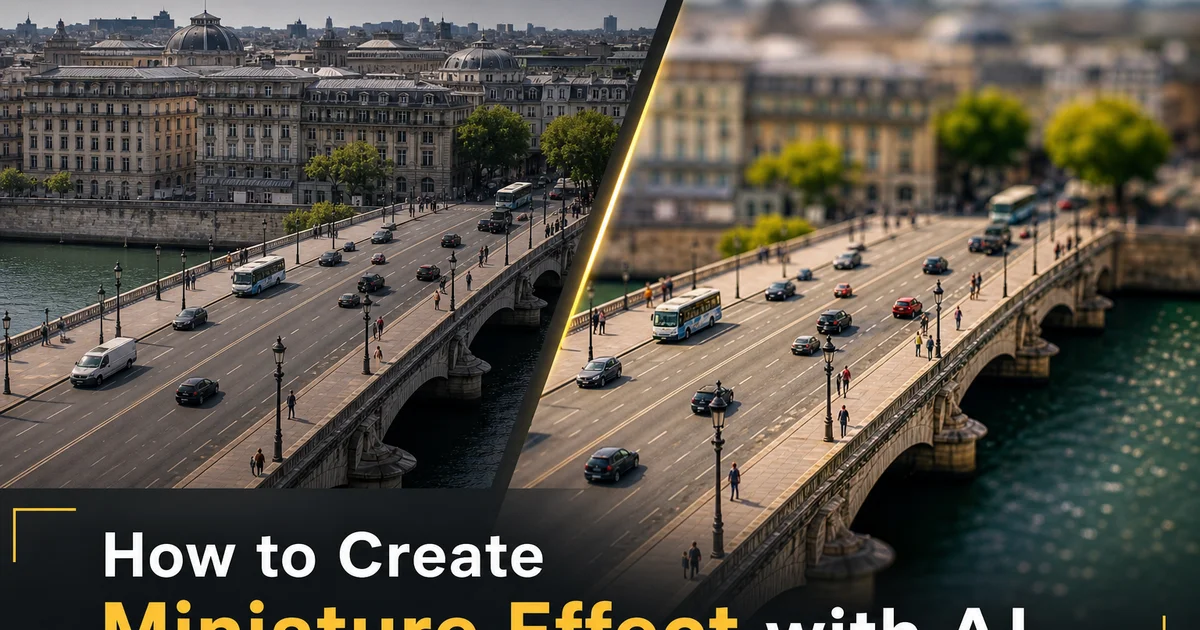
O efeito miniatura — às vezes chamado de fotografia tilt-shift ou efeito diorama — transforma fotografias de cenas do mundo real em imagens que parecem fotografias de minúsculos modelos feitos à mão. A técnica explora uma peculiaridade da percepção visual humana: quando vemos uma cena com profundidade de campo muito rasa, nosso cérebro assume que o assunto deve ser muito pequeno e muito próximo da câmera. A profundidade de campo rasa na experiência cotidiana está correlacionada com a fotografia macro e de close-up. Ao aplicar desfoque seletivo, cores saturadas e ajustes de contraste que imitam a fotografia de modelos em close-up, enganamos o espectador fazendo-o perceber uma paisagem urbana em tamanho real, um canteiro de obras ou um porto como um meticulosamente elaborado diorama de mesa.
A fotografia tilt-shift tradicional requer lentes especializadas que inclinam fisicamente o plano focal em relação ao sensor, criando uma zona de foco em forma de cunha em vez do plano paralelo usual. Essas lentes custam entre mil e dois mil dólares e oferecem flexibilidade limitada. A gradação do desfoque é fixada pelas propriedades ópticas da lente, e o efeito não pode ser ajustado após a captura. Abordagens baseadas em Photoshop substituíram lentes especializadas por gradientes de desfoque digitais. As máscaras de desfoque linear no Photoshop não levam em conta a profundidade da cena, produzindo artefatos onde objetos a distâncias diferentes, mas na mesma posição vertical, recebem quantidades diferentes de desfoque. Um edifício ao fundo e um carro em primeiro plano podem estar ambos no centro do quadro. O edifício deve ser desfocado enquanto o carro permanece nítido. Gradientes lineares não conseguem fazer essa distinção.
Os efeitos miniatura com IA resolvem tanto as limitações de custo quanto de qualidade ao usar modelos de estimativa de profundidade que entendem a estrutura tridimensional da cena. A IA coloca o desfoque de acordo com a distância real da câmera, em vez da posição vertical no quadro, produzindo resultados fisicamente corretos e visualmente convincentes. Combinado com realce de cor e limpeza de detalhes orientados por IA, o fluxo de trabalho produz efeitos miniatura profissionais a partir de qualquer fotografia em ângulo elevado em minutos. Este guia aborda o processo completo, desde a seleção da foto de origem até o refinamento final, incluindo a ciência perceptual por trás do funcionamento do efeito e os ajustes específicos que distinguem uma miniatura convincente de uma foto com filtro óbvio.
- A ilusão de miniatura explora a percepção de profundidade de campo: foco extremamente raso faz o cérebro assumir que o assunto é minúsculo e próximo, mesmo quando a cena é uma paisagem urbana em escala real.
- A estimativa de profundidade por IA aplica desfoque com base na distância real da cena, em vez da posição vertical, separando corretamente objetos em primeiro plano de estruturas de fundo na mesma altura do quadro.
- Aumentos de saturação de cor de vinte a trinta por cento simulam as tintas acrílicas e esmaltadas vívidas usadas em superfícies de modelos físicos, deslocando materiais orgânicos em direção a acabamentos de aparência manufaturada.
- Detalhes que revelam escala, como texto legível, características faciais, névoa atmosférica e desfoque de movimento, devem ser removidos para evitar que o cérebro do espectador recalcule o tamanho real da cena.
- Iluminação em estilo de estúdio com temperatura de cor quente e sombras suaves e uniformes completa a ilusão de que a cena foi fotografada em ambiente fechado sobre uma mesa de exposição sob luz controlada.
A ciência perceptual por trás da ilusão de miniatura
O efeito miniatura funciona devido a uma correlação aprendida na experiência visual humana entre profundidade de campo e distância do assunto. A profundidade de campo — a faixa de distâncias que aparecem aceitavelmente nítidas em uma imagem — é inversamente relacionada à ampliação do assunto. Quando você fotografa uma pessoa a três metros de distância com uma lente padrão, quase tudo na cena está aceitavelmente nítido porque a profundidade de campo nessa distância abrange vários metros. Quando você fotografa uma moeda sobre uma mesa a dez centímetros de distância, a profundidade de campo se reduz a milímetros. A borda frontal da moeda pode estar nítida enquanto a borda traseira já está desfocada. Essa relação é tão consistente na experiência visual cotidiana que o cérebro a usa como uma dica de escala: profundidade de campo extremamente rasa sinaliza um assunto muito pequeno e muito próximo.
A técnica tilt-shift de miniatura sequestra essa dica ao aplicar profundidade de campo extremamente rasa a uma cena que é na verdade grande e distante. O cérebro recebe informações contraditórias — o conteúdo diz cidade em tamanho real, a profundidade de campo diz modelo minúsculo — e na maioria dos espectadores, a dica de profundidade de campo vence, pelo menos inicialmente. A cena se transforma em uma interpretação perceptual como miniatura. O espectador experimenta um momento genuíno de confusão de escala que é ao mesmo tempo agradável e esteticamente forte. Essa inversão perceptual é mais forte quando outras dicas são consistentes com a interpretação de miniatura: ângulo de visão elevado, cores saturadas, superfícies limpas e iluminação uniforme. Quando dicas contraditórias estão presentes — texto legível revelando escala real, rostos humanos distintos, névoa atmosférica implicando grandes distâncias — a ilusão enfraquece ou falha.
O ângulo de visão é crítico por causa de como os humanos interagem com miniaturas na vida real. Ferrovias em miniatura, modelos arquitetônicos, casas de bonecas e dioramas são quase sempre vistos de cima, olhando para baixo em um ângulo de trinta a setenta graus. Este é o ângulo no qual os objetos são acessíveis e visíveis em um contexto de mesa. Fotografias ao nível da rua falham como miniaturas porque não olhamos para modelos de mesa do nível do chão. Exigiria colocar nossos olhos na altura da mesa e olhar horizontalmente através da superfície. A perspectiva elevada sinaliza ao cérebro que estamos olhando para algo abaixo de nós em uma superfície, o que é consistente com um modelo pequeno e inconsistente com ser um pedestre em uma cidade real. A fotografia com drones e pontos de vista de telhados naturalmente fornecem essa perspectiva elevada e são o ponto de partida ideal para efeitos miniatura.
- A profundidade de campo é inversamente relacionada à ampliação do assunto — foco raso sinaliza fortemente um assunto pequeno e próximo ao sistema visual humano.
- O cérebro resolve dicas contraditórias (conteúdo em escala real vs. profundidade de campo de miniatura) optando por padrão pela interpretação da profundidade de campo, pelo menos inicialmente.
- Ângulos de visão elevados de trinta a setenta graus são críticos porque correspondem a como os humanos naturalmente olham para dioramas de mesa e modelos arquitetônicos.
- Dicas que contradizem a escala, como texto legível, rostos reconhecíveis e névoa atmosférica, devem ser removidas ou a ilusão perceptual colapsa.
Escolhendo a foto de origem certa para máximo impacto de miniatura
Nem toda fotografia produz um efeito miniatura convincente. Escolher o material de origem certo é mais importante do que qualquer quantidade de refinamento de pós-processamento. A foto de origem ideal tem quatro características: um ângulo de câmera elevado, objetos de referência em pequena escala distintos, boa separação de assunto e iluminação razoavelmente uniforme. A fotografia com drones é a fonte mais consistente porque naturalmente fornece elevação. Fotos de edifícios altos, colinas, pontes e arquibancadas também funcionam bem. A câmera deve estar olhando para baixo na cena em um ângulo entre trinta e sessenta graus da horizontal. Ângulos mais íngremes são geralmente melhores, mas fotos perfeitamente verticais de cima perdem a profundidade tridimensional que faz a ilusão funcionar porque comprimem tudo em um plano plano sem separação entre primeiro plano e fundo.
Objetos de referência distintos são fundamentais porque a ilusão de miniatura depende do espectador saber o tamanho real das coisas na cena e então ser enganado a percebê-las como minúsculas. Carros, ônibus, pessoas, casas, barcos, trens e equipamentos de construção são excelentes porque todos sabem quão grandes são na realidade. Uma cena com apenas formas abstratas — um pedaço aleatório de chão, uma extensão de água, um dossel de floresta — não produz um efeito miniatura porque não há nada para o espectador re-escalar. As melhores cenas combinam múltiplos objetos distintos em diferentes profundidades: carros em primeiro plano, edifícios em distância média e mais veículos ou estruturas ao fundo, todos contribuindo com pontos de referência que reforçam a interpretação de miniatura em cada plano de profundidade.
Separação de assunto significa distinção visual clara entre objetos individuais na cena. Um estacionamento cheio de carros ordenadamente dispostos separados por pavimento visível produz uma miniatura melhor do que uma floresta densa onde árvores individuais se fundem em uma massa verde indiferenciada. Canteiros de obras, portos com barcos separados, bairros suburbanos com casas distintas e estádios esportivos com figuras de jogadores separadas pontuam alto em separação de assunto. A ilusão de miniatura depende da identificação pelo espectador de objetos individuais de aparência minúscula. Se os objetos não puderem ser distinguidos um por um, o efeito se reduz a um simples filtro de desfoque sem mudança perceptual de escala. A uniformidade da iluminação é importante porque a fotografia de modelos reais usa iluminação controlada de estúdio que elimina as sombras nítidas e a luminosidade variável da luz solar externa. Fotos tiradas em dias nublados ou com luz suave da manhã requerem menos correção de iluminação no pós-processamento.
- Ângulos elevados de trinta a sessenta graus da horizontal fornecem a profundidade tridimensional necessária para a ilusão, com ângulos mais íngremes geralmente produzindo efeitos mais fortes.
- Objetos reconhecíveis como carros, pessoas, barcos e edifícios são essenciais — eles dão ao espectador pontos de referência para experimentar a mudança de escala.
- Boa separação de assunto (objetos individuais distintos em vez de massas fundidas) permite que o espectador identifique os itens de aparência minúscula que impulsionam a percepção de miniatura.
- Iluminação nublada ou suave requer menos correção do que a luz solar intensa porque já se assemelha à iluminação uniforme de estúdio usada para fotografia de modelos.
Desfoque AI com consciência de profundidade vs. gradiente linear tradicional tilt-shift
A simulação tradicional tilt-shift no Photoshop e na maioria dos aplicativos de telefone aplica desfoque usando uma máscara de gradiente linear: uma faixa horizontal de nitidez com desfoque progressivamente crescente acima e abaixo. Essa abordagem linear funciona de forma aceitável para cenas planas como uma estrada vista de cima, onde a profundidade se correlaciona perfeitamente com a posição vertical no quadro. Mas as cenas do mundo real são tridimensionais, e objetos em diferentes profundidades frequentemente ocupam a mesma zona vertical na fotografia. Um edifício alto ao fundo e um carro em primeiro plano podem ambos estar centralizados verticalmente no quadro. O edifício está a cinquenta metros de distância enquanto o carro está a cinco metros de distância. Um gradiente de desfoque linear os trata de forma idêntica, desfocando o edifício e o carro na mesma quantidade. Na realidade, se o carro está em foco, o edifício distante deve estar fortemente desfocado, e vice-versa. Essa inconsistência é a falha mais comum da simulação tradicional tilt-shift.
A estimativa de profundidade por IA resolve isso analisando a cena para determinar a distância real de cada objeto da câmera e, em seguida, aplicando desfoque proporcional a essa distância em vez da posição vertical. A IA reconhece que o edifício ao fundo está mais distante do que o carro em primeiro plano, independentemente de onde cada um está no quadro, e aplica o nível de desfoque correto a cada um. Isso produz profundidade de campo fisicamente correta que corresponde ao que uma lente tilt-shift real criaria — ou mais precisamente, ao que uma lente de abertura muito grande focada em uma distância específica na cena criaria. O resultado é um padrão de desfoque que o sistema visual do espectador aceita como desfoque óptico genuíno em vez de um filtro de pós-processamento, e é fundamental para que a ilusão de miniatura se mantenha sob escrutínio.
O mapa de profundidade da IA também possibilita transições mais matizadas entre zonas nítidas e desfocadas. Gradientes lineares criam uma linha de transição abrupta onde a nitidez dá lugar ao desfoque repentinamente, o que parece artificial quando divide um objeto ao meio — metade do edifício em foco e metade desfocado. O mapa de profundidade da IA cria transições com consciência de objeto, onde objetos inteiros em profundidades semelhantes compartilham o mesmo nível de foco, com transições de desfoque ocorrendo entre objetos em diferentes profundidades em vez de através do meio de um único objeto. Um edifício está ou completamente na zona de foco ou completamente na zona de desfoque, com a transição ocorrendo no espaço entre ele e a próxima estrutura em uma profundidade diferente. Essa coerência de objeto é uma diferença de qualidade sutil, mas importante, que faz os efeitos tilt-shift de IA parecerem opticamente autênticos.
- O desfoque de gradiente linear trata todos os objetos na mesma posição vertical de forma idêntica, independentemente de sua distância real da câmera, criando padrões de profundidade de campo fisicamente impossíveis.
- A estimativa de profundidade por IA determina a distância real de cada objeto na cena e aplica desfoque proporcional a essa distância, produzindo profundidade de campo rasa opticamente correta.
- Transições de desfoque com consciência de objeto mantêm objetos inteiros em níveis de foco consistentes em vez de dividi-los com uma linha de transição abrupta entre zonas nítidas e desfocadas.
- O padrão de desfoque fisicamente correto é o que faz o sistema visual do espectador aceitar o efeito como desfoque óptico genuíno em vez de um filtro digital, sustentando a ilusão de miniatura.
Ajustes de cor e contraste que completam o visual de mundo de modelo
O desfoque sozinho cria profundidade de campo rasa, mas a ilusão de miniatura atinge todo o seu potencial apenas quando a cor e o contraste são ajustados para corresponder ao que uma cena em miniatura realmente pareceria. Modelos físicos e dioramas têm propriedades de cor e superfície distintamente diferentes das cenas do mundo real porque são feitos de materiais diferentes. A grama real é uma mistura complexa de folhas verdes, amarelas e secas que coletivamente se leem como um verde suave e variável. A grama de modelo é feita de fibra tingida ou espuma pintada que produz um verde uniforme e vívido. O tijolo real é intemperizado, manchado e variável em cor. O tijolo de modelo é pintado de forma limpa com cor consistente. Essas diferenças materiais significam que as cores do mundo real são mais suaves, variáveis e dessaturadas do que as cores do mundo de modelo, e aumentar a saturação em vinte a trinta por cento desloca a paleta em direção à estética de modelo.
Os ajustes de contraste servem a um propósito semelhante. As cenas do mundo real exibem efeitos atmosféricos que reduzem o contraste com a distância. Objetos distantes parecem mais nebulosos, mais claros e menos saturados do que objetos próximos devido à dispersão da luz na atmosfera entre eles e a câmera. Em um diorama de mesa, não há atmosfera entre a câmera e qualquer parte da cena porque o modelo inteiro está dentro de alguns metros. Edifícios modelo distantes têm o mesmo contraste e clareza que carros modelo próximos porque não há essencialmente atmosfera para dispersar a luz. Para simular isso, use AI Enhance para equalizar o contraste em toda a cena, aumentando o contraste de elementos distantes que parecem nebulosos na fotografia original e reduzindo ligeiramente o contraste de elementos de primeiro plano muito próximos que parecem anormalmente detalhados. O objetivo é uma clareza uniforme e sem atmosfera em toda a profundidade da cena.
A qualidade da superfície também se desloca em direção a uma aparência manufaturada. Superfícies externas reais — estradas, calçadas, fachadas de edifícios — acumulam sujeira, manchas e intemperismo que reduzem sua refletividade e criam texturas complexas e irregulares. As superfícies dos modelos são recém-pintadas e lisas, com refletividade especular mais alta e textura mais uniforme. AI Enhance pode aumentar a nitidez e o micro-contraste das superfícies para simular essa qualidade limpa, dura e manufaturada. A combinação de cores saturadas, contraste uniforme em toda a profundidade e renderização de superfície limpa cria a ilusão material completa de que a cena é feita de plástico, madeira e tinta, em vez de concreto, vegetação e aço. Cada ajuste individualmente é sutil, mas seu efeito cumulativo transforma a impressão visual de documentário do mundo real para diorama em miniatura.
- Aumente a saturação de cor em vinte a trinta por cento para mudar das cores suaves e variáveis dos materiais reais para as cores vívidas e uniformes das superfícies de modelos pintados.
- Equalize o contraste em toda a profundidade da cena para eliminar efeitos de névoa atmosférica que não existem na fotografia de dioramas de mesa.
- Aumente a nitidez da superfície e o micro-contraste para simular as superfícies limpas, recém-pintadas e de alta refletividade dos componentes de modelos físicos.
- O efeito cumulativo dos ajustes de cor, contraste e superfície cria uma ilusão material de que a cena é feita de plástico e tinta em vez de concreto e vegetação.
How to do it
- 1
Select or capture a photo from a high angle looking down on a scene
The miniature effect works by mimicking the very shallow depth of field that occurs when a camera photographs a tiny object at close range. This illusion is most convincing when the viewer's perspective matches how they would naturally look at a miniature model. From above, looking down at an angle of thirty to seventy degrees. Photographs shot from ground level or eye level rarely produce convincing miniature effects because the perspective does not match how humans interact with small objects. Ideal source photos include aerial drone shots, photos taken from rooftops or balconies overlooking streets, stadium views looking down at the playing field. Elevated views of harbors, parking lots, train stations, or construction sites. The scene should contain distinct objects. Cars, people, buildings, boats — whose scale provides the visual reference that makes the miniature illusion work.
- 2
Apply AI depth-aware selective blur to simulate shallow depth of field
Use AI Filter to apply a tilt-shift blur effect that keeps a narrow horizontal band of the image sharp while progressively blurring everything above and below that band. The AI uses depth estimation to apply blur that follows the actual geometry of the scene rather than a simple linear gradient. Objects at the same distance remain at the same focus level even if they appear at different vertical positions in the frame. The sharp focus band should be placed over the area of primary interest. Often one-third to one-half of the way from the bottom of the frame, where the main subjects like vehicles or pedestrians are located. The blur should increase gradually toward the top and bottom of the frame, reaching its maximum at the extreme edges.
- 3
Boost color saturation and contrast to mimic painted model surfaces
Real miniature models and dioramas are painted with acrylic and enamel paints that produce more vivid, saturated colors than real-world surfaces. Grass on a model railroad layout is a brighter, more uniform green than real grass. Model cars are glossy and primary-colored rather than dusty and muted. Use AI Enhance to increase overall color saturation by twenty to thirty percent, with particular emphasis on greens, blues, and reds. Boost local contrast and clarity to make surfaces appear hard and manufactured rather than soft and organic. The combination of vivid colors and increased surface contrast is what makes the eye read the scene as a collection of painted objects under studio lighting rather than real-world objects under natural light.
- 4
Clean distracting elements that break the miniature scale illusion
Certain details in a photograph reveal real-world scale and break the miniature illusion. Use Magic Eraser to remove these scale giveaways: visible text on signs that would be impossibly small on a model, detailed facial features on people that reveal they are full-sized humans, atmospheric haze between the camera and distant objects that would not exist in a tabletop diorama. Motion blur on vehicles that implies real-world speeds. Also remove any elements that look untidy or random in a way that models never are. Real construction sites have random debris, but a model of a construction site is carefully arranged. The cleaned scene should have the intentional, curated quality of a diorama built by a meticulous hobbyist.
- 5
Fine-tune the overall lighting to simulate studio-lit diorama conditions
Real miniature scenes are often lit by overhead studio lighting that produces even, slightly warm illumination with soft but defined shadows. Natural outdoor photographs often have harsh directional sunlight, blue shadows from atmospheric scattering, and variable brightness across the scene. Use AI Filter to even out the lighting. Slightly lifting shadows and reducing highlights to simulate the more uniform illumination of a tabletop setup. Add a subtle warm shift of two hundred to three hundred Kelvin to mimic tungsten or warm LED studio lighting. Reduce any blue color cast in shadow areas. The final image should look like it was photographed indoors on a display table rather than outdoors under the open sky, completing the miniature diorama illusion.