
Como Criar o Efeito Kolam com IA — Magic Eraser
Transforme fotos em arte geométrica de chão kolam do sul da Índia usando geração de padrões por IA. Guia passo a passo sobre estruturas de grade de pontos, loops sikku, cores rangoli e princípios de design tradicional.

Visual Arts Editor
Revisado por Magic Eraser Editorial ·
Índice
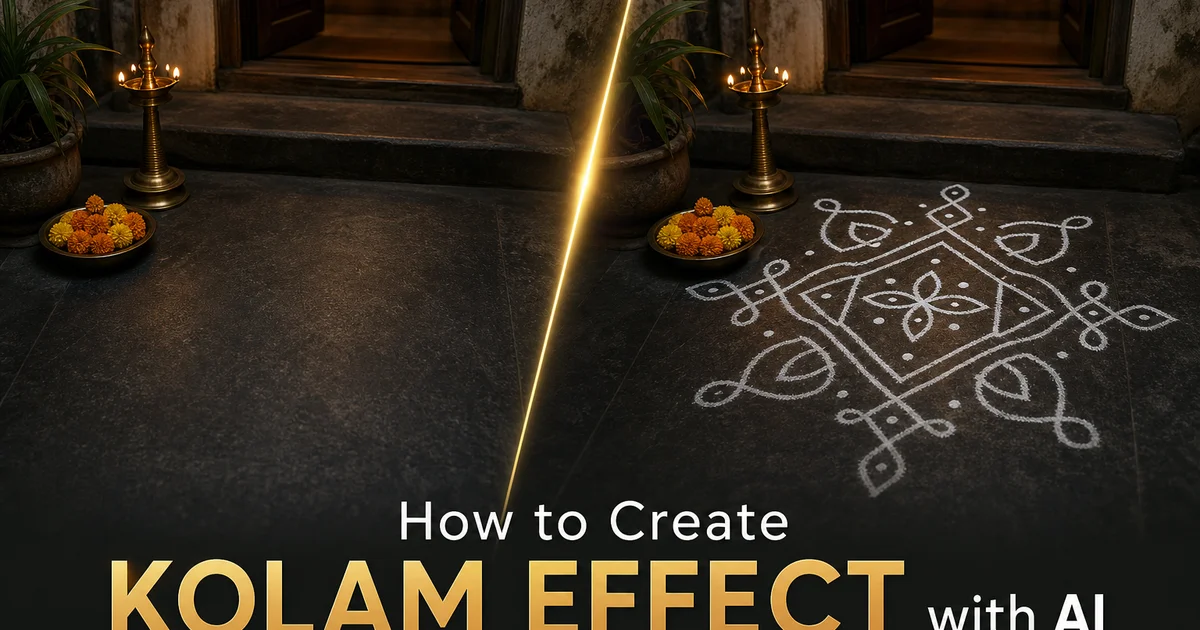
Kolam é uma tradição artística viva praticada diariamente por milhões de mulheres no sul da Índia, principalmente em Tamil Nadu, Karnataka, Andhra Pradesh e Kerala. Cada manhã antes do amanhecer, a soleira da casa é varrida e decorada com um padrão geométrico intrincado desenhado à mão livre usando farinha de arroz, pó de giz ou pó de rangoli colorido no chão. Os designs variam de curvas simples conectadas por pontos que levam minutos para serem desenhadas a padrões de laços entrelaçados extraordinariamente complexos que podem levar horas e cobrir pátios inteiros. Kolam serve ao mesmo tempo como uma prática espiritual marcando o limite entre o espaço doméstico e público, uma expressão estética de beleza matemática e uma oferenda prática. A farinha de arroz alimenta formigas e pequenas criaturas, incorporando o princípio hindu de viver em harmonia com todos os seres. A precisão geométrica e a complexidade visual do kolam atraíram a atenção de matemáticos, cientistas da computação e artistas em todo o mundo.
A recriação digital de padrões kolam no passado dependeu de geração algorítmica em vez de conversão fotográfica. Os designs são construções geométricas abstratas em vez de representações de cenas naturais. Softwares que geram kolam frequentemente começam com uma grade de pontos e aplicam regras gramaticais formais para desenhar curvas conectando e circundando os pontos de acordo com princípios tradicionais de design. Converter uma fotografia em arte no estilo kolam é um desafio fundamentalmente diferente. Requer mapear o conteúdo distinto de uma imagem no vocabulário geométrico abstrato do kolam mantendo tanto a legibilidade do sujeito original quanto a elegância matemática da forma de arte tradicional. Simples sobreposições de padrões kolam em fotografias parecem artificiais porque não há relação significativa entre o conteúdo da fotografia e a estrutura geométrica.
A conversão kolam alimentada por IA preenche essa lacuna analisando a geometria estrutural da fotografia e usando-a como estrutura organizacional para gerar padrões kolam autênticos. A IA identifica eixos de simetria, elementos repetidos, curvas dominantes e pontos focais na imagem, então constrói uma grade de pontos alinhada a essas características estruturais e gera curvas kolam que seguem tanto as regras de design tradicionais quanto traçam os contornos significativos do sujeito. O resultado é um padrão kolam que se lê como uma versão distinta da fotografia original enquanto incorpora a estrutura matemática, a disciplina de linha contínua e a sensibilidade estética da autêntica arte de chão do sul da Índia. Este guia cobre o processo completo desde a seleção do sujeito até a configuração de estilo, escolhas de cores e os detalhes de acabamento que fazem a diferença entre uma sobreposição de padrão e uma conversão kolam convincente.
- A IA mapeia a geometria estrutural das fotografias para as tradicionais estruturas de grade de pontos kolam, gerando curvas que seguem simultaneamente regras de design e contornos significativos do sujeito.
- Múltiplos estilos kolam estão disponíveis, incluindo curvas simples pulli conectadas por pontos, laços entrelaçados sikku complexos e padrões angulares kambi de linhas retas, cada um adequado a diferentes tipos de sujeito.
- Os modos de cor variam de farinha de arroz branca tradicional em fundo escuro a vibrantes paletas rangoli de festival que mapeiam as cores da fotografia original em seções geométricas do padrão.
- Controles de simetria incluem espelhamento quádruplo para aparência kolam tradicional e rotação radial para sujeitos com estrutura circular natural como flores e detalhes arquitetônicos.
- A simulação de superfície de chão replica a textura de terracota, pedra ou concreto com farinha de arroz granulada visível ou meio pastoso liso ao longo das curvas desenhadas.
O significado cultural e a estrutura matemática da arte kolam
Kolam ocupa uma posição única na intersecção de ritual doméstico, arte visual e matemática. Na tradição hindu tamil, desenhar kolam cada manhã é um ato auspicioso que convida Lakshmi, a deusa da prosperidade, para dentro de casa. A soleira onde o kolam é desenhado representa um espaço liminar entre o mundo doméstico interior e o mundo público exterior. O padrão geométrico serve tanto como decoração quanto como proteção simbólica. A prática é passada de mãe para filha através de observação direta e imitação, com meninas aprendendo padrões simples e gradualmente dominando designs mais complexos ao longo de anos de prática diária. A transitoriedade do kolam — desenhado fresco cada manhã e apagado pelo tráfego de pedestres durante o dia — incorpora princípios filosóficos sobre a impermanência da beleza e o valor da prática criativa por si só, em vez de para preservação.
Matematicamente, os padrões kolam têm sido analisados através das lentes da teoria dos nós, teoria da linguagem formal e geometria fractal. O estilo sikku kolam, onde uma única linha contínua tece sobre e sob si mesma para criar um padrão completo sem que a linha nunca cruze ou quebre, foi demonstrado como equivalente a certas classes de nós matemáticos. Pesquisadores mostraram que as regras que governam a construção kolam podem ser expressas como gramáticas formais, especificamente gramáticas de matriz e linguagens pictóricas que geram padrões bidimensionais através da aplicação recursiva de regras. Esta estrutura matemática significa que padrões kolam podem ser sistematicamente gerados por algoritmos que aplicam as mesmas regras que artistas tradicionais seguem intuitivamente, produzindo resultados que são tanto matematicamente válidos quanto esteticamente consistentes com designs feitos à mão.
A grade de pontos que serve como andaime para a maioria dos designs kolam é ela própria um objeto matemático com propriedades específicas. A grade determina o grupo de simetria do padrão, sua complexidade máxima e o conjunto de curvas válidas que podem ser desenhadas através dela. Grades quadradas com pontos em intersecções regulares suportam simetria quádrupla e curvas em ângulo reto. Arranjos hexagonais de pontos suportam simetria sêxtupla e ângulos de 60 graus. O número de pontos e seu arranjo definem o espaço de design. Uma grade pulli cinco por cinco suporta um número finito mas grande de padrões kolam válidos, cada um seguindo as regras de continuidade de linha única e encapsulamento de pontos. A IA usa essas restrições matemáticas como estrutura generativa para converter fotografias em kolam, garantindo que cada padrão gerado seja válido de acordo com regras tradicionais de design, em vez de ser uma coleção arbitrária de curvas decorativas.
- Kolam é desenhado fresco cada manhã como uma decoração auspiciosa de soleira na tradição hindu tamil, passado de mãe para filha através de observação direta ao longo de anos de prática diária.
- Padrões sikku kolam onde uma única linha contínua tece sobre e sob si mesma foram analisados matematicamente como equivalentes a classes específicas de nós na teoria dos nós.
- Regras de construção kolam podem ser expressas como gramáticas formais que geram padrões bidimensionais válidos através da aplicação recursiva de regras, permitindo geração algorítmica.
- Arranjos de grade de pontos definem o grupo de simetria e o espaço de design de padrões válidos, com grades quadradas suportando simetria quádrupla e grades hexagonais suportando simetria sêxtupla.
Como a IA mapeia conteúdo fotográfico em estruturas geométricas kolam
O desafio técnico central em converter uma fotografia em arte kolam é estabelecer uma correspondência significativa entre o conteúdo de imagem de tom contínuo e o vocabulário geométrico discreto dos padrões kolam. A IA aborda isso através de um pipeline de múltiplos estágios que primeiro extrai informações estruturais da fotografia, então gera uma grade de pontos adequada para kolam alinhada a essa estrutura e finalmente desenha curvas através da grade que tanto seguem regras de design kolam quanto traçam as características importantes da imagem original. A fase de extração estrutural identifica bordas, eixos de simetria e regiões de textura ou cor consistentes na imagem, criando um mapa do esqueleto geométrico da imagem que servirá como estrutura organizacional para o padrão kolam.
O posicionamento da grade de pontos é o passo crítico de tradução onde o conteúdo fotográfico se torna estrutura kolam. Em vez de colocar pontos em uma grade regular uniforme, a IA varia a densidade de pontos com base no conteúdo da imagem, colocando pontos mais próximos em áreas de detalhe fino e mais distantes em áreas de tom uniforme. A grade é alinhada ao eixo de simetria dominante da imagem e rotacionada para corresponder à orientação angular das principais características estruturais. Contornos importantes do sujeito como o contorno de um rosto ou a borda de um edifício influenciam o layout da grade para que curvas kolam sigam naturalmente esses contornos à medida que conectam e circundam os pontos. Este posicionamento de pontos sensível ao conteúdo garante que o padrão kolam resultante não seja meramente sobreposto na imagem, mas seja gerado a partir da própria geometria da imagem.
A geração de curvas segue as regras formais do estilo kolam selecionado enquanto é guiada pela grade de pontos sensível ao conteúdo. No estilo sikku, uma única linha contínua deve passar por cada célula da grade, tecendo sobre e sob em cada cruzamento em um padrão alternado. A IA roteia esta linha de modo que o caminho siga preferencialmente os contornos identificados na fase de extração estrutural, significando que o laço contínuo traça os contornos de rostos, objetos e características principais enquanto serpenteia através da grade. No estilo pulli, curvas individuais conectam pontos próximos em arcos suaves, e a IA atribui densidade e peso de curva com base nos valores tonais da imagem. Áreas mais escuras da imagem recebem aglomerados de curva mais densos enquanto áreas mais claras têm curvas esparsas com mais superfície de chão visível. O resultado é um padrão kolam onde o vocabulário geométrico tradicional simultaneamente representa o conteúdo da imagem.
- Pipeline de múltiplos estágios extrai informações estruturais de fotografias, gera grades de pontos sensíveis ao conteúdo, então desenha curvas kolam que seguem tanto regras de design quanto características da imagem.
- Posicionamento de pontos sensível ao conteúdo varia a densidade da grade com base nos níveis de detalhe da imagem e alinha-se a eixos de simetria dominantes, garantindo que padrões emergem da própria geometria da imagem.
- O roteamento de linha contínua sikku segue preferencialmente contornos do sujeito identificados durante a extração estrutural, traçando contornos de rostos e objetos enquanto o laço serpenteia através da grade.
- O estilo pulli atribui densidade e peso de curva com base em valores tonais — áreas mais escuras recebem aglomerados mais densos enquanto áreas mais claras mostram curvas esparsas com superfície de chão visível.
Paletas de cores: da farinha de arroz tradicional ao rangoli de festival
A estética kolam mais simples e distinta é a farinha de arroz branca em uma superfície de fundo escura. Kolam tradicional é desenhado em terra varrida, pedra ou concreto que foi umedecido para ajudar o pó a aderir. O contraste entre o pó branco brilhante e o fundo escuro cria padrões geométricos ousados visíveis à distância. A IA imita isso renderizando as curvas kolam em tons de branco off-white com textura granular sutil que sugere as propriedades físicas da farinha de arroz: bordas ligeiramente irregulares onde grãos individuais se dispersam além da linha desenhada, variações na opacidade onde o pó assenta mais grosso ou mais fino, e a cor quente amarelo-branca do arroz cru em vez de branco digital puro. A superfície do chão é renderizada com a textura de terracota varrida, pedra polida ou concreto áspero dependendo do substrato selecionado.
Kolam festivo e rangoli usam pós coloridos vibrantes para criar designs que celebram ocasiões especiais como Pongal, Diwali e Navaratri. A paleta tradicional inclui amarelo açafrão, vermelho vermelhão, azul índigo, branco farinha de arroz e preto carvão, com adições modernas de cores sintéticas em pó em rosa brilhante, verdes e roxos. O modo policromático da IA mapeia as regiões de cor da fotografia original em diferentes seções do padrão kolam, com cada segmento geométrico recebendo uma cor derivada da área de imagem correspondente. As cores são renderizadas com a qualidade opaca e fosca de pigmentos em pó em vez da translucidez da tinta ou da suavidade de preenchimentos de cor digital, mantendo a qualidade material artesanal que distingue rangoli da arte de padrão digital.
Kolam de pétalas de flor representa uma categoria especial onde o padrão geométrico é preenchido com pétalas de flores reais, folhas e outros materiais naturais em vez de pó. Este estilo, comum durante festivais e casamentos, produz texturas orgânicas exuberantes dentro da estrutura geométrica rígida do design kolam. A IA pode simular isso gerando a estrutura kolam a partir do conteúdo da fotografia, então preenchendo cada seção geométrica com texturas derivadas dos materiais naturais na imagem. Se a fotografia contém flores, as pétalas se tornam o material de preenchimento dentro das curvas kolam. Isso cria um efeito híbrido distinto que combina a precisão geométrica do kolam tradicional com a riqueza visual orgânica do arranjo floral, produzindo resultados que parecem festivos e abundantes.
- Farinha de arroz branca tradicional em fundo escuro é simulada com textura granular, bordas de pó irregulares e coloração off-white quente que replica as propriedades físicas do arroz cru.
- Rangoli de festival usa cores de pó vibrantes incluindo amarelo açafrão, vermelho vermelhão e azul índigo, renderizadas com a qualidade opaca e fosca de pigmento em pó.
- Modo policromático mapeia as regiões de cor da fotografia original nas seções do padrão kolam, derivando a cor de cada segmento geométrico da área de imagem correspondente.
- Kolam de pétalas de flor preenche estruturas geométricas com texturas orgânicas da fotografia fonte, combinando estruturas kolam rígidas com riqueza de material natural exuberante.
How to do it
- 1
Upload your photo and evaluate its geometric structure for kolam conversion
Open your image in AI Filter and assess whether the subject has symmetrical elements, repeating patterns, or strong geometric structure that will translate well into kolam-style art. Kolam designs are traditionally drawn each morning with rice flour on the ground in front of South Indian homes, using a grid of dots as scaffolding for intricate looping curves that weave over and under in steady paths. Photographs with central subjects, symmetrical compositions, or regular repeating elements convert best because the AI can map these structural features onto the dot-grid framework that underlies kolam patterns. Portraits with frontal symmetry, architectural details with geometric repetition, and nature photographs with radial patterns like flowers and starfish produce especially striking results.
- 2
Select the kolam style and configure pattern complexity
Choose from kolam style presets that range from simple pulli kolam with straightforward dot-connected curves to complex sikku kolam with elaborate interlocking loops that weave over and under each other in steady single-line paths. The complexity slider controls how many dot-grid intersections the AI uses as anchor points for the looping curves. Low complexity produces bold, open designs with large curves and ample negative space, while high complexity generates dense intricate patterns where thin lines create detailed geometric textures. Kambi kolam style uses straight lines connecting dots in angular geometric patterns rather than curves, producing a more architectural aesthetic. The AI analyzes the subject's dominant features to determine which elements become the primary pattern structure and which become secondary fill patterns.
- 3
Configure the color palette and ground surface simulation
Select the rendering medium that determines the visual character of the kolam. Traditional white rice flour on a dark ground produces the most authentic look. Bright white geometric curves against a dark brown or terracotta surface, with the slightly granular texture of rice powder visible along the line edges. Colored kolam powder mode uses the vibrant pinks, yellows, blues, and greens of festival rangoli designs, mapping the original photograph's color regions onto different sections of the geometric pattern. Wet paste kolam mimics the smoother, more defined lines drawn with rice paste rather than dry powder, producing cleaner edges with subtle dimensional relief where the paste sits above the ground surface.
- 4
Adjust symmetry, dot grid density, and line weight parameters
Control the symmetry mode to determine how the kolam pattern relates to the original image's composition. Four-fold symmetry creates patterns that mirror across both horizontal and vertical axes, producing the most traditional kolam look. Radial symmetry generates patterns that rotate around a central point, ideal for subjects with natural radial structure like flowers or circular architectural details. The dot grid density determines the spacing between anchor points. Tighter grids allow finer detail but can produce patterns that feel cluttered, while wider grids create bolder designs with stronger individual curves. Line weight controls the thickness of the drawn curves, from delicate single-pixel lines that suggest fingertip-drawn rice flour to bold strokes that evoke thick paste application.
- 5
Export the kolam design and enhance details with AI post-processing
Save the kolam effect at full resolution and use AI Enhance to sharpen the curve intersections and crossing points where lines weave over and under each other. These are the most visually complex and important areas of any kolam design. Compare the result against photographs of real hand-drawn kolam to verify that line weight is consistent, curves flow smoothly through dot intersections without kinking, and the over-under weaving pattern at crossing points is clearly legible. The ground surface texture should remain visible between the lines. The powder or paste medium should show the correct granular or smooth texture depending on the selected rendering mode. Adjust any parameters that produce results inconsistent with the physical traits of actual kolam art.
Fontes
- Kolam: A Mathematical and Cultural Analysis of South Indian Floor Art — Leonardo — MIT Press
- Computational Generation of Kolam Patterns Using Formal Grammars — ACM SIGGRAPH
- The Mathematics of Kolam: Knot Theory and Ethnomathematics — Springer — Axiomathes