
Como Criar um Efeito Koftgari com AI: Incrustação de Fios de Ouro em Aço — Magic Eraser
Tutorial passo a passo para criar efeitos de incrustação de fios de ouro e prata koftgari em superfícies de aço com edição de fotos por AI. Simule o trabalho decorativo em metal indiano com arabescos fluidos e padrões Mughal.
SEO & Growth
Revisado por Magic Eraser Editorial ·
Índice
- Compreendendo o koftgari: origens, técnicas e tradições regionais
- Construindo o fundo de aço: cor de oxidação, qualidade do polimento e carácter da superfície
- Padrões de incrustação de fios: arabescos, inscrições e o vocabulário de design koftgari
- Aplicação de ouro e prata: texturas metálicas, hierarquia e acabamento superficial
- Aplicações: visualização histórica, design de produtos e portfólios de trabalhos em metal decorativos
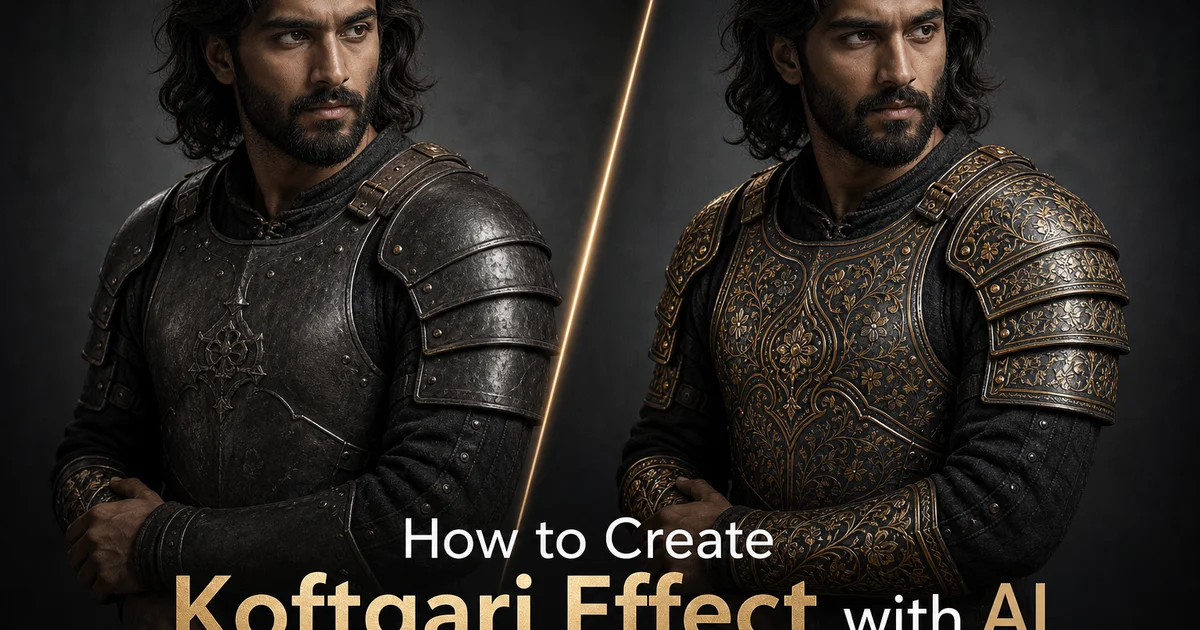
Koftgari é a arte de incrustar fios de ouro e prata em superfícies de ferro ou aço para criar padrões decorativos de finura extraordinária e riqueza visual. Uma técnica que atingiu sua mais alta expressão na Índia Mughal e no Rajasthan, onde adornava desde armas e armaduras reais até vasos decorativos, ferragens de móveis e trabalhos metálicos arquitetônicos. A palavra vem do persa 'koft', que significa batido, descrevendo a técnica fundamental de martelar fio de metal precioso em ranhuras cortadas em uma superfície de aço. O resultado é uma das técnicas decorativas em metal mais visualmente impressionantes já desenvolvidas: arabescos fluidos, padrões de videiras ondulantes, inscrições caligráficas, bordas geométricas em ouro quente e prata brilhante contra o aço escuro, azul-negro polido, criando uma superfície que combina a força do metal base com o luxo da decoração em metal precioso.
O processo técnico do koftgari tradicional envolve várias etapas que criam as qualidades visuais características que uma simulação digital deve replicar. Primeiro, a superfície de aço é limpa e polida, depois asperizada com finos cortes hachurados que criam uma textura para o fio aderir. Fios de ouro ou prata — geralmente entre 0,2 e 0,5 milímetros de diâmetro — são colocados nas ranhuras do padrão pretendido e martelados com um pequeno martelo de face plana até que o fio se assente na superfície hachurada. O aço é então aquecido a uma cor de óxido azul-negro e a superfície é polida, pressionando o fio rente ao metal circundante. O aspecto final é uma superfície de aço escura e lustrosa decorada com linhas brilhantes de metal precioso que são incrustadas no, não elevadas acima do, fundo. Padrões fluidos que captam e brincam com a luz à medida que o objeto é virado na mão.
Ferramentas de edição de fotos por AI podem simular esta técnica de trabalho em metal digitalmente, sobrepondo texturas de fundo de aço polido com padrões de incrustação de fios de metal precioso. O AI Filter gera a superfície característica de aço oxidado azul-negro com seu brilho característico polido à mão. O Magic Eraser cria os finos canais lineares que representam as ranhuras hachuradas que recebem o fio. O AI Enhance aplica as qualidades metálicas de ouro quente e prata brilhante que distinguem o metal precioso da mera coloração amarela ou branca. Este tutorial cobre o processo completo de transformar uma fotografia de uma superfície metálica em uma composição koftgari convincente, abordando as qualidades visuais específicas do fundo de aço, da técnica de incrustação de fios e do vocabulário de design que definem esta extraordinária tradição decorativa.
- AI Filter gera a superfície característica de aço polido azul-negro com brilho polido à mão que forma o fundo escuro essencial de toda a decoração koftgari.
- Magic Eraser cria finos canais lineares de incrustação seguindo a qualidade de linha caligráfica fluida dos padrões tradicionais de arabescos, videiras e inscrições.
- AI Enhance aplica a profundidade quente do ouro de 22 quilates e a refletividade fria e brilhante do fio de prata, com sutil irregularidade martelada ao longo do comprimento do fio.
- Background Eraser isola superfícies koftgari concluídas para colocação em documentação de museu, apresentações de design e layouts de portfólio de trabalhos em metal decorativos.
- Vocabulários de design regional permitem padrões historicamente precisos — estilo cortesão Mughal, tradições folclóricas Rajasthani, padrões geométricos Deccani ou decoração militar Sikh.
Compreendendo o koftgari: origens, técnicas e tradições regionais
O koftgari tem suas origens na tradição mais ampla de incrustação em metal que se desenvolveu no mundo islâmico desde o início do período medieval, com centros importantes na Pérsia, Síria e na região Deccani da Índia. A técnica foi aperfeiçoada sob o patrocínio Mughal a partir do século XVI, quando as oficinas imperiais de Agra, Delhi e Lahore empregavam koftgars especializados que decoravam armas, armaduras e objetos de luxo para a corte. O período Mughal produziu os trabalhos koftgari mais finos e elaborados, com lâminas de espada inteiras cobertas por densos e fluidos arabescos de fio de ouro que combinavam trabalhos florais ondulantes, inscrições caligráficas e bordas geométricas em composições de complexidade e refinamento impressionantes. Após o declínio político Mughal no século XVIII, a produção koftgari migrou para centros regionais, principalmente Rajasthan, onde a tradição continuou — e continua hoje — em cidades como Jaipur e Udaipur.
A distinção técnica entre o verdadeiro koftgari e a técnica relacionada de damasquinagem é importante para compreender as características visuais a replicar. No verdadeiro koftgari, o fio de metal precioso é martelado em ranhuras hachuradas cortadas na superfície de aço, criando uma ligação mecânica que mantém o fio no lugar através de atrito e deformação. Na damasquinagem, as ranhuras são recortadas para criar um perfil em cauda de andorinha que prende mecanicamente o fio no lugar. A diferença visual é sutil, mas presente. O fio koftgari tende a ficar ligeiramente saliente em relação à superfície de aço e tem uma qualidade mais suave e orgânica, onde o fio martelado se conforma à ranhura com ligeiras variações de largura e profundidade. O fio damasquinado assenta mais precisamente rente e uniforme porque a ranhura em cauda de andorinha o restringe mais exatamente. Para simulação digital, a qualidade koftgari de ligeira irregularidade orgânica nas linhas do fio adiciona realismo.
Os vocabulários de design regional dentro da tradição koftgari são distintivos e historicamente importantes. O koftgari cortesão Mughal favorece composições densas e fluidas de arabescos com formas naturalistas de flores e folhas influenciadas pela pintura persa. Os característicos motivos Mughal de papoula, íris e cravo representados em padrões ondulantes contínuos de videiras. O koftgari Rajasthani inclui motivos folclóricos como pavões, elefantes e imagens de divindades hindus, juntamente com o vocabulário de arabescos islâmicos herdado da prática Mughal. O koftgari Deccani, de Bidar e Hyderabad, tende a padrões geométricos mais ousados com menos detalhes naturalistas. O koftgari militar Sikh, decorando os anéis de arremesso chakram e os punhais kirpan do Khalsa, desenvolveu seu próprio vocabulário simbólico incluindo o emblema khanda e a escrita Gurmukhi. Cada tradição regional sugere diferentes escolhas de padrões para recriação digital.
- As oficinas imperiais Mughal a partir do século XVI produziram o melhor koftgari, cobrindo lâminas de espada inteiras com densos arabescos de ouro combinando trabalhos florais ondulantes, caligrafia e bordas geométricas.
- O verdadeiro koftgari usa fio martelado em ranhuras hachuradas, produzindo ligeira irregularidade orgânica, enquanto a damasquinagem usa ranhuras em cauda de andorinha para uma colocação do fio mais precisamente uniforme.
- A tradição Rajasthani incorpora motivos folclóricos como pavões, elefantes e imagens de divindades hindus juntamente com o vocabulário de arabescos islâmicos herdado da prática cortesã Mughal.
- O koftgari Deccani de Bidar e Hyderabad favorece padrões geométricos mais ousados, enquanto a decoração militar Sikh desenvolveu seu próprio vocabulário simbólico para armas e objetos cerimoniais.
Construindo o fundo de aço: cor de oxidação, qualidade do polimento e carácter da superfície
O fundo de aço é a tela escura contra a qual as linhas de metal precioso do koftgari alcançam seu drama visual. Acertar o carácter da superfície é a base de uma simulação digital convincente. O aço koftgari tradicional é tratado termicamente para desenvolver uma camada de oxidação controlada que produz a característica cor azul-negra. Uma química de superfície que ocorre quando o aço limpo é aquecido a cerca de 300 graus Celsius e deixado arrefecer, produzindo uma fina camada de magnetite que é tanto protetora quanto esteticamente distintiva. Aplique a textura metálica do AI Filter com ajustes de cor para este registro azul-negro. Não preto puro, que parece tinta, e não cinza metálico brilhante, que se lê como aço não acabado, mas o tom escuro quente característico que sugere tratamento térmico controlado e polimento manual.
A qualidade do polimento da superfície de aço é o que distingue o fundo koftgari de outras superfícies metálicas escuras. Depois que o fio de ouro e prata foi martelado nas ranhuras e a superfície aquecida para desenvolver a cor de óxido, toda a superfície é polida com uma ferramenta de polimento lisa de ágata ou aço. Este processo comprime o metal da superfície, fechando as marcas de hachura ao redor do fio incrustado e produzindo um acabamento liso e lustroso que é distintamente diferente de cromo polido ou pintura preta fosca. O AI Enhance replica este polimento ajustando a refletividade da superfície para uma faixa específica. Mais refletivo que fosco, menos refletivo que espelho polido, com uma qualidade quente que sugere metal trabalhado à mão em vez de superfície acabada à máquina. O polimento deve ser ligeiramente irregular, mostrando as variações subtis que vêm do polimento manual, onde a pressão varia ligeiramente em superfícies curvas ou complexas.
A pátina superficial e os efeitos de envelhecimento adicionam profundidade histórica ao fundo de aço. Objetos koftgari antigos desenvolvem uma pátina rica e quente à medida que a camada de óxido escurece ainda mais com a idade e o manuseio. O contraste entre a incrustação de metal precioso e o fundo de aço aumenta frequentemente com o tempo, à medida que o aço escurece enquanto o ouro retém seu brilho. O koftgari novo tem um aspeto mais azulado e metálico. Exemplos centenários podem parecer quase pretos, com ouro que parece brilhar contra a superfície escura. Para aplicações decorativas modernas, o aspeto mais recente de aço azulado pode ser mais adequado. Para simulação histórica ou contextos de registo de museu, a pátina mais profunda e quente do koftgari envelhecido adiciona realismo. Ajuste o equilíbrio de cores do fundo de aço conforme necessário. Mais frio e metálico para trabalho novo, mais quente e escuro para exemplares envelhecidos.
- O aço koftgari tradicional desenvolve sua cor azul-negra a partir de oxidação controlada a cerca de 300 graus Celsius, produzindo uma camada de magnetite que é tanto protetora quanto esteticamente distintiva.
- A qualidade do polimento situa-se entre o fosco e o espelho polido — brilho quente e trabalhado à mão com sutis irregularidades das variações de pressão do polimento manual em superfícies curvas.
- O koftgari novo apresenta um fundo de aço mais azulado e metálico, enquanto exemplares antigos desenvolvem pátina quase preta que aumenta o contraste com a brilhante incrustação de ouro ao longo dos séculos.
- O AI Enhance ajusta a refletividade da superfície para a faixa específica de polimento manual que distingue o aço koftgari de superfícies cromadas com acabamento mecânico ou pretas foscas.
Padrões de incrustação de fios: arabescos, inscrições e o vocabulário de design koftgari
O vocabulário de design do koftgari é construído sobre a linha de arabesco fluida. O caule firme e sinuosamente curvo que gera padrões ondulantes de folhas, flores e gavinhas numa linguagem decorativa infinitamente variável mas estilisticamente consistente. Use o Magic Eraser para criar os finos canais lineares que representam os caminhos do fio de ouro e prata, começando com os caules ondulantes principais que estabelecem o ritmo geral da composição. Estes caules primários devem fluir com a curvatura confiante e suave de uma linha caligráfica. Sem hesitação, sem bordas irregulares, sem mudanças angulares bruscas, a menos que especificamente pretendidas para elementos geométricos. A qualidade da linha é primordial no koftgari porque o fio regista literalmente a mão do artesão que desenhou o padrão. O melhor koftgari distingue-se pela elegância e confiança do seu fluxo linear.
Elementos de design secundários ramificam-se dos caules ondulantes principais. Folhas de vários tamanhos e formas, flores em perfil e vista planar, botões e gavinhas, e as distintas cápsulas de sementes de papoula e formas de cravo que caracterizam o vocabulário floral Mughal. Cada elemento tem sua própria forma característica e relação de tamanho com o caule, e os elementos são dispostos com regularidade rítmica mas não repetição mecânica. As folhas de um lado de um enrolamento podem ser ligeiramente de tamanhos diferentes das do outro lado, dando ao padrão vida orgânica dentro da sua formalidade decorativa. Crie estes elementos secundários como canais mais finos ramificando-se dos caules principais, mantendo a qualidade de linha fluida em todo o processo. Os detalhes mais finos — nervuras das folhas, estames de flores, espirais de gavinhas — são executados no fio mais fino e devem ser criados como o trabalho de apagamento mais delicado.
Inscrições caligráficas são um elemento crucial de muitas composições koftgari, principalmente em armas, onde servem tanto propósitos decorativos quanto funcionais. Abençoando o proprietário, invocando proteção divina, identificando o fabricante ou registando a data e ocasião da encomenda. As escritas árabe e persa nos estilos caligráficos nastaliq ou naskh aparecem ao longo das espinhas das lâminas, ao redor das bordas dos escudos e dentro de cartelas emolduradas pela decoração de arabescos circundante. Estas inscrições não estão separadas do esquema decorativo, mas estão integradas nele, com o texto caligráfico fluindo em ritmo com o trabalho ondulante circundante. Para koftgari digital incluindo inscrições, os canais de texto devem mostrar a mesma qualidade de linha precisa que os elementos de arabesco, com a variação de traço grosso-e-fino que caracteriza a caligrafia manual em fio de ouro.
- Os caules ondulantes primários estabelecem o ritmo da composição com a curvatura caligráfica confiante e suave que regista a mão do artesão — sem hesitação ou oscilação nas linhas fluidas de arabesco.
- Elementos secundários — papoulas Mughal, cravos, folhas, botões, gavinhas — ramificam-se dos caules principais com regularidade rítmica mas variação orgânica que evita a repetição mecânica.
- Inscrições caligráficas em escrita nastaliq ou naskh integram-se com a decoração de arabescos circundante, mostrando a variação de traço grosso-e-fino do texto em fio de ouro escrito à mão.
- O detalhe progressivo, dos caules primários grossos através de elementos secundários até às mais finas gavinhas e nervuras de folhas, reflete a hierarquia tradicional de calibre do fio, do mais grosso ao mais fino.
Aplicação de ouro e prata: texturas metálicas, hierarquia e acabamento superficial
A aplicação das texturas metálicas de ouro e prata nos canais de incrustação transforma a composição de uma superfície escura com linhas apagadas numa representação convincente de decoração em fio de metal precioso. O ouro preenche os elementos decorativos principais — os caules ondulantes principais de arabesco, medalhões centrais, formas de flores proeminentes e texto de inscrições. O ouro deve ter o tom quente, profundo e ligeiramente avermelhado do ouro indiano de alto quilate, geralmente 22 quilates ou superior, que é distintamente mais quente que o amarelo mais frio das ligas ocidentais de 14 ou 18 quilates. O AI Enhance intensifica este calor e o brilho metálico, produzindo o característico brilho rico do fio de ouro que foi martelado em aço e polido. Uma qualidade que é mais luminosa que tinta dourada mas mais subtil que o reflexo de espelho da placa de ouro polida.
O fio de prata preenche elementos secundários — contornos de folhas onde o ouro preenche o corpo da folha, faixas de borda menores que emolduram painéis centrais preenchidos com ouro, e os padrões de preenchimento de fundo chamados 'zarnishan', onde finas linhas de prata criam um fundo texturizado nas áreas entre a decoração principal de ouro. A prata deve mostrar sua característica refletividade fria e brilhante que contrasta tanto com o ouro quente quanto com o aço escuro. Na hierarquia dos materiais koftgari, a prata fornece o termo médio visual entre o calor do ouro e a escuridão do aço. Em objetos koftgari envelhecidos, a prata desenvolve frequentemente um tom cinzento a preto que reduz seu brilho, aproximando-o da cor do fundo de aço e fazendo o ouro destacar-se mais. Para efeitos de envelhecimento historicamente precisos, reduza ligeiramente o brilho da prata enquanto mantém o calor total do ouro.
O acabamento superficial final unifica todos os três materiais — aço, ouro e prata — numa única superfície coesa que se lê como um objeto integrado em vez de uma colagem de texturas separadas. No koftgari genuíno, o fio é martelado rente ao aço circundante e toda a superfície é polida em conjunto. Não há bordas elevadas ou limites visíveis além da mudança de cor entre os materiais. Aplique o AI Enhance em toda a composição para equalizar a refletividade da superfície e criar o polimento unificado que indica que todos os materiais partilham o mesmo plano físico. Adicione comportamento sutil de realce que responda consistentemente à direção da luz em todos os três materiais, de modo que o ouro capte luz onde o aço capta, e a prata reflita onde o ouro reflete. A assinatura de uma única superfície polida à mão, em vez de camadas separadas.
- A incrustação de ouro usa o tom quente, profundo e ligeiramente avermelhado do ouro indiano de alto quilate (22 quilates ou mais), distintamente mais quente que ligas ocidentais, com brilho luminoso de fio martelado.
- A prata preenche elementos secundários e padrões zarnishan de fundo, fornecendo o termo médio refletivo e frio entre o calor do ouro e a escuridão do aço na hierarquia de materiais.
- A pátina envelhecida reduz o brilho da prata para um tom cinzento a preto enquanto o ouro retém seu calor total, aumentando o contraste de metal precioso em peças históricas ou de estilo antigo.
- A unificação da superfície garante que todos os três materiais partilhem o mesmo plano de polimento e resposta à luz, lendo-se como um objeto acabado à mão integrado em vez de camadas de textura separadas.
Aplicações: visualização histórica, design de produtos e portfólios de trabalhos em metal decorativos
O efeito koftgari digital serve uma série de aplicações especializadas onde o impacto visual da decoração ouro-sobre-aço é necessário sem os meses de trabalho qualificado exigidos para a execução física. Curadores de museus e historiadores de arte usam simulações koftgari para criar visualizações de como objetos deteriorados apareciam originalmente, reconstruindo incrustações perdidas ou desgastadas com base em fragmentos sobreviventes e exemplos comparativos, produzindo imagens que ajudam o público a apreciar o esplendor original de objetos agora reduzidos a vestígios de ouro sobre aço escuro. Estas visualizações de reconstrução aparecem em catálogos de exposições, materiais educativos e guias de galeria digitais, onde fornecem contexto fundamental para os objetos físicos em exposição.
Designers de produtos no setor de bens de luxo usam padrões inspirados em koftgari como motivos decorativos em objetos modernos: instrumentos de escrita de alta qualidade, caixas de relógios, joalheiras, ferragens arquitetónicas e acessórios de moda. A simulação digital koftgari permite a exploração rápida de opções de padrões, variações de cor e opções de colocação antes de qualquer prototipagem física começar. Um designer pode testar dezenas de composições de arabescos, comparar esquemas apenas com ouro contra esquemas de ouro-e-prata e pré-visualizar o efeito em diferentes formas de objeto em horas, em vez das semanas que a prototipagem koftgari física exigiria. A simulação digital também permite apresentação ao cliente com visualização realista que assegura aprovação antes de se comprometer com a execução artesanal dispendiosa.
Artesãos de trabalhos em metal decorativos que praticam koftgari ou aspiram a aprender a técnica usam a simulação digital como ferramenta de planeamento de design. Esboçar uma composição complexa de arabescos em papel não capta o peso visual do fio de ouro e prata contra aço escuro — a interação de brilho metálico, largura de linha, densidade de padrão e escuridão de fundo que determina se uma composição koftgari se lê como elegante ou sobrecarregada. A simulação digital fornece uma pré-visualização realista do aspeto final, permitindo ao artesão refinar a composição, ajustar a densidade do padrão e equilibrar a distribuição de ouro e prata antes de cortar o primeiro sulco na superfície de aço real. Esta capacidade de planeamento é principalmente valiosa para encomendas únicas, onde o custo de material e mão de obra torna impraticável a tentativa-e-erro.
- As visualizações de reconstrução de museu restauram a aparência original de objetos koftgari deteriorados, fornecendo contexto essencial em catálogos de exposições e guias de galeria digitais.
- Designers de produtos testam padrões inspirados em koftgari em bens de luxo — instrumentos de escrita, caixas de relógios, ferragens — explorando dezenas de composições digitalmente antes da prototipagem física.
- A apresentação ao cliente com visualização koftgari realista assegura aprovação antes de se comprometer com a execução artesanal dispendiosa que uma única peça pode exigir.
- O planeamento de design artesanal com simulação digital revela o peso visual do ouro e prata contra o aço, permitindo o refinamento da densidade do padrão e do equilíbrio de materiais antes de cortar sulcos.
How to do it
- 1
Select a source image with steel or iron surfaces suitable for koftgari decoration
Begin with a photograph featuring dark metal surfaces where the koftgari gold and silver wire inlay effect will appear most convincing. Sword blades, shield bosses, helmet surfaces, armor plates, or decorative steel vessels. Koftgari was historically applied to iron and steel objects because the technique depends on the visual drama of precious gold and silver wire against a dark, burnished steel ground. Flat or gently curved metal surfaces provide the best substrate for the flowing arabesque and floral patterns that characterize the finest Mughal and Rajasthani koftgari work.
- 2
Apply the AI burnished steel texture filter to establish the dark metal ground
Use the AI Filter tool to apply or enhance the dark burnished steel texture that forms the background surface of the koftgari composition. Traditional koftgari steel has a distinctive blue-black or warm dark gray look achieved through controlled oxidation and burnishing. The surface should show the subtle luster of hand-polished steel. Not mirror-bright chrome, but a deep, warm metallic sheen with subtle surface variations that reveal the hand-finished character of the underlying material. This ground provides the key dark contrast against which the gold and silver wire inlay achieves its visual impact.
- 3
Use Magic Eraser to create fine channel patterns for the gold and silver wire inlay
Apply Magic Eraser to remove fine linear areas of the steel ground in the flowing patterns characteristic of koftgari. Interlacing arabesques, scrolling vines with leaves and flowers, calligraphic inscriptions, and the running border patterns that frame the central design field. Traditional koftgari artisans cut fine crosshatched grooves into the steel surface and then hammered gold or silver wire into these grooves. The erased channels should be narrow and linear, following the sinuous curves of the design with the confidence and flow of hand-drawn calligraphic line. Work from the main design stems outward to the finest tendrils and leaf veining.
- 4
Fill inlay channels with gold and silver wire textures using AI Enhance
Apply warm gold and bright silver metallic textures to the channel patterns, following the traditional hierarchy where gold fills the primary decorative elements. Central medallions, major scrolling stems, and inscription text — while silver fills secondary elements like leaf outlines, minor border bands, and background filling patterns. AI Enhance intensifies the metallic luster of each wire element, ensuring that the gold has the warm, rich depth of 22-karat wire and the silver has the bright, cool reflectivity that contrasts with both the gold and the dark steel. The metal textures should show the slight irregularity of hammered wire. Not perfectly uniform but subtly varied in width and reflectivity along their length.
- 5
Export the finished koftgari composition for design presentations and portfolio use
Save the completed koftgari effect at full resolution for decorative metalwork design displays, museum records mockups, historical illustration projects, and artisan portfolio showcases. The fine detail of koftgari wire inlay demands high-resolution export that preserves the delicate line work and metallic surface qualities at viewing distances right to the final use. Create web-optimized versions for online portfolios and social media. Print-resolution exports for gallery displays and client proposals where the intricate craftsmanship needs to survive close examination.
Fontes
- Indian Arms and Armor: The Art of Koftgari Metalwork — The Metropolitan Museum of Art
- Decorative Metalwork of the Islamic World: Techniques and Traditions — Victoria and Albert Museum
- Conservation of Metal Objects: Surface Decoration and Inlay Techniques — Getty Conservation Institute