
Como Criar Efeito Damasquinado com AI — Magic Eraser
Transforme fotos em arte de metal damasquinado com incrustação de ouro e prata em aço usando AI. Guia passo a passo cobindo Toledo, nunome-zogan japonês, koftgari indiano e estilos persas de incrustação.

SEO & Growth
Revisado por Magic Eraser Editorial ·
Índice
- Como a simulação de damasquinado com AI captura propriedades ópticas dos materiais
- Tradições culturais: estilos de Toledo, nunome-zogan, koftgari e persa
- Controlando densidade de incrustação, escala do padrão e acabamento de superfície
- Aplicações criativas: retratos, maquetes de produtos e arte decorativa
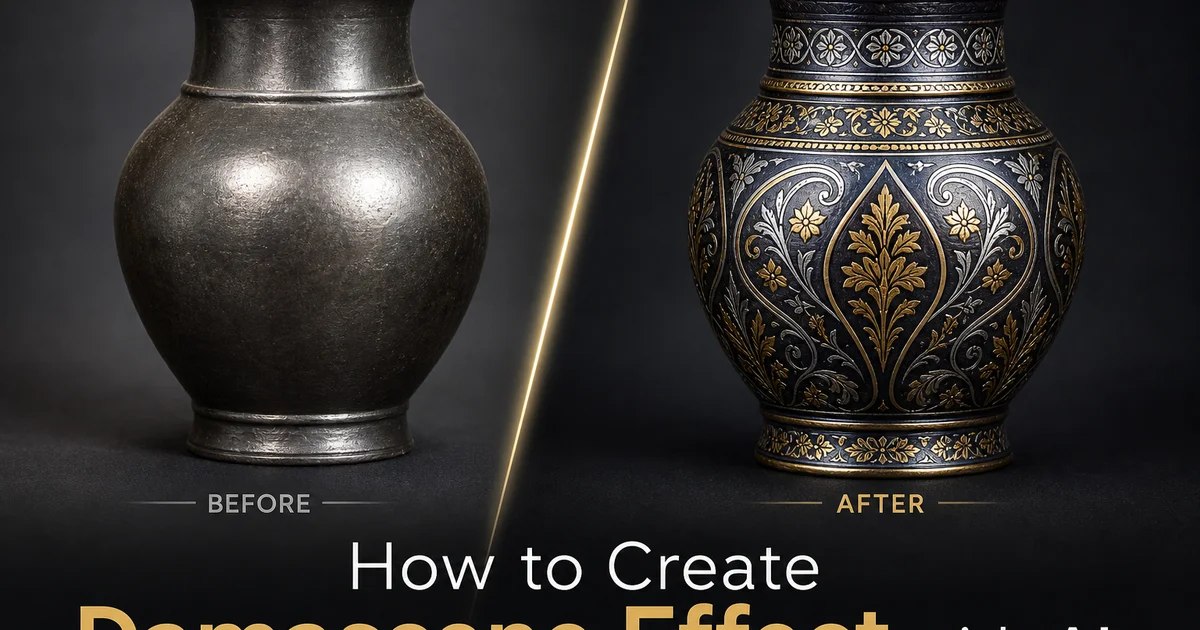
Damasquinagem é a arte metalúrgica ancestral de incrustar fios ou lâminas de ouro ou prata em um metal base mais escuro — geralmente ferro ou aço — para criar padrões decorativos que variam de delicados traçados geométricos a cenas figurativas elaboradas. A técnica é praticada há milênios em várias culturas, de Toledo na Espanha a Damasco na Síria, de Kyoto no Japão aos ateliês da Índia Mughal, cada tradição desenvolvendo vocabulários de padrões e abordagens técnicas distintas que refletem suas estéticas culturais. O damasquinado de Toledo apresenta arabescos fluidos e volutas incrustados em ouro sobre aço azulado. O nunome-zogan japonês usa superfícies de aço texturizadas para prender padrões geométricos de ouro. O koftgari indiano preenche o aço com densos desenhos florais e vegetais em ouro. O impacto visual de todas essas tradições deriva do mesmo contraste fundamental: o brilho quente e luminoso do metal precioso contra a autoridade escura do aço, criando padrões que parecem flutuar sobre uma superfície de poder contido.
A simulação digital de damasquinado tem sido historicamente limitada a sobreposições de gradiente metálico e filtros de relevo que produzem um brilho genérico sem capturar o que torna o damasquinado real visualmente distinto. A qualidade crítica que separa o damasquinado de outras metalurgias decorativas é a relação física entre a incrustação e a base. O ouro ou a prata é martelado em canais recortados na superfície do aço para ficar perfeitamente nivelado, criando um padrão que pode ser sentido com a ponta do dedo, mas apresenta uma superfície completamente lisa aos olhos. Essa integração nivelada significa que a incrustação capta a luz no mesmo ângulo que o aço circundante, mas a reflete de forma diferente devido às propriedades ópticas distintas do ouro versus o ferro, produzindo um contraste material sutil que a simples diferença de cor não consegue replicar.
A transferência de estilo damasquinado com AI avança além das abordagens de sobreposição ao compreender tanto a estrutura geométrica dos padrões tradicionais de incrustação quanto as propriedades ópticas dos materiais que tornam o damasquinado visualmente distinto. A AI gera padrões informados por tradições culturais específicas, posiciona-os em superfícies de acordo com a geometria tridimensional do sujeito e renderiza a incrustação de ouro ou prata com refletância metálica fisicamente precisa que difere do aço base da mesma forma que o metal precioso real difere do metal ferroso. Este guia aborda o uso de AI Filter e AI Enhance para criar efeitos damasquinados que honram as tradições artesanais desta forma de arte extraordinária enquanto transforma qualquer fotografia em arte em metal.
- A AI gera padrões de incrustação culturalmente informados, de arabescos de Toledo a nunome-zogan japonês e koftgari indiano, cada um seguindo seus vocabulários de design históricos.
- A incrustação de ouro e prata é renderizada com refletância metálica fisicamente precisa que difere do aço base, capturando o contraste material sutil que define o verdadeiro damasquinado.
- O posicionamento do padrão segue a geometria tridimensional da superfície do sujeito, curvo ao longo das formas e respeitando a perspectiva, em vez de aplicar sobreposições planas.
- Os controles de densidade de incrustação variam de designs elegantes e esparsos, onde o aço domina, a cobertura luxuosa de superfície total, característica de peças cerimoniais de apresentação.
- AI Enhance nitidifica os limites nítidos entre a incrustação de metal precioso e o aço base que caracterizam o artesanato de incrustação martelada nivelada.
Como a simulação de damasquinado com AI captura propriedades ópticas dos materiais
A magia visual do damasquinado deriva não apenas do contraste de cores — um padrão amarelo sobre fundo escuro pode ser produzido com tinta — mas dos comportamentos ópticos distintos de dois metais diferentes existindo no mesmo plano. O ouro tem uma refletância espectral característica que absorve comprimentos de onda azul-violeta e reflete comprimentos de onda amarelo-vermelho com alta eficiência, produzindo sua cor quente característica. O aço reflete todos os comprimentos de onda visíveis de forma mais uniforme, mas com refletividade geral menor, especialmente quando azulado ou escurecido. Quando esses dois materiais estão nivelados na mesma superfície, recebem iluminação idêntica do mesmo ângulo, mas a refletem de forma diferente, criando um contraste que muda com o ângulo de visão de maneiras que padrões à base de pigmento não conseguem.
A AI imita isso atribuindo funções de distribuição de refletância bidirecional distintas às regiões de incrustação versus regiões de metal base. Em termos práticos, isso significa que a incrustação de ouro e a base de aço respondem de forma diferente à mesma fonte de luz inferida. Onde a luz atinge a superfície em um ângulo raso, o ouro reflete realces quentes enquanto o aço mostra uma reflexão mais fria e escura. Em ângulos de visão íngremes, ambos os materiais escurecem, mas o ouro retém seu tom quente enquanto o aço se desloca para o cinza neutro. Essa distinção material dependente do ângulo é o que faz o damasquinado com AI parecer metal real em vez de um padrão pintado. Os dois materiais são visivelmente substâncias diferentes antes mesmo de considerar o design do padrão.
A integração nivelada da incrustação com o metal base é outra propriedade física crítica que a AI replica. No damasquinado real, o ouro fica dentro da superfície do aço, não sobre ela. Não há sombra projetada pela incrustação sobre a base nem diferença de altura visível entre os dois materiais. A AI garante que os padrões de incrustação produzam deslocamento de sombra zero e compartilhem a mesma posição de realce especular que o metal base. Essa é a dica visual que diz ao observador que estes são dois materiais no mesmo plano, em vez de uma decoração elevada sobre uma superfície plana. Este detalhe aparentemente sutil é a diferença entre um efeito que se lê como incrustação versus um que se lê como aplique ou pintura de superfície.
- Ouro e aço recebem funções de refletância distintas — o ouro reflete amarelo-vermelho quente com alta eficiência, enquanto o aço reflete tons neutros mais frios de forma mais uniforme.
- A resposta material dependente do ângulo significa que ambos os metais mudam de forma diferente conforme a geometria de visão se altera, produzindo contraste metálico realista que sobreposição plana de cores não consegue alcançar.
- Deslocamento de sombra zero entre incrustação e metal base replica a integração nivelada da incrustação martelada, distinguindo o efeito de aplique elevado ou pintura de superfície.
- A AI mapeia esses comportamentos dos materiais para a direção da luz inferida na imagem de origem, garantindo que os reflexos metálicos respondam consistentemente à iluminação da cena.
Tradições culturais: estilos de Toledo, nunome-zogan, koftgari e persa
O damasquinado de Toledo representa a tradição europeia mais amplamente reconhecida, desenvolvida na antiga cidade espanhola de fabricação de espadas, onde as tradições metalúrgicas mourisca e cristã se fundiram ao longo dos séculos. Os padrões de Toledo apresentam arabescos fluidos, desenhos vegetais ondulantes e motivos de pássaros incrustados em ouro sobre aço azulado ou escurecido. O vocabulário de design bebe da arte geométrica islâmica e do ornamento barroco espanhol, criando padrões que preenchem superfícies com curvas fluidas e elegantes que evitam espaços vazios. A AI gera padrões no estilo de Toledo seguindo as regras composicionais do arabesco islâmico: linhas fluidas e contínuas que se ramificam, curvam e reconectam sem becos sem saída, preenchendo a superfície alocada com densidade visual uniforme enquanto mantêm equilíbrio assimétrico orgânico.
O nunome-zogan japonês é tecnicamente distinto do damasquinado ocidental. Em vez de cortar canais para receber fios, a técnica japonesa envolve riscar um padrão cruzado na superfície do aço para criar pequenas rebarbas elevadas, depois pressionar folha de ouro sobre a superfície rugosa, onde se prende mecanicamente. Isso produz uma superfície de ouro mais plana e uniforme em comparação com a abordagem de fio incrustado, e os padrões tendem à precisão geométrica: brasões de família angulares, medalhões de crisântemo e elementos paisagísticos estilizados renderizados com a clareza gráfica das gravuras em madeira. A AI imita o nunome-zogan aplicando ouro com caráter de superfície uniforme e gerando padrões com a precisão angular e estrutura geométrica características da metalurgia decorativa japonesa.
O koftgari indiano e o damasquinado persa compartilham similaridades técnicas com o trabalho de Toledo, mas desenvolvem direções estéticas completamente diferentes. Os padrões koftgari são densamente florais, preenchendo superfícies com intrincadas volutas de vinhas, flores de lótus e formas foliares naturalistas que se entrelaçam pelo aço em redes fluidas e contínuas. O damasquinado persa frequentemente inclui caligrafia — versos Koranic ou poesia em elegante escrita nasta'liq incrustados em ouro sobre aço. A AI oferece predefinições para cada tradição, gerando padrões culturalmente precisos que respeitam os vocabulários de design distintos enquanto permitem ajustes de densidade e cobertura. Misturar tradições também é possível para fins criativos, embora os puristas prefiram manter a consistência cultural.
- O damasquinado de Toledo apresenta arabescos fluidos e volutas seguindo regras composicionais de arabescos islâmicos — linhas contínuas que se ramificam, curvam e reconectam pela superfície.
- O nunome-zogan japonês produz ouro plano e uniforme sobre aço texturizado com precisão geométrica angular adequada para brasões de família e elementos gráficos estilizados.
- O koftgari indiano preenche superfícies com trabalho floral densamente entrelaçado, flores de lótus e padrões naturalistas de videiras em redes contínuas e fluidas.
- O damasquinado persa incorpora elementos caligráficos — versos Koranic ou poesia em escrita nasta'liq — criando padrões onde o texto se torna metalurgia ornamental.
Controlando densidade de incrustação, escala do padrão e acabamento de superfície
A densidade de incrustação determina a proporção de metal precioso para aço base visível e, em sua essência, muda o caráter do efeito damasquinado. Incrustação esparsa — onde motivos de ouro isolados flutuam em grandes extensões de aço escuro — produz uma elegância austera associada a objetos utilitários que receberam decoração modesta: um guarda-mão de espada com um único crisântemo de ouro, uma placa de aço com uma borda fina de ouro, uma tampa de caixa com um monograma central. Incrustação densa — onde o ouro cobre a maior parte da superfície com apenas linhas estreitas de aço mostrando entre os elementos do padrão — produz o caráter opulento de objetos cerimoniais feitos para impressionar: espadas de exibição, presentes diplomáticos, armaduras reais. Placas de exibição onde a cobertura de ouro sinaliza a riqueza investida no objeto.
A escala do padrão interage com a densidade para determinar legibilidade e textura visual. Padrões em grande escala com áreas amplas de ouro são legíveis a qualquer distância e se reproduzem bem em tamanhos de imagem pequenos, tornando-os adequados para miniaturas de redes sociais e imagens de produtos pequenos. Padrões em escala fina com detalhes intrincados criam uma textura visual rica que recompensa a inspeção próxima, mas pode ser lida como um tom uniforme de ouro à distância. A AI oferece predefinições de escala calibradas para usos comuns de saída: escala de miniatura web que permanece legível a 200 pixels, escala de redes sociais otimizada para exibição de 1080 pixels e escala de impressão projetada para saída de alta resolução onde detalhes finos são visíveis.
O acabamento da superfície do aço base muda muito o caráter do efeito damasquinado. Aço polido brilhante reflete o ambiente e cria alto contraste com a incrustação de ouro apenas em áreas de realce, produzindo uma qualidade brilhante tipo joia. Aço azulado — o acabamento tradicional de Toledo obtido por oxidação controlada — fornece uma superfície azul-escura profunda que maximiza o contraste do ouro uniformemente em toda a superfície, produzindo o visual clássico de damasquinado. Aço escurecido ou patinado cria uma superfície marrom-escura quente que confere à peça um caráter antigo e envelhecido. A AI imita cada acabamento com propriedades corretas de refletância e cor. A escolha do acabamento muda o clima geral do efeito damasquinado tanto quanto o próprio design do padrão.
- Incrustação esparsa cria elegância austera com motivos de ouro isolados sobre aço escuro, enquanto cobertura densa produz o caráter opulento de peças cerimoniais de apresentação.
- Predefinições de escala de padrão são calibradas para saídas comuns — legibilidade de miniatura web a 200 pixels, otimização para redes sociais a 1080 pixels e detalhes finos em qualidade de impressão.
- Aço azulado fornece o visual clássico de damasquinado de Toledo com contraste máximo uniforme de ouro, enquanto aço polido cria realces brilhantes tipo joia.
- Aço patinado ou escurecido confere um caráter antigo e envelhecido, mudando o clima do efeito damasquinado tão significativamente quanto o próprio design do padrão.
Aplicações criativas: retratos, maquetes de produtos e arte decorativa
Retratos transformados em damasquinado criam uma fusão notável de retrato fotográfico e arte em metal decorativo. Quando a AI aplica padrões de incrustação de ouro a um rosto humano, o resultado se assemelha à tradição de retrato ornamental encontrada em moedas, medalhas e metalurgia comemorativa — um rosto como se tivesse sido martelado e incrustado por um mestre metalúrgico. A base de aço escuro fornece contraste dramático para as características faciais enquanto a incrustação de ouro traça contornos, preenche áreas de realce e cria padrões ornamentais nas regiões de fundo. Esses retratos produzem impressões premium distintas, perfis de redes sociais e itens de presente personalizados que combinam o reconhecimento de uma fotografia com a grandeza material da ourivesaria.
Designers de produtos e artesãos usam efeitos damasquinados para visualizar como os padrões de incrustação ficariam em objetos de metal reais antes de se comprometerem com o processo intensivo de trabalho do damasquinado real. Um joalheiro pode fotografar um pingente de aço em branco, aplicar diferentes estilos de damasquinado e avaliar qual padrão melhor se adequa à forma antes de gastar horas na incrustação real. Um cuteleiro pode pré-visualizar a colocação do padrão em uma fotografia de lâmina para determinar cobertura, escala e design antes de começar o trabalho em aço forjado à mão insubstituível. Embora a simulação de AI não replique o resultado exato do trabalho manual, ela fornece uma visualização de design útil que ajuda artesãos a tomar melhores decisões sobre seleção e posicionamento de padrões.
Impressões de arte decorativa em estilo damasquinado trazem a estética da ourivesaria de museu para o design de interiores moderno. Uma fotografia de paisagem transformada em damasquinado — árvores e folhagem douradas sobre céu de aço azulado, água prateada sobre terra de aço escuro — cria arte de parede que combina composição fotográfica com a riqueza material do trabalho em metal. Composições abstratas com tratamento damasquinado produzem impressões que poderiam ser confundidas com fotografias de instalações reais de arte em metal em grande escala. A renderização metálica é especialmente eficaz quando impressa em papel fotográfico metálico ou substratos de alumínio. A superfície metálica real do material de impressão realça a qualidade metálica simulada do efeito damasquinado.
- Retratos damasquinados se assemelham a retratos de medalhas e moedas comemorativas, combinando semelhança fotográfica com a grandeza material da incrustação de metal precioso em aço.
- Artesãos usam pré-visualizações de damasquinado para avaliar o posicionamento de padrões de incrustação em objetos de metal antes de se comprometerem com o artesanato manual intensivo em peças insubstituíveis.
- Composições de paisagem e abstratas em estilo damasquinado criam arte de parede que faz a ponte entre fotografia e ourivesaria decorativa para design de interiores contemporâneo.
- Papel fotográfico metálico e substratos de alumínio realçam a qualidade metálica simulada, produzindo impressões onde superfícies metálicas reais e simuladas se reforçam mutuamente.
How to do it
- 1
Upload your photo and evaluate its suitability for damascene transformation
Open your image in AI Filter and assess whether the subject has flat or gently curved surfaces where inlay patterns can be applied convincingly. Damascene work in the past appears on steel surfaces. Sword blades, armor plates, jewelry boxes, decorative plates — so subjects with smooth metallic or dark surfaces translate most naturally. The AI needs clear tonal structure to determine where to place gold and silver inlay patterns. Images with well-defined subjects against contrasting backgrounds work best.
- 2
Select the damascene style and configure inlay pattern complexity
Choose from damascene presets that simulate different historical traditions. Toledo-style gold arabesques on blued steel, Japanese nunome-zogan geometric patterns, Indian koftgari floral scrollwork, or Persian calligraphic inlay designs. Adjust the pattern density slider to control how much of the surface receives inlay decoration: sparse placement creates elegant minimal designs where steel dominates. Dense coverage produces the lavishly ornamented surfaces trait of display-grade ceremonial objects.
- 3
Adjust metal appearance for gold, silver, and steel surface interactions
Control the inlay metal type and look on its own from the base surface. Gold inlay ranges from bright yellow 24-karat purity to warm rose gold to pale white gold, each creating different contrast against the dark steel base. Silver inlay offers bright polished surfaces or oxidized darkened tones. The steel base surface can be configured from bright polished to blued to blackened patina. The AI maps these material properties to the image's lighting to produce realistic metallic reflections that respond to the inferred light direction.
- 4
Use AI Enhance to sharpen inlay detail and metallic surface quality
After the initial damascene conversion, apply AI Enhance to sharpen the edges of inlay patterns and increase the contrast between gold or silver and steel surfaces. Real damascene has extraordinarily crisp boundaries where the precious metal meets the base steel because the inlay is physically hammered into undercut channels. Boost sharpens these boundaries and adds the subtle surface texture differences between polished gold and the surrounding steel.
- 5
Export the final damascene artwork and verify material authenticity
Save the finished image at full resolution and compare it against photographs of actual damascene work from museum collections. Verify that the gold or silver inlay sits flush with the steel surface rather than appearing to float above it, that the inlay pattern follows the surface curvature of the subject. That metallic reflections behave always across inlay and base metal. The most convincing damascene effects show the inlay catching light slightly differently from the steel base due to their different surface properties.
Fontes
- Damascening: The Art of Gold and Silver Inlay on Steel — The Metropolitan Museum of Art — Heilbrunn Timeline of Art History
- Metal Inlay Techniques in Historical Arms and Armor — Victoria and Albert Museum
- Computational Metalwork: Neural Approaches to Decorative Metal Surface Simulation — arXiv — Computer Graphics and Visualization