
Como criar efeito Bidriware com edição de fotos IA — Magic Eraser
Tutorial passo a passo para criar o efeito de incrustação de prata Bidriware indiano com IA. Transforme fotos com a pátina preta fosca e padrões prateados deste artesanato do Decão. Magic Eraser.
SEO & Growth
Revisado por Magic Eraser Editorial ·
Índice
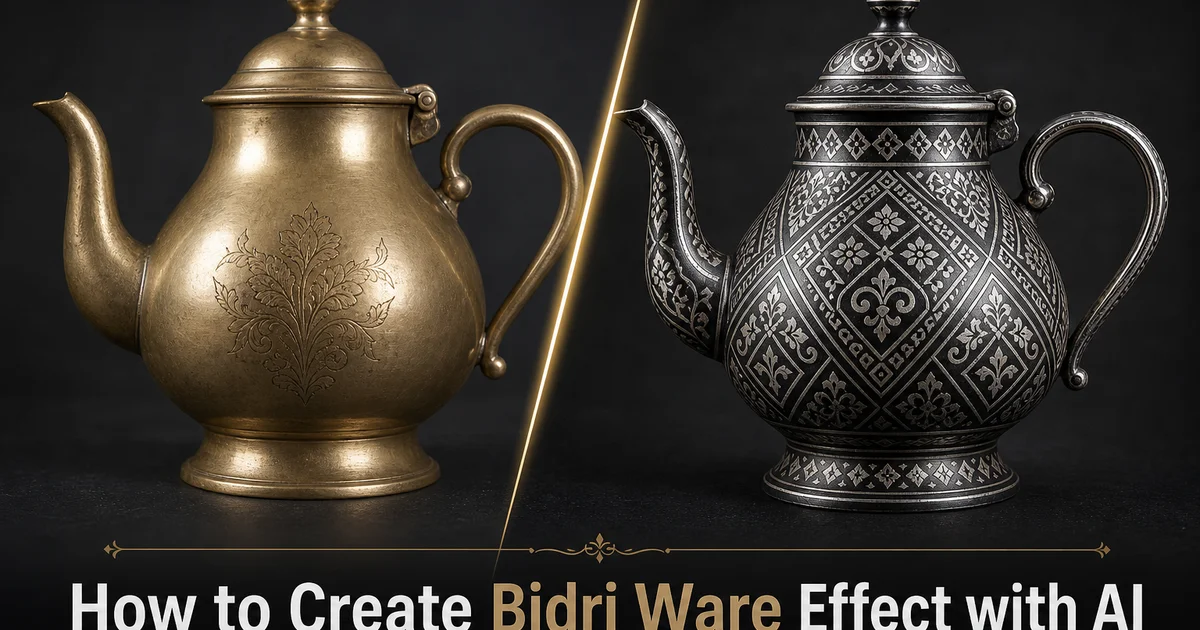
O Bidriware é uma das tradições de metalurgia mais visualmente distintas do mundo — uma forma de arte indiana secular originária da cidade de Bidar, em Karnataka, onde artesãos incrustam fios e lâminas de prata pura em uma base de liga de zinco-cobre que é então enegrecida até um acabamento fosco permanente usando solo do Bidar Fort. O contraste resultante entre os designs luminosos de prata e o corpo negro aveludado cria uma aparência instantaneamente reconhecível e impossível de replicar através de qualquer outra técnica de metalurgia. A estética do Bidriware — padrões geométricos ou florais brilhantes flutuando em uma superfície escura impenetrável — se traduz poderosamente para o design digital, e as ferramentas de edição de fotos com IA tornam possível aplicar este efeito a fotografias, imagens de produtos e elementos de design gráfico sem habilidades em metalurgia ou software especializado.
A base técnica da aparência do Bidriware é o contraste extremo entre duas qualidades materiais muito específicas. A incrustação de prata é polida até um brilho de espelho após o processo de enegrecimento, capturando e refletindo a luz com o calor e a luminosidade do metal precioso. O corpo de liga de zinco-cobre, após tratamento com o solo do Bidar Fort contendo cloreto de amônio e nitrato de potássio, atinge um preto fosco que absorve a luz completamente — não brilhante, não cinza carvão, mas um preto verdadeiro e profundo com uma textura macia, quase aveludada. Replicar este efeito digitalmente requer compreender ambos os lados da equação de contraste: os elementos brilhantes precisam de luminosidade metálica, não apenas branco ou cinza claro, enquanto as áreas escuras precisam da profundidade de absorção de luz do metal oxidado, em vez de simples preenchimento preto.
As ferramentas de edição de fotos com IA são particularmente adequadas para criar o efeito Bidriware porque podem realçar seletivamente diferentes áreas de uma imagem com tratamentos distintos — clareando e nitificando os elementos de design que representam a incrustação de prata enquanto escurecem e fosqueiam as áreas de fundo que representam a liga oxidada. Este guia percorre o processo completo, desde a seleção da imagem de origem até a exportação final, explicando como cada ferramenta de IA contribui para construir a aparência característica do Bidriware e oferecendo dicas para alcançar as qualidades materiais específicas que tornam o Bidriware autêntico tão visualmente impressionante.
- AI Enhance nitifica os detalhes das bordas ao longo dos elementos de design para simular o limite nítido onde o fio de prata martelado encontra a superfície de liga zinco-cobre oxidada no Bidriware autêntico.
- A substituição de fundo com preto fosco profundo replica a pátina característica criada pelo solo do Bidar Fort, que oxida seletivamente a liga até um acabamento preto aveludado permanente.
- O clareamento seletivo dos elementos de design adiciona luminosidade metálica que sugere incrustação de prata polida em vez de branco chapado, capturando a qualidade de metal precioso do verdadeiro Bidriware.
- Magic Eraser remove elementos indesejados das imagens de origem antes da aplicação do efeito, garantindo padrões geométricos e florais limpos, característicos dos motivos Bidriware de influência persa.
- A otimização de exportação preserva a faixa de contraste extremo entre as linhas brilhantes de incrustação de prata e o fundo preto fosco tanto em displays digitais quanto em mídia impressa.
Compreendendo o Bidriware: o artesanato por trás da estética
O Bidriware recebe o nome da cidade de Bidar, no canto nordeste de Karnataka, Índia, onde o artesanato é praticado desde o século XIV durante o Bahmani Sultanate. A técnica foi provavelmente trazida para o Decão por artesãos persas e adaptada usando materiais locais, particularmente a composição única do solo encontrado nas ruínas do Bidar Fort, que contém sais naturais que criam a reação de enegrecimento. O artesanato é reconhecido como um produto de Geographical Indication de Karnataka, o que significa que apenas o trabalho produzido na região de Bidar usando métodos tradicionais pode legalmente portar a designação Bidriware. Compreender esta herança é importante para qualquer pessoa que crie efeitos Bidriware digitais, tanto para o realismo do design quanto para a representação respeitosa de uma tradição cultural viva.
O processo de produção começa com a fundição do objeto base a partir de uma liga específica de zinco (cerca de 90-95%) e cobre (5-10%), produzindo um metal macio o suficiente para ser gravado à mão, mas duro o suficiente para reter detalhes finos. Os artesãos revestem a peça fundida com uma solução de sulfato de cobre que escurece a superfície temporariamente, depois usam cinzéis de aço para gravar o design à mão — frequentemente motivos florais de influência persa, padrões geométricos de treliça ou cenas figurativas. Fio ou lâmina de prata pura é então martelado nestes sulcos gravados, preenchendo-os precisamente e criando uma superfície bimetálica onde a prata fica nivelada dentro do corpo de zinco-cobre. Toda a peça é então polida para que as superfícies de prata e liga fiquem perfeitamente niveladas.
A fase de enegrecimento é o que dá ao Bidriware seu caráter distintivo. Uma pasta feita do solo específico do Bidar Fort — rico em cloreto de amônio e nitrato de potássio — é aplicada em toda a superfície e a peça é aquecida suavemente. Estes sais reagem com a liga de zinco-cobre para formar uma camada de óxido preto fosco, permanente e profunda, sem ter qualquer efeito químico sobre a incrustação de prata, que permanece brilhante. Após a pasta de solo ser lavada e a prata polida, a peça final apresenta sua aparência característica: designs prateados brilhantes sobre um fundo escuro impenetrável. Esta química seletiva é a chave para a aparência do Bidriware, e replicá-la digitalmente significa entender que o preto não é pintado — é uma mudança química do próprio metal, com uma textura e qualidade de absorção de luz que difere de qualquer revestimento aplicado.
- O Bidriware originou-se no Bidar do século XIV durante o Bahmani Sultanate, combinando tradições de design persas com a liga de zinco-cobre disponível localmente e a química única do solo do Bidar Fort.
- A liga base de 90-95% de zinco e 5-10% de cobre é macia o suficiente para gravação manual, mas rígida o suficiente para segurar fios e lâminas de prata finos martelados em sulcos cinzelados.
- O solo do Bidar Fort contém cloreto de amônio e nitrato de potássio que oxidam seletivamente a liga de zinco-cobre para um preto fosco permanente, deixando a prata quimicamente inalterada.
- O status de Geographical Indication protege o Bidriware como um produto da região de Bidar, tornando a consciência cultural importante ao criar interpretações digitais do estilo.
Selecionando e preparando imagens de origem para o efeito Bidriware
As conversões de efeito Bidriware mais bem-sucedidas começam com imagens de origem que já contêm fortes elementos de design linear com contraste claro entre figura e fundo. Os padrões tradicionais de Bidriware se enquadram em várias categorias: treliças geométricas com formas repetidas de losangos, hexágonos ou estrelas; motivos florais com gavinhas, folhas e flores dispostas em composições fluidas; e cenas figurativas representando pássaros, animais ou elementos arquitetônicos dentro de bordas decorativas. Ao selecionar uma foto de origem para transformar, procure imagens que ecoem estes tipos de padrão — fotografia botânica com contornos claros de flores e caules, detalhes arquitetônicos com traceria geométrica, padrões têxteis com motivos bem definidos, ou mesmo fotografia abstrata com linhas e curvas fortes que poderiam ser lidas como incrustação de metal.
A preparação da imagem é crítica porque o efeito Bidriware depende de uma separação limpa entre os elementos que se tornarão incrustação de prata e as áreas que se tornarão a superfície de liga enegrecida. Use Magic Eraser para remover quaisquer elementos indesejados, detalhes dispersos ou ruído visual que complicariam o padrão. O objetivo é reduzir sua imagem de origem aos seus elementos de design principais — linhas claras, formas definidas e separação nítida entre primeiro plano e fundo. Se sua imagem de origem tiver um fundo ocupado ou elementos sobrepostos que confundam o padrão, simplifique-a antes de aplicar o efeito. Os designs tradicionais de Bidriware são notáveis por sua clareza e precisão — cada linha é intencional e cada espaço é considerado, portanto sua imagem de origem deve alcançar a mesma disciplina visual.
A cor na imagem de origem importa menos do que o contraste tonal. O efeito Bidriware em última análise reduz tudo a duas faixas tonais: prata-brilhante e preto-fosco. O que importa é que os elementos que você deseja que apareçam como incrustação de prata sejam distintamente mais claros ou mais escuros do que as áreas que se tornarão o fundo preto. Se sua imagem de origem tiver elementos de tom médio que se misturam ao ambiente, aumente o contraste antes de aplicar o efeito para garantir uma separação limpa. Alguns fotógrafos acham útil converter a imagem de origem para preto e branco primeiro, avaliar a separação tonal e então decidir qual faixa tonal representa a incrustação de prata e qual representa o corpo de liga antes de prosseguir com o tratamento de cor completo.
- Imagens de origem com contornos botânicos, arquitetura geométrica, motivos têxteis ou linhas abstratas fortes se traduzem mais efetivamente na estética de padrão de incrustação Bidriware.
- Magic Eraser remove ruído visual e elementos distractivos para alcançar a clareza de design limpa característica do Bidriware tradicional, onde cada linha é intencional.
- O contraste tonal importa mais do que a cor — elementos destinados a se tornar incrustação de prata devem estar distintamente separados das áreas que se tornarão o fundo preto fosco.
- Converter para preto e branco antes do processamento ajuda a avaliar a separação tonal e decidir quais elementos se leem como prata polida versus superfície de liga oxidada.
Construindo a pátina preta fosca e o efeito de incrustação de prata passo a passo
A fase de escurecimento do fundo é a base de todo o efeito Bidriware. Acertar a qualidade do preto é o que separa uma peça digital convincente de Bidriware de um simples filtro de alto contraste. O alvo não é o preto RGB puro (#000000), mas sim um tom muito escuro com subtons quentes sutis. O óxido de zinco-cobre produzido pelo solo do Bidar Fort tem um tom ligeiramente quente em comparação com o preto frio, e incluir este calor faz o efeito digital parecer uma superfície material em vez de um vazio. Defina seu fundo de substituição para aproximadamente #0A0806, um quase-preto com quantidades vestigiais de calor marrom. Certifique-se de que o acabamento seja lido como fosco em vez de brilhante — se sua ferramenta criar uma superfície preta brilhante ou refletora, reduza os realces especulares para alcançar a qualidade de absorção de luz do metal oxidado.
A simulação da incrustação de prata requer mais nuance do que simplesmente tornar os elementos de design brancos ou cinza claro. A prata polida real tem uma qualidade óptica específica — ela reflete seus arredores com uma temperatura de cor fria, ligeiramente azul-branca, e a reflexão varia através da superfície com base no ângulo de visão e na curvatura do metal. Para simular isto, aplique realce de IA que clareia os elementos de design para uma luminosidade quase branca enquanto adiciona variação sutil de gradiente que sugere metal refletor. As bordas das linhas de incrustação de prata devem ser ligeiramente mais brilhantes do que os centros devido à maneira como a luz captura as bordas chanfradas onde a prata encontra o sulco da liga. Este efeito de brilho nas bordas é o que dá ao Bidriware seu cintilar característico quando a peça é virada na mão.
A zona de transição entre prata e preto é o detalhe mais crítico para o realismo. No verdadeiro Bidriware, não há espaço entre a incrustação de prata e a superfície preta circundante — os dois materiais se encontram em um limite perfeitamente limpo e nítido com zero transição. Isto ocorre porque a prata é martelada na superfície da liga até ficar perfeitamente nivelada, e o processo de enegrecimento afeta apenas os átomos da liga na própria superfície, criando um limite nítido a nível molecular. Digitalmente, isto significa que suas linhas de incrustação devem encontrar o fundo preto com precisão a nível de pixel, sem desfoque de anti-aliasing, nenhuma zona de transição cinza e nenhuma borda suave. Use realce de IA na nitidez máxima nos limites para alcançar esta junção material nítida que é a marca do artesanato fino do Bidriware.
- Use quase-preto (#0A0806) em vez de preto puro para a pátina, a fim de capturar o tom ligeiramente quente do óxido de zinco-cobre, fazendo a superfície parecer metal real oxidado.
- Elementos de incrustação de prata precisam de variação de gradiente e temperatura de cor azul-branca fria que sugira metal polido refletor em vez de preenchimento branco chapado.
- O brilho nas bordas ao longo das linhas de incrustação simula a luz capturando o limite chanfrado onde o fio de prata encontra o sulco da liga, criando o cintilar característico do Bidriware.
- A transição prata-para-preto deve ser nítida a nível de pixel sem desfoque de anti-aliasing — no Bidriware autêntico, o limite material é limpo a nível molecular.
Técnicas avançadas: padrões em camadas, formas de vasos e variações de design
O Bidriware tradicional usa hierarquias de padrões em camadas onde um design primário — frequentemente um medalhão central ou motivo floral repetido — situa-se dentro de uma moldura de padrões de borda secundários e preenchimento de fundo terciário. Replicar esta abordagem em camadas digitalmente cria resultados mais autênticos do que aplicar um único padrão em toda a superfície. Comece com os elementos de design primários em brilho prateado total, depois adicione padrões de borda em luminosidade ligeiramente reduzida para criar hierarquia de profundidade visual e, finalmente, adicione texturização sutil de fundo que sugira as marcas fracas de ferramenta visíveis na superfície enegrecida do Bidriware feito à mão. Esta abordagem de três camadas imita a maneira como os artesãos tradicionais de Bidriware organizam suas composições, com motivos principais, elementos de moldura e tratamento de fundo cada um contribuindo para a riqueza visual geral.
Aplicar o efeito Bidriware a fotografias de objetos tridimensionais — vasos, pratos, caixas de joias e outros itens que tradicionalmente recebem tratamento Bidriware — adiciona outra camada de complexidade porque a incrustação de prata deve seguir os contornos do objeto. Em uma superfície plana, as linhas de incrustação têm largura e brilho uniformes. Em uma superfície curva, as linhas se estreitam à medida que recuam em direção às bordas devido ao encurtamento perspectivo, e seu brilho varia com o ângulo de reflexão. O realce de IA lida com isto naturalmente quando aplicado a uma fotografia de um objeto tridimensional real, pois as informações originais de iluminação e perspectiva na fotografia fornecem as pistas dimensionais que a IA usa para modular o realce. O resultado parece um vaso Bidriware real em vez de um padrão plano enrolado em torno de uma forma.
A variação de design dentro da tradição do Bidriware oferece extensas possibilidades criativas para interpretação digital. Além do vocabulário floral e geométrico persa clássico, artesãos modernos de Bidriware expandiram-se para motivos arquitetônicos dos monumentos medievais de Bidar, composições abstratas inspiradas pela caligrafia islâmica e padrões gráficos modernos que impulsionam a tradição enquanto mantêm o contraste material fundamental. Digitalmente, isto abre a porta para aplicar a estética Bidriware a qualquer estilo gráfico — arte linear minimalista, composições tipográficas ousadas, silhuetas fotográficas ou elementos de visualização de dados — enquanto mantém a qualidade material fundamental de prata-sobre-preto que define o artesanato. A versatilidade do efeito vem de sua simplicidade: qualquer design que possa ser reduzido a linha e preenchimento pode se tornar Bidriware.
- Hierarquias de padrões em camadas com motivos primários em brilho total, bordas secundárias em luminosidade reduzida e texturização terciária de fundo criam profundidade composicional autêntica do Bidriware.
- Aplicações tridimensionais em objetos se beneficiam do realce de IA que modula a largura e o brilho das linhas de incrustação com base nas pistas de perspectiva e iluminação da fotografia original.
- O Bidriware contemporâneo incorpora motivos arquitetônicos, abstrações caligráficas e padrões gráficos modernos junto aos tradicionais designs florais e geométricos de influência persa.
- A estética Bidriware se aplica a qualquer design redutível a linha e preenchimento — tipografia, silhuetas, visualização de dados ou arte minimalista — mantendo a essência material de prata-sobre-preto.
How to do it
- 1
Select a source image with strong geometric or floral composition for the Bidriware base pattern
Choose a photograph with well-defined shapes that can serve as the foundation for your Bidriware effect. Bidriware traditionally features Persian-influenced floral motifs, geometric lattice patterns, and vine scrollwork, so images with strong botanical elements, architectural geometry, or repeating decorative patterns translate most effectively.
- 2
Use AI Enhance to isolate and sharpen the design elements that will become silver inlay lines
Apply AI Enhance to bring out the edge detail and fine lines in your source image that will represent silver wire and sheet inlay. AI enhancement sharpens design boundaries and increases micro-contrast along edges, mimicking the crisp definition where polished silver meets the matte-black oxidized surface.
- 3
Apply background darkening to simulate the signature matte-black patina of Bidriware soil treatment
Darken background areas to the characteristic deep matte black that defines Bidriware. Replicate the chemical blackening by replacing original background color with a rich, non-reflective black that has the velvety matte quality of oxidized metal.
- 4
Enhance the silver inlay contrast to achieve the luminous metal-on-dark effect
Apply targeted AI enhancement to brighten and sharpen design elements representing silver inlay, creating dramatic contrast. Use settings that increase luminosity and add a subtle metallic sheen to light-colored design elements while preserving the depth of dark background areas.
- 5
Export the finished Bidriware effect image with settings optimized for print and digital display
Save at full resolution with color profile and format choices that preserve the extreme contrast range between bright silver and matte black. For digital display use sRGB and PNG format. For print applications export in CMYK at 300 DPI.
Fontes
- Bidriware: The Craft of Silver Inlay on Blackened Alloy — Government of India National Portal
- Geographical Indications and Traditional Craftsmanship Protection — World Intellectual Property Organization
- Digital Photography Techniques for Metalwork and Inlay Surfaces — Adobe Creative Cloud